


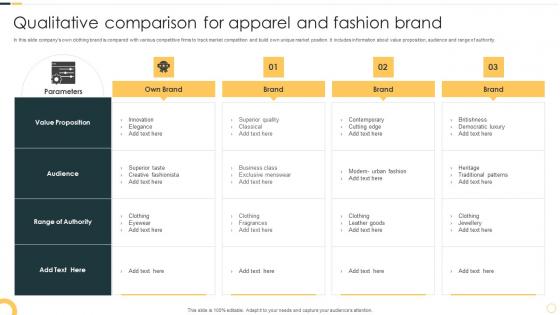
Qualitative Comparison For Apparel And Fashion Brand




Try Before you Buy Download Free Sample Product
 Impress Your
 Audience
 100%
100% Editable
 Save Hours
 of Time


In this slide companys own clothing brand is compared with various competitive firms to track market competition and build own unique market position. It includes information about value proposition, audience and range of authority.
People who downloaded this PowerPoint presentation also viewed the following :
Qualitative Comparison For Apparel And Fashion Brand with all 6 slides:
Use our Qualitative Comparison For Apparel And Fashion Brand to effectively help you save your valuable time. They are readymade to fit into any presentation structure.





FAQs for Qualitative Comparison For Apparel
Qualitative research explores subjective experiences, behaviors, and meanings through interviews, observations, and open-ended analysis, while quantitative research measures numerical data, statistical relationships, and objective patterns through surveys, experiments, and mathematical analysis. These complementary approaches enable organizations to understand both the "why" behind customer behaviors and the "what" in measurable outcomes, with many businesses combining both methods for comprehensive market insights and strategic decision-making.
Qualitative comparison enhances business decision-making by providing comprehensive context, revealing underlying patterns, and incorporating stakeholder perspectives that quantitative data alone cannot capture. Through detailed analysis of customer feedback, market positioning, and competitive advantages, organizations streamline strategic planning, minimize risks, and ultimately deliver more informed choices that drive sustainable growth and competitive differentiation.
Context plays a crucial role in qualitative comparisons by influencing interpretation, relevance, and meaning of findings across different environments, cultures, and organizational settings. Through contextual analysis, researchers and businesses can understand how factors like industry dynamics, regulatory frameworks, and cultural nuances affect outcomes, with many organizations finding that context-sensitive comparisons deliver more actionable insights and strategic advantages.
Stakeholder perspectives can be integrated through structured interviews, focus groups, surveys, and collaborative workshops that capture diverse viewpoints across different organizational levels and external partners. These methodologies enable comprehensive data collection by incorporating employee insights, customer feedback, and partner observations into the comparative framework, ultimately delivering more holistic analysis outcomes and stakeholder buy-in for strategic decisions.
Effective qualitative comparison presentations include tailored messaging for different stakeholder groups, visual storytelling through infographics and narrative frameworks, interactive workshops, and multi-format deliverables combining executive summaries with detailed appendices. These approaches streamline complex findings by adapting terminology, emphasizing relevant insights for each audience segment, and incorporating compelling case studies, ultimately delivering clearer understanding and faster decision-making across organizational levels.
Sample size significantly impacts qualitative comparison validity through data saturation, pattern reliability, and representativeness across different contexts and perspectives. While smaller samples enable deeper analysis, larger samples enhance credibility and transferability, with many researchers finding that strategic sampling approaches ultimately deliver more robust insights and stronger comparative conclusions than size alone.
Maintaining objectivity in qualitative comparisons faces challenges including researcher bias, subjective interpretation of data, cultural assumptions, selective evidence gathering, and personal preconceptions influencing analysis. These obstacles can compromise findings through inconsistent evaluation criteria, cherry-picked examples, and skewed conclusions, with many organizations finding that structured frameworks, diverse review teams, and transparent methodologies significantly enhance reliability and strategic decision-making accuracy.
Thematic analysis enhances qualitative comparison studies by identifying recurring patterns, codes, and themes across different datasets, enabling researchers to systematically compare experiences, behaviors, and perspectives. Through this structured approach, organizations conducting market research, healthcare studies, and educational evaluations can uncover meaningful insights, streamline data interpretation, and ultimately deliver more reliable conclusions that inform strategic decision-making across multiple contexts.
**INPUT**: What tools or software are recommended for qualitative comparisons? **OUTPUT**: Recommended tools include NVivo, ATLAS.ti, MAXQDA, Dedoose, and Tableau for visualization, along with traditional methods like comparison matrices and frameworks. These platforms streamline data analysis by enabling pattern recognition, thematic coding, and collaborative interpretation, with many research organizations and consulting firms finding that integrated approaches ultimately deliver deeper insights and more actionable strategic recommendations. [Word count: 58 words]
Cultural differences significantly influence qualitative comparison interpretation through varying communication styles, decision-making frameworks, relationship priorities, and risk tolerance levels across different societies. These cultural lenses affect how organizations evaluate data significance, with many multinational companies finding that standardized comparison metrics must be adapted regionally to ensure accurate strategic insights and effective cross-cultural business outcomes.
Visual storytelling communicates qualitative comparison results through narrative frameworks, thematic visualizations, persona-based presentations, journey mapping, and comparative case studies. These approaches enable organizations to transform complex qualitative insights into compelling business narratives, with many companies finding that visual storytelling enhances stakeholder understanding, accelerates decision-making, and ultimately delivers more persuasive presentations that drive strategic action.
Ethical considerations in qualitative research comparisons include informed consent, participant confidentiality, cultural sensitivity, power dynamics awareness, and fair representation of diverse perspectives. These principles ensure research integrity by protecting vulnerable populations, minimizing bias across comparison groups, and maintaining transparency in data interpretation, ultimately delivering credible insights while respecting participant dignity and community values.
Qualitative comparison contributes to policy formulation by identifying successful approaches across different contexts, understanding implementation challenges, and revealing unintended consequences through detailed case studies. Policymakers leverage comparative insights from healthcare reforms, education initiatives, and economic programs to adapt proven strategies, ultimately enhancing policy effectiveness and avoiding costly implementation mistakes.
Strategies to improve reproducibility include standardized coding frameworks, detailed methodology documentation, inter-rater reliability protocols, transparent data collection procedures, and systematic analysis templates. These approaches enhance research credibility by ensuring consistent interpretation across studies, with academic institutions and research organizations finding that structured methodologies deliver more reliable insights, ultimately strengthening evidence-based decision-making and competitive research positioning.
Qualitative comparison methodologies in educational settings include case study analysis, cross-institutional benchmarking, curriculum evaluation frameworks, student outcome assessments, and teaching approach comparisons. These methodologies enable educators to evaluate program effectiveness, identify best practices across different schools or districts, and enhance learning outcomes by comparing teaching strategies, with many educational institutions finding that systematic qualitative comparisons ultimately deliver improved student engagement and academic performance.
-
“There is so much choice. At first, it seems like there isn't but you have to just keep looking, there are endless amounts to explore.”
-
I can always count on your designs for my professional needs. I believe I found a one-stop-shop for PPTs.