


Qualitative research methods overview with knowledge type




Try Before you Buy Download Free Sample Product
 Impress Your
 Audience
 100%
100% Editable
 Save Hours
 of Time


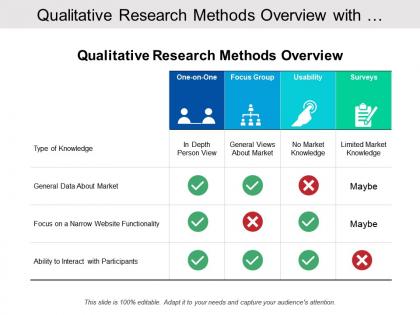
We present our new Qualitative Research Methods Overview with Knowledge Type PowerPoint slides. Qualitative research provides you with ideas to conduct potential quantitative research. Using this PPT presentation you can gain knowledge about the preferences of your clients. When you have complete knowledge about the preferences of your customers, you will be able to provide them with maximum satisfaction. Accordingly, they will be more generous with the finances. You can use various techniques to conduct surveys like, one-on-one, Focus Group, Usability and Surveys. This PowerPoint presentation is three stage process. The stages in this process are Qualitative, Observation and Analysis. Once your clients are generous with their finances it gets easier for the firm to expand its business. Expansion of the business leads to the fulfillment of its long term objectives. This readymade deck of slides is helpful for you as you just have to enter the collected information in a pre designed format. Convince them you deserve the grant with our Qualitative Research Methods Overview With Knowledge Type. They will be generous with their finances.
People who downloaded this PowerPoint presentation also viewed the following :
Qualitative research methods overview with knowledge type with all 5 slides:
Never leave important projects to chance. Our Qualitative Research Methods Overview With Knowledge Type take all of the guesswork out of your projects.




FAQs for Qualitative research methods overview
Qualitative research emphasizes understanding experiences, meanings, and contexts through descriptive data, while quantitative research focuses on measuring numerical relationships and statistical patterns. Qualitative methods enable organizations to explore customer motivations, employee satisfaction, and market perceptions through interviews and observations, ultimately delivering deeper insights that enhance strategic decision-making and competitive positioning.
Qualitative research uncovers lived experiences through in-depth interviews, focus groups, ethnographic observation, narrative analysis, and phenomenological studies. These methods enable researchers to capture nuanced perspectives, cultural contexts, and emotional dimensions that quantitative data often misses, with many healthcare organizations, social services, and market research firms finding that participant-centered approaches ultimately deliver richer insights and more authentic understanding.
Common qualitative data collection methods include in-depth interviews, focus groups, participant observation, document analysis, and ethnographic studies. These approaches enable researchers to gather rich, contextual insights by exploring human behaviors, motivations, and experiences in detail, with many organizations finding that combining multiple methods delivers more comprehensive understanding and actionable findings.
Researchers ensure validity and reliability in qualitative studies through triangulation, member checking, peer debriefing, thick description, and prolonged engagement with participants. These methodological approaches enhance credibility by cross-verifying findings through multiple data sources, participants, and analytical perspectives, with many academic institutions and research organizations finding that systematic documentation and reflexive practices ultimately deliver more robust insights and defensible conclusions.
Focus groups enhance qualitative data richness through dynamic group interactions, diverse perspectives, real-time idea building, spontaneous discussions, and collective memory recall that individual interviews cannot capture. These collaborative sessions enable researchers to observe social dynamics, uncover shared experiences, and generate deeper insights through participant dialogue, while revealing consensus patterns and conflicting viewpoints that ultimately deliver more comprehensive understanding.
Thematic analysis serves as a foundational method for identifying, analyzing, and interpreting patterns within qualitative data by systematically coding responses, grouping related concepts, and extracting meaningful themes. This approach enables researchers across sectors like healthcare, education, and market research to transform complex narratives into actionable insights, ultimately delivering clearer understanding of customer behaviors, employee experiences, and strategic decision-making opportunities.
Researchers address bias in qualitative data analysis through triangulation, member checking, peer debriefing, reflexive journaling, and maintaining detailed audit trails. These methodologies enhance credibility by incorporating multiple perspectives, validating findings with participants, and ensuring transparency throughout the research process, with many academic institutions and research organizations finding that systematic application of these techniques ultimately delivers more reliable insights and stronger analytical frameworks.
Qualitative research ethics include informed consent, participant confidentiality, voluntary participation, cultural sensitivity, and data protection protocols. These considerations ensure participant wellbeing by minimizing psychological risks, maintaining anonymity throughout analysis, and respecting cultural contexts, with many academic institutions and healthcare organizations finding that robust ethical frameworks ultimately enhance research credibility and participant trust.
The choice of qualitative methodology significantly shapes study findings by determining data collection approaches, analytical frameworks, and interpretive lenses used to understand phenomena. Different methodologies like ethnography, grounded theory, or phenomenology yield distinct insights from the same research context, with many organizations finding that strategic methodology selection enhances research validity and delivers more actionable, contextually relevant business intelligence.
Interviews offer deep insights through flexible questioning, personal rapport, rich contextual data, and real-time clarification opportunities, while presenting challenges including time intensity, potential researcher bias, and limited generalizability. Many organizations find that structured interview protocols streamline data collection across departments like HR and marketing, ultimately delivering nuanced understanding of customer behaviors, employee experiences, and stakeholder perspectives for strategic decision-making.
Qualitative research contributes to theory building by uncovering deep patterns, generating new conceptual frameworks, and revealing underlying mechanisms that quantitative methods might miss. Through rich data collection like ethnographies and case studies, researchers in fields like organizational behavior, healthcare, and education develop grounded theories that explain complex phenomena, ultimately advancing theoretical understanding and providing foundations for future empirical testing.
Saturation strategies include theoretical sampling, constant comparative analysis, member checking, triangulation, and purposive sampling across diverse participants. These methods enhance data richness by systematically comparing findings, validating interpretations with participants, and expanding sample diversity until no new themes emerge, with many researchers finding that combining multiple approaches accelerates comprehensive understanding.
Qualitative research is most appropriately applied when exploring complex human behaviors, understanding customer motivations, developing new products, and investigating organizational culture changes. It proves particularly valuable in healthcare settings for patient experience studies, retail environments for consumer behavior analysis, and technology companies for user experience research, ultimately delivering deeper insights that quantitative methods cannot capture.
Technology streamlines qualitative research through digital interview platforms, automated transcription services, cloud-based data storage, and AI-powered coding software that identifies patterns and themes. These tools enhance research efficiency by reducing manual transcription time, enabling remote data collection, and facilitating collaborative analysis, with many academic institutions and market research firms finding faster insights and improved accuracy.
Best practices for presenting qualitative research findings include tailoring content complexity to audience expertise, using visual storytelling through charts and infographics, providing clear context for themes, and balancing detailed insights with actionable recommendations. These approaches enhance comprehension by simplifying complex data, emphasizing key patterns, and connecting findings to practical applications, with many organizations finding that audience-specific presentations ultimately deliver greater stakeholder engagement and strategic decision-making outcomes.
No Reviews