

Quality Function Deployment Powerpoint Ppt Template Bundles




Try Before you Buy Download Free Sample Product
 Impress Your
 Audience
 100%
100% Editable
 Save Hours
 of Time


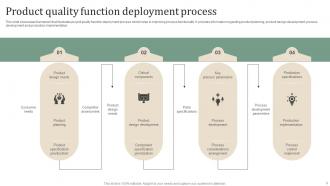
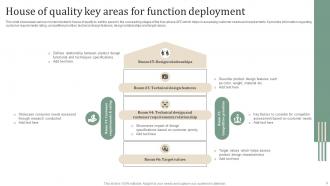
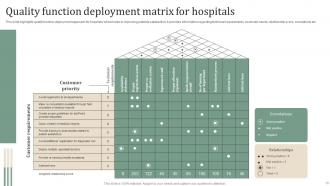
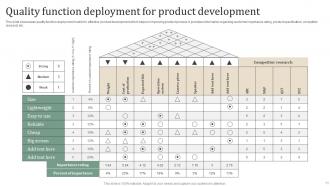
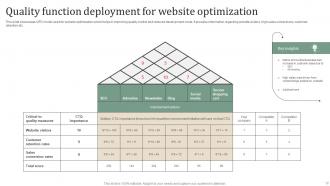
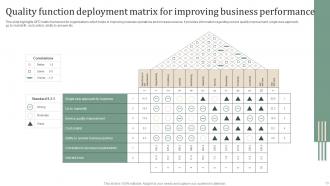
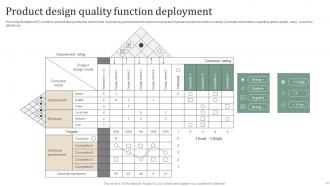
Introducing our Quality Function Deployment QFD PowerPoint PPT presentation, a comprehensive guide to implementing this powerful methodology across various domains. Explore the Software Engineering QFD Model, designed to ensure that software products meet customer expectations and quality standards. Unlock the secrets of Website Optimization using the QFD Matrix, enhancing user experiences and driving online success through data-driven decisions Dive into the Quality Function Deployment Process, a systematic approach to aligning product or service design with customer needs and preferences. Discover the Product Design QFD Model, empowering your team to create products that excel in both functionality and customer satisfaction. With visually engaging slides and expert insights, this PPT equips your organization with the tools to effectively employ Quality Function Deployment methodologies. Elevate your product and service quality, optimize processes, and exceed customer expectations. Get this presentation now and unlock the potential for quality excellence in your projects.
People who downloaded this PowerPoint presentation also viewed the following :
Quality Function Deployment Powerpoint Ppt Template Bundles with all 26 slides:
Use our Quality Function Deployment Powerpoint Ppt Template Bundles to effectively help you save your valuable time. They are readymade to fit into any presentation structure.









FAQs for Quality Function Deployment Powerpoint
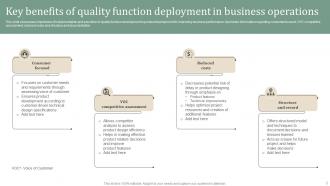
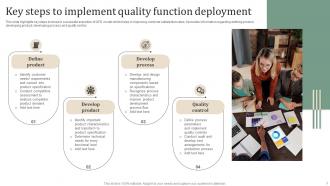
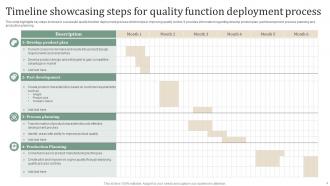
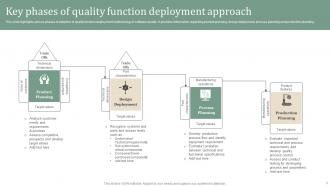
So QFD has four phases you'll go through. Start by capturing what customers actually want, then translate that into technical specs using the House of Quality matrix - honestly that part's a nightmare with all the symbols but stick with it. Next, convert those specs into component characteristics. After that, map everything to your manufacturing processes. Last step is defining production controls and quality measures. The whole point is making sure customer feedback flows through your entire development cycle. Phase one is crucial though - really nail down those customer needs first or you'll be scrambling later.
So basically you want to start with QFD right when you kick off development. Build that House of Quality matrix to turn what customers actually say they want into real technical specs - don't guess what they need. I've watched teams skip this and then scramble later trying to fix everything. The outputs help you figure out which features matter most and where to set your performance targets. Get your whole crew involved too - engineering, marketing, quality people. Otherwise you'll have everyone pulling in different directions. Honestly, just run a QFD workshop before writing any specs. Saves so much headache down the road.
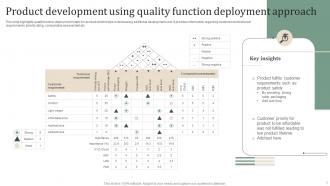
VoC is where you figure out what customers actually want - surveys, interviews, focus groups, whatever gets them talking about their problems. It's the foundation of your whole QFD thing. Without good VoC data, you're basically flying blind and making up requirements. The tricky part is turning all that customer feedback into specific stuff your team can measure and prioritize. I mean, someone saying "it should be easier to use" doesn't help much unless you can break that down into actual requirements. That's what feeds into your House of Quality matrix and drives everything else forward.
Cast a wide net first - surveys, interviews, focus groups, plus actually watching how people use your product. Teams always skip that last part and wonder why they missed obvious stuff. Got all your requirements? Now rank them using pairwise comparison or the Kano model. Don't do this solo though - pull in people from different teams since they'll catch things you won't. Honestly, the biggest mistake is just going with whoever yells loudest in meetings. You need a real scoring system so you're not just winging it based on gut feelings.
Honestly, just start with Excel or Google Sheets - they're perfect for basic House of Quality stuff and super flexible. I still use spreadsheets for most of mine, no joke. If you want to get fancy later, there's specialized software like QFD Designer or QI Macros that'll do the correlation math automatically. Some people swear by Visio, or hell, even whiteboard sessions work great for team workshops. The real trick is using whatever your team won't abandon after two weeks. Begin with a simple spreadsheet template first - you can always level up once you've figured out the whole process.
So QFD is this matrix thing that gets all your departments in one room - marketing, engineering, manufacturing, quality. Instead of everyone guessing what customers want, they're all staring at the same chart figuring it out together. Sales people can actually see how their feedback affects what engineers build. Engineers show manufacturing why certain specs aren't negotiable. Honestly, it's way better than the usual mess where everyone's speaking different languages. The "house of quality" sounds fancy but it's just a shared visual that stops the silos. Try it on something small first - you'll be surprised how much people start collaborating when they're working off the same page.
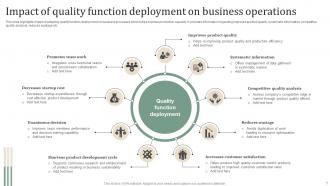
Honestly, QFD is a game-changer for getting to market faster. You get everyone on the same page about what customers actually want right from the start - no more building features nobody asked for. Been in too many projects where we figured out customer needs halfway through and had to backtrack. With QFD, you capture all that voice-of-customer stuff upfront and turn it into real engineering requirements. Plus it helps you spot those awkward moments early where marketing's promising something your dev team can't actually build. Try using the matrices in your next project kickoff - saves so much headache later.
Yeah, totally works for services! You just flip from thinking about product specs to service stuff - like how fast you respond, how your staff acts, your actual process steps. Hotels do this constantly. They'll connect "I want quick check-in" directly to how many people they staff at the front desk and whether their systems actually work smoothly. Banks and restaurants use it too. Honestly, consulting firms probably overuse it at this point. But the trick is mapping out where customers actually interact with you, then figure out what operational things you can control and measure from there.
Look, when customer preferences shift, you basically have to go back and update your House of Quality. Super annoying, I know. Your voice-of-customer data gets stale fast, so those "whats" need re-prioritizing. Everything downstream changes too - technical requirements, correlations, targets. I learned this the hard way on a project last year. But catching these shifts during QFD beats building the wrong thing entirely. Way cheaper to pivot early. Set up regular feedback loops with customers so you're not blindsided by preference changes mid-development. Trust me on this one.
Honestly, QFD is a pain at first - super time-consuming and complex. Your team will probably pushback because it needs way more upfront work than usual. Getting good customer data is harder than you'd think, and those matrices get messy quick if you don't keep the scope tight. Oh, and keeping everyone motivated across departments? Good luck with that. I'd say start with something small, maybe just one product feature or whatever. Get your key people on board early - trust me on this one. Don't go crazy trying to do everything perfectly right away.
Dude, QFD software is a game changer. No more manually calculating those correlation scores - the tools do all that tedious math for you. Your whole team can work on it at the same time too, which beats emailing spreadsheets back and forth like it's 2005. The visual reports generate themselves, making stakeholder presentations actually bearable. I'd start simple with QFD Online or maybe just a solid Excel template if you're not ready to commit to new software yet. Honestly, even basic automation will save you hours of headache.
So QFD is basically this feedback system that keeps everyone zeroed in on what customers actually care about. When customer needs shift, your development automatically shifts with them. It's like having early warning radar for market changes - sounds cheesy but it works. The cool part is when you get engineers, marketers, and designers all staring at the same customer data together, they start coming up with stuff nobody thought of before. Oh and here's a tip: don't just do QFD sessions during initial planning. Run them quarterly and you'll spot problems way sooner.
QFD's solid for hearing what customers want, but don't make it your whole world. Those matrices get insane - I've seen ones that'd make Excel cry. Problem is, customers might love an idea that's basically impossible to build without going broke. Also, people don't always know what they actually want anyway. The thing turns into a spreadsheet monster if you're not careful. Mix it with technical reality checks and market stuff. Trust your engineering gut too. It's one tool in the box, not the magic answer to everything. Just saying.
Honestly, QFD works great with Six Sigma and Lean - it's like the customer voice that makes everything else actually matter. During Six Sigma's Define phase, use QFD's House of Quality so you're fixing stuff customers care about instead of just making your dashboards look prettier. For Lean projects, it shows you which processes really add value before you go crazy cutting things. I always run improvement projects through QFD first now - you'll catch requirements you'd totally miss otherwise. The trick is letting QFD set your direction upfront, then Six Sigma or Lean can handle the heavy lifting.
Honestly, start with customer satisfaction scores and cycle time - those are your bread and butter metrics. Defect rates matter too, but the development timeline stuff is where you'll see massive wins. I've watched teams shave literal months off projects when they nail the QFD process. Track how well your technical requirements actually match what customers want (shows if your House of Quality isn't just pretty wall art). Cost savings and team buy-in are worth measuring, though they're trickier to quantify. Oh, and cycle time metrics are super easy to baseline, which makes selling the ROI upstairs way easier.
-
“Ample and amazing variety of templates available, really helpful for making professional PPT for day to day workings.”
-
It's always a delight to see new templates from you! I am extremely pleased with the fact that they are easy to modify and fit any presentation layout in seconds!