


Quarterly cyber security roadmap for organization




Try Before you Buy Download Free Sample Product
 Impress Your
 Audience
 100%
100% Editable
 Save Hours
 of Time


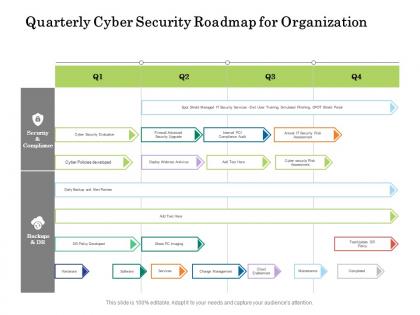
Utilize our pre build Quarterly Cyber Security Roadmap For Organization to present your plan of action in the most effective way. Reduce the paperwork and showcase how different activities are linked to each other by incorporating this attention grabbing PowerPoint theme. This completely editable roadmap PPT layout is suitable to fit all your needs and to have a structured outline of the entire process flow using color coding. Provide guidelines to your teammates about the progression process by employing our PPT theme. Team members can easily be designated into teams by accessing the work milestones to be accomplished within the timeframe. You can easily modify the PowerPoint slide according to real time situations. Download our stunning Quarterly Cyber Security Roadmap For Organization, and you are good to go to prove your expertise in strategic planning.
People who downloaded this PowerPoint presentation also viewed the following :
Quarterly cyber security roadmap for organization with all 2 slides:
Use our Quarterly Cyber Security Roadmap For Organization to effectively help you save your valuable time. They are readymade to fit into any presentation structure.

FAQs for Quarterly cyber security
A comprehensive cybersecurity strategy includes risk assessment frameworks, network security protocols, incident response plans, employee training programs, and continuous monitoring systems. These components work together by identifying vulnerabilities, protecting critical assets, and ensuring rapid threat detection, with many organizations finding that this integrated approach significantly reduces breach risks while maintaining operational efficiency.
Businesses can assess their current cybersecurity posture through comprehensive security audits, vulnerability assessments, penetration testing, compliance evaluations, and risk analysis frameworks. These methodologies enable organizations to identify gaps, prioritize threats, and benchmark against industry standards, with many financial institutions and healthcare providers finding that regular assessments ultimately deliver enhanced protection and regulatory compliance.
The most common cybersecurity threats include phishing attacks, ransomware, malware infections, data breaches, and insider threats targeting organizational vulnerabilities. These threats increasingly impact sectors like healthcare, financial services, and retail through compromised email systems, encrypted data demands, and unauthorized access attempts, ultimately requiring comprehensive security frameworks to protect sensitive information and maintain operational continuity.
Employee training is critically important in mitigating cybersecurity risks, as human error accounts for approximately 95% of successful cyberattacks through phishing, social engineering, and poor password practices. Well-designed training programs significantly reduce security incidents by enhancing threat recognition, promoting secure behaviors, and creating a security-conscious culture, with many organizations finding that regular employee education delivers measurable risk reduction.
Incident response serves as a critical recovery and learning component within cybersecurity roadmaps, enabling organizations to contain breaches, minimize damage, and restore operations quickly. This strategic framework helps businesses like financial institutions and healthcare providers transform security incidents into valuable intelligence, ultimately strengthening defenses, reducing future response times, and maintaining customer trust during crisis situations.
Organizations integrate cybersecurity within business strategy by embedding security considerations into strategic planning, budget allocations, and operational decisions from the outset. Through cross-functional collaboration between IT, legal, and executive teams, companies streamline risk management, enhance regulatory compliance, and protect revenue streams, with many financial institutions and healthcare organizations finding that strategic cybersecurity integration ultimately delivers competitive advantage and stakeholder trust.
Essential cybersecurity tools include endpoint detection and response systems, multi-factor authentication, security information and event management platforms, vulnerability assessment scanners, and network monitoring solutions. These technologies enhance protection by automating threat detection, streamlining incident response, and providing real-time visibility, with many organizations finding that strategic integration ultimately delivers reduced breach risks and improved operational resilience.
Companies can measure cybersecurity effectiveness through key performance indicators like incident response times, vulnerability remediation rates, security awareness training completion, and mean time to detection. Financial services and healthcare organizations increasingly track metrics such as reduced breach costs, improved compliance scores, and decreased security incidents, ultimately delivering measurable ROI and enhanced organizational resilience.
Emerging cybersecurity trends include AI-powered threat detection, zero-trust architecture, cloud security mesh, quantum-resistant encryption, and extended detection and response (XDR) platforms. These technologies enhance organizational defense by automating threat identification, eliminating perimeter-based trust assumptions, and providing comprehensive visibility across endpoints, with many financial services and healthcare institutions finding that integrated approaches deliver faster incident response and significantly reduced breach risks.
Small businesses can improve cybersecurity through employee training programs, regular software updates, strong password policies, multi-factor authentication, and basic firewall protection. Many retail stores, medical practices, and consulting firms find that implementing these foundational measures, combined with cloud-based security solutions and regular data backups, significantly reduces vulnerabilities while delivering cost-effective protection and operational peace of mind.
Regulatory compliance significantly shapes cybersecurity roadmaps by mandating specific security controls, data protection measures, audit requirements, and incident response protocols across different industries. Companies in healthcare, financial services, and retail must align their security investments with GDPR, HIPAA, or PCI-DSS standards, ultimately driving strategic resource allocation and ensuring comprehensive protection frameworks.
Cloud security best practices include multi-factor authentication, data encryption, regular security audits, zero-trust architecture, and continuous monitoring systems. These approaches enhance protection by minimizing unauthorized access, securing data transmission, and detecting threats in real-time, with many financial services and healthcare organizations finding that strategic implementation ultimately delivers improved compliance and reduced security incidents.
Zero trust architecture fundamentally transforms cybersecurity frameworks by eliminating implicit trust, requiring continuous verification of every user, device, and transaction regardless of location. This approach streamlines security through micro-segmentation, identity-based access controls, and real-time monitoring, with many financial institutions and healthcare organizations finding that zero trust delivers enhanced data protection, reduced breach risks, and improved regulatory compliance.
Organizations can implement multi-layered data protection strategies including encryption, access controls, regular security audits, employee training, and backup systems. These approaches work together by securing data at rest and in transit, limiting unauthorized access, and ensuring rapid recovery, with many financial institutions and healthcare organizations finding that comprehensive protection strategies ultimately deliver enhanced customer trust and regulatory compliance.
Threat intelligence enhances security protocols by providing real-time data on emerging threats, attack patterns, and vulnerability assessments, enabling proactive defense strategies rather than reactive responses. Through automated threat feeds and behavioral analytics, organizations in banking, healthcare, and retail can strengthen their incident response capabilities, minimize breach risks, and ultimately deliver more robust customer data protection while maintaining operational efficiency.
-
Excellent design and quick turnaround.