Raci Matrix For Software Development Life Cycle SDLC Phases IT
Try Before you Buy Download Free Sample Product
Audience
Editable
of Time
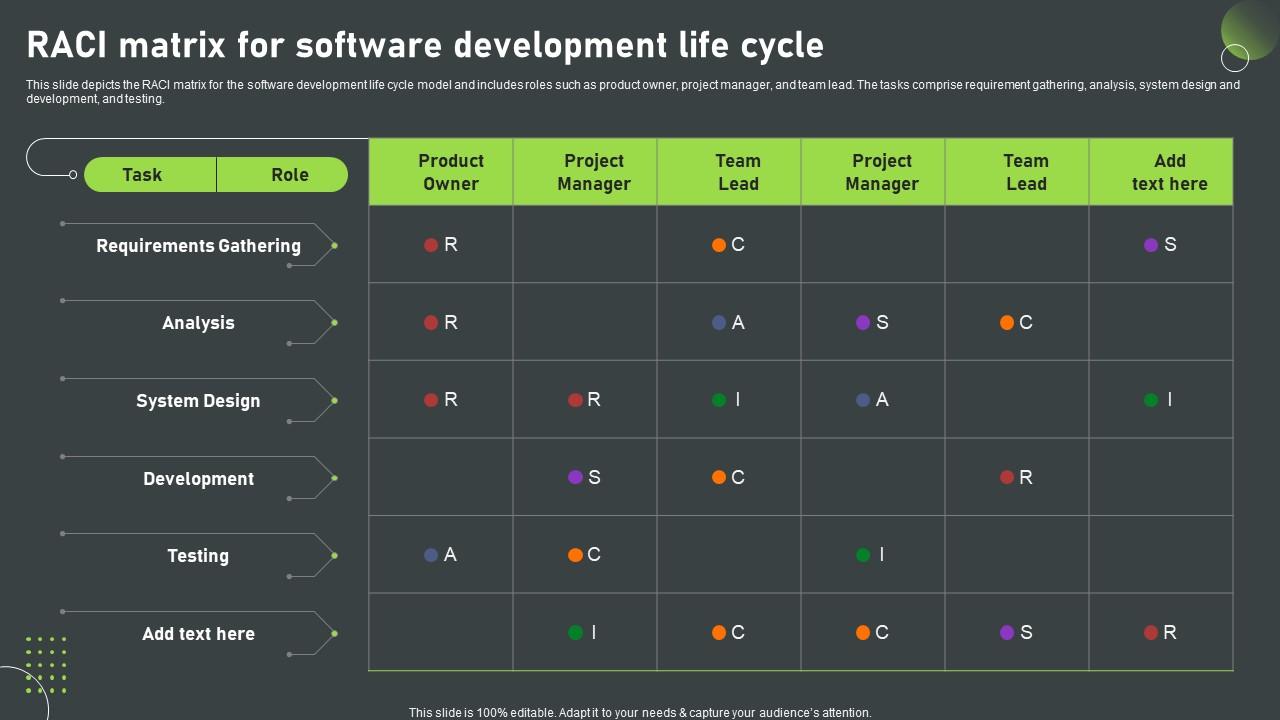
This slide depicts the RACI matrix for the software development life cycle model and includes roles such as product owner, project manager, and team lead. The tasks comprise requirement gathering, analysis, system design and development, and testing.
People who downloaded this PowerPoint presentation also viewed the following :
Raci Matrix For Software Development Life Cycle SDLC Phases IT with all 6 slides:
Use our Raci Matrix For Software Development Life Cycle SDLC Phases IT to effectively help you save your valuable time. They are readymade to fit into any presentation structure.
FAQs for Raci Matrix For Software Development Life Cycle
Oh, RACI matrix - you'll love this thing! It's just a simple chart where you assign four roles to every task: who's Responsible for doing it, who's Accountable (the final decision person), who gets Consulted for their opinion, and who just needs updates to stay Informed. Trust me, it saves so much drama when projects get messy. No more "wait, wasn't that your job?" conversations because everyone knows exactly what they're supposed to be doing. I started using these after a project went sideways last year - honestly wish I'd discovered them sooner. Makes everything way less chaotic.
So first, figure out who's actually doing the work - that's your Responsible person. The Accountable one owns the final decision and outcome (only pick one here or you'll have chaos). Consulted people are the ones with expertise you need - like, who'd you call if this goes sideways? And Informed is basically everyone who needs the updates but doesn't need to give input. Honestly, I just ask myself "who's gonna be pissed if they're left out?" Works every time and saves you from those awkward conversations later.
So basically, RACI is for regular project stuff - who owns what tasks day-to-day. The other two (DACI and RAPID) are more about making big decisions and figuring out approval chains. DACI has a "Driver" who pushes things forward, while RAPID focuses on who gets to "Decide" at the end. Both work better than RACI when you're stuck on complex choices that need sign-offs. Honestly? Just use RACI for most things - it's simpler and covers like 90% of situations. Only switch to the decision-focused ones when you're dealing with messy politics or multiple stakeholders who can't agree on anything. Start simple, then complicate later if needed.
Yeah, they totally work! Just don't make them super complicated. RACI helps clarify who's doing what with user stories and sprint goals - honestly beats having those awkward "wait, whose job was this?" moments. Keep it simple though. Traditional RACI feels way too rigid for Agile teams (nobody needs more bureaucracy). Update yours during retros when team roles shift or you get new people. I've seen teams skip this step and regret it later. The whole point is reducing confusion, not creating another process to maintain. Works great for cross-team stuff too.
Oh man, so the classic screw-up is having multiple people "Accountable" for one thing - you need exactly one person or everyone just assumes someone else will handle it. Don't go crazy with detail either, you'll waste hours updating the damn thing instead of using it. Here's what always bites people: they make someone Responsible but don't give them actual authority or resources to get it done. Also resist marking everyone as "Consulted" on everything because then you're just creating endless meetings. Honestly? Start small with one project first, see what actually works for your team before going all-in.
Dude, RACI matrices are honestly a game changer for avoiding that "wait, who's supposed to do this?" chaos. So you've got four roles: Responsible, Accountable, Consulted, and Informed for every task. No more showing up to meetings where everyone thinks they're in charge – or worse, nobody shows up at all. It forces those awkward role conversations upfront instead of mid-project meltdowns. When people start arguing about ownership, you literally just point at the chart. I know it sounds kinda corporate-y, but seriously try it on your next project. Decisions happen way faster when everyone knows their lane.
Okay so RACI matrices are actually pretty useful - they stop everyone from stepping on each other's toes. Basically you label people as Responsible (does the work), Accountable (owns it), Consulted (gives input), or Informed (just gets updates). Sounds boring but trust me, it prevents those awful meetings where everyone's like "oh I thought Sarah was doing that." The best part? You hash out who does what before the project even starts. No more mid-crisis scrambling to figure out roles. I learned this the hard way on a project that went sideways fast. Definitely try it at your next kickoff - makes everything way smoother.
Honestly? Check your RACI every 2-4 weeks or at big milestones. I can't tell you how many times I've watched teams make one and then totally ignore it - such a waste. When scope changes or people switch roles, update it immediately. Also anytime there's confusion about responsibilities or things start falling through the cracks. Oh and definitely review it during regular project meetings. Set a calendar reminder because you'll forget otherwise. Trust me, it's way better than dealing with the chaos later when everyone's pointing fingers about who was supposed to do what.
Honestly, just start with Excel or Google Sheets - they're dead simple and everyone already knows them. If you want to get fancy later, Asana and Monday.com have RACI stuff built right in that updates automatically (which is pretty sweet). Lucidchart makes things look way more professional if you're presenting to executives or whatever. For huge companies, Microsoft Project usually has this covered already. The real trick? Use whatever your team's already comfortable with. I've seen people overthink this and spend weeks picking the "perfect" tool. A basic spreadsheet still beats having responsibilities scattered across Slack threads and sticky notes.
Honestly, RACI matrices are kind of a nightmare in fast-moving situations - like startup life or when you're putting out fires. Small teams usually hate them because everyone's already doing five different jobs anyway. When responsibilities get messy and overlap (which happens constantly), you end up spending forever debating the stupid chart instead of just... doing the work? They also slow down decisions when you need to move fast. I'd skip it completely for anything experimental or collaborative. Oh, and if your team already talks well together naturally, don't mess with that dynamic.
Honestly, you've gotta sit down with everyone and walk through it together - emailing the matrix never works, learned that the hard way. Go person by person explaining what each letter actually means for their stuff. During the meeting, spell out who's Responsible for doing the work, who's Accountable if things go sideways, who you need to Consult, and who just gets updates. Let people ask questions until they're totally clear on their piece. Then keep that thing visible somewhere and actually reference it in your updates. Way too many teams create these matrices and then forget they exist.
Put that RACI matrix up on screen and go through it together - tackle the messy deliverables first, not the roles. Those are where people get confused anyway. Ask "does this actually work with your bandwidth?" when someone's drowning in A's or R's. Don't just email it afterward and hope for the best (I've watched that fail so many times). Let people negotiate right then and there. You'll save yourself headaches later. Oh, and definitely set a check-in date halfway through the project to see how it's actually working.
So RACI matrices are clutch for risk stuff because you know exactly who handles what when things blow up. No more "wait, whose job is this?" moments. The person marked "R" jumps in, "A" makes the calls, and everyone else just gets looped in. Honestly saves so much drama when projects go sideways - which they always do, let's be real. You can also spot slackers pretty easily since responsibilities are right there in black and white. Just make one for your big risks and don't let it get stale.
Basically anywhere with tons of people working on the same thing. Healthcare teams use them all the time for patient protocols - too much at stake otherwise. Construction projects are a nightmare without clear roles, trust me. Banks need them for regulatory stuff where someone's gotta be accountable. Manufacturing uses RACI for product launches and quality control. Software teams swear by them during releases. Honestly? If screwing up communication could cost you serious money or hurt someone, you probably need one. I'd start with whatever project feels most chaotic right now and just map out who does what.
Oh man, cultural stuff will totally mess with your RACI if you're not careful. Japanese and German teams usually want super detailed role breakdowns, but other cultures hate being boxed in like that. The power distance thing is brutal too - I've watched projects drag on forever because people won't push back on whoever's marked "Accountable," even when they're supposed to be doing the work. And don't get me started on how different cultures view deadlines... Honestly? Just talk through these expectations upfront in your kickoffs and adapt the whole RACI conversation for each region. Way easier than fixing it later.
-
The quality of the templates is as fine as it could get. It was a purchase well made!
-
A fantastic collection of templates. I'll likely use this as my go-to resource for future templates and support.