


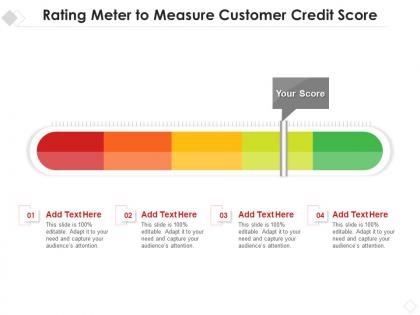
Rating meter to measure customer credit score




Try Before you Buy Download Free Sample Product
 Impress Your
 Audience
 100%
100% Editable
 Save Hours
 of Time


Our Rating Meter To Measure Customer Credit Score are topically designed to provide an attractive backdrop to any subject. Use them to look like a presentation pro.
People who downloaded this PowerPoint presentation also viewed the following :
Rating meter to measure customer credit score with all 2 slides:
Use our Rating Meter To Measure Customer Credit Score to effectively help you save your valuable time. They are readymade to fit into any presentation structure.

FAQs for Rating meter to measure
So there are five main things that affect your credit score. Payment history is huge - like 35% of it, so don't be late on anything. Then there's credit utilization at around 30%, which honestly confused me for the longest time. Basically just don't max out your cards - stay under 30% if you can. Length of credit history matters too, plus what types of accounts you have and how often you're applying for new stuff. Really though, if you just pay on time and keep your balances low compared to your limits, you'll be in good shape.
Honestly, I'd check it monthly if I were you. Most banks give you free monitoring now anyway, so why not? It's way easier to spot weird charges or fraud when you're looking regularly. Plus you'll actually see if paying down that credit card is helping your score - which is pretty satisfying tbh. Weekly checking is nuts unless you're really trying to rebuild your credit fast. Just pick a day each month and stick with it. I use the first Monday but whatever works. The consistency matters more than being perfect about it.
So the credit agencies don't actually calculate your scores - they're more like data collectors. Experian, Equifax, and TransUnion gather all your payment info, balances, account details from lenders. Then FICO and VantageScore take that data and run it through their formulas to spit out your actual scores. Your scores might be different between agencies since they don't always have identical info about you. Honestly, it's kind of annoying how the system works. But yeah, definitely check all three reports once a year to catch any errors in your data.
Yeah, they use totally different formulas so you'll see huge gaps - like 50+ points sometimes. FICO cares most about payment history (35%), but VantageScore looks at your overall credit usage differently. Plus FICO needs 6 months of history while VantageScore can score you way faster. It's honestly such a mess having two systems. Oh and most lenders still use FICO, especially for mortgages, so I'd focus on that one when you're applying for big stuff. Don't freak out if the numbers look weird on different sites though.
Oh man, a late payment can totally tank your score - we're talking 60-110 points depending on where you started. Higher scores get hit the worst, which seems backwards but whatever. Since payment history is 35% of your score, even one slip-up really matters. The damage is brutal at first but gets better over time. Here's the thing though - if you're still within 30 days of the due date, call them right away. Most lenders will actually remove it if you've been good about payments before. Worth a shot!
Ugh, most negative stuff stays on there for 7 years - late payments, collections, foreclosures, all that crap. Bankruptcies are worse though, they hang around for 10 years which honestly seems excessive but whatever. The timer starts from your first missed payment, not when it actually got reported to collections or anything. At least the damage to your score gets better over time, especially after year two. Oh and definitely check your credit report once a year to make sure old stuff actually falls off when it's supposed to. Sometimes they "forget" to remove it.
Honestly, just focus on paying everything on time first - that's gonna give you the biggest boost. After that, work on paying down what you owe. Try to keep credit card balances under 30% of the limit, but 10% is even better if you can swing it. Oh and don't close those old cards you never use anymore! I know it feels weird keeping them open, but credit history length actually matters. Also check your credit report for random errors - you'd be surprised how often banks mess stuff up. But seriously, start with on-time payments and you'll see changes in a couple months.
So credit utilization is just how much of your available credit you're using. It's the second biggest thing that affects your credit score after payment history. Try to stay under 30% on all your cards, but honestly under 10% is way better if possible. Like if you've got a $1,000 limit, don't carry more than $100-300. Here's the annoying part though - they calculate it when your statement closes, not when you pay. I learned this the hard way lol. Pay down your balances before the statement date and you'll keep that ratio nice and low.
So that college credit card you never use? Don't close it! Account age is like 15% of your credit score, and older accounts make you look way more trustworthy to lenders. They want to see you've been managing credit for years without screwing up. Your average account age matters too - honestly, being "boring" with credit actually pays off here. Just throw a small purchase on those old cards once in a while so they don't get closed for inactivity. Closing them tanks your score because you lose all that history.
Don't stress too much about this - credit models actually get that people shop around for rates. Auto loans, mortgages, student loans within like 2-3 weeks usually just count as one inquiry, not multiple hits. The timeframe varies between 14-45 days depending on the scoring model, but you're generally safe if you keep it focused. Now if you're applying for random stuff all over the place - credit cards, personal loans, AND a car loan - yeah, that'll raise eyebrows. I'd wrap up your rate shopping pretty quickly though, maybe within a couple weeks max.
Hey! So student loans work basically like car loans or mortgages for your credit - payment history is what counts most. The annoying thing is they stick around forever (like seriously, decades sometimes), so they're part of your credit mix for ages. Unlike credit cards though, having a big balance doesn't hurt your score the same way. Just don't miss payments - that's what'll wreck everything. If money's tight, definitely look into those income-based payment plans or deferment before you default. Way better than tanking your credit over it.
Honestly, I'd start by just pulling your free reports from AnnualCreditReport.com - that's the legit government site. Each of the big three bureaus (Experian, Equifax, TransUnion) has decent explanations on their sites too. The CFPB actually writes stuff in plain English for once, which is nice. Credit Karma and those apps will walk you through what's hurting your score, though sometimes they're trying to sell you something. Oh, and don't feel like you need to understand everything at once - credit reports are honestly pretty confusing at first. Just focus on the basics: payment history, balances, that kind of thing.
Yeah, being an authorized user can definitely help your credit score! Their payment history and how much they use the card gets added to your report. So if they're good with money - paying on time, not maxing it out - you benefit from that. It's honestly not a bad setup. The flip side though? If they mess up and miss payments or go crazy with spending, your score takes a hit too. How much it affects you depends on what your credit looks like already. I'd honestly want to see their payment history first before agreeing to anything.
Oh man, so many people get this stuff wrong! First off - checking your own credit score won't hurt it. That's only hard inquiries when lenders pull it. Don't close old credit cards either, even if you're not using them much. It'll mess up your credit history length and your utilization ratio. Here's the thing that drives me crazy - people think carrying a small balance helps your score. Total myth! Pay that thing off completely every month. And you definitely don't need to go into debt to build credit. Just use your card for normal stuff like groceries, then pay it off. Way easier than people make it out to be.
So basically, the better your credit score, the less you'll pay in interest rates. Lenders think you're less risky with a high score, so they give you better deals. If you've got 750+, you're golden - that's where the best rates kick in. Below 650? Yeah, you're gonna pay way more. I'm talking like 15% APR versus 25%+ on credit cards - that adds up fast. Over the life of a big loan, poor credit can cost you thousands extra. Honestly, it's worth obsessing over a bit. Pay your bills on time and check your score every few months.
-
Thanks for all your great templates they have saved me lots of time and accelerate my presentations. Great product, keep them up!
-
Great quality slides in rapid time.