


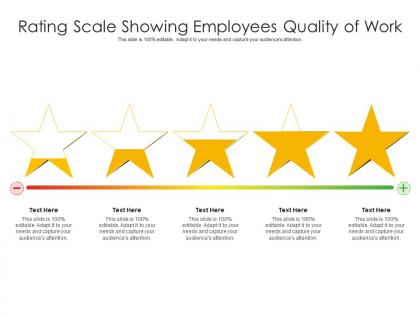
Rating scale showing employees quality of work infographic template




Try Before you Buy Download Free Sample Product
 Impress Your
 Audience
 100%
100% Editable
 Save Hours
 of Time


This is a Rating Scale Showing Employees Quality Of Work Infographic Template that can be used by professionals belonging to any domain. It is a powerful illustrative tool that can be deployed to showcase consumer behavior, sales reports, progress reports, IT research results, and many more. In short, this PPT layout works for every industry, irrespective of its operations. The combination of compelling information and visual content added in this template makes it a very resourceful layout to grab. Utilize it to present information and insightful details about your business or the finished product that can be visualized from the onset. This PPT design features high quality elements like graphics, icons, etc. that can be used to further enhance the illustrative properties of a presentation. It can also be reproduced as PNG, JPG and PDF, for the users convenience.
People who downloaded this PowerPoint presentation also viewed the following :
Rating scale showing employees quality of work infographic template with all 2 slides:
Use our Rating Scale Showing Employees Quality Of Work Infographic Template to effectively help you save your valuable time. They are readymade to fit into any presentation structure.
FAQs for Rating scale showing employees quality of
Key factors include defining clear performance criteria, establishing measurable objectives, ensuring rating consistency across managers, incorporating both quantitative and qualitative metrics, and aligning scales with organizational goals. These elements work together by streamlining evaluation processes, enhancing manager objectivity, and delivering actionable feedback, with many organizations finding that well-structured scales ultimately improve employee development and retention.
Different performance rating scales significantly impact employee motivation through clarity, fairness perception, and feedback quality, with forced ranking systems often reducing collaboration while continuous feedback models enhance engagement. Research shows that organizations using behaviorally-anchored rating scales and regular check-ins experience higher retention rates, improved goal alignment, and stronger performance outcomes, ultimately delivering better workplace satisfaction and competitive talent retention.
Performance rating scales significantly impact organizational culture by establishing clear expectations, promoting transparency in evaluations, and fostering accountability across teams. These systems enhance employee relations through structured feedback mechanisms, reduced evaluation bias, and improved communication between managers and staff, with many organizations finding that consistent rating frameworks ultimately build trust, encourage professional development, and create a more merit-based workplace environment.
Organizations ensure fairness and objectivity in performance rating scales through standardized criteria, comprehensive rater training, and multi-source feedback systems. These approaches streamline evaluation consistency by establishing clear behavioral anchors, minimizing bias through calibration sessions, and incorporating peer input, ultimately delivering transparent assessments and enhanced employee trust across diverse teams.
Employee performance rating scales should include goal achievement, quality of work, collaboration and teamwork, communication skills, problem-solving abilities, and initiative or innovation. These metrics enable organizations to assess both quantitative outcomes and behavioral competencies, with many companies finding that combining project-specific results with soft skills creates comprehensive evaluations, ultimately delivering fairer assessments and strategic talent development.
Technology enhances performance rating scales by automating data collection, providing real-time feedback capabilities, and enabling comprehensive analytics across multiple performance metrics. Through AI-powered platforms and integrated HR systems, organizations streamline evaluation processes, reduce bias in assessments, and deliver more accurate performance insights, ultimately enabling managers to make data-driven decisions while improving employee engagement.
Feedback serves as the foundation of effective performance rating by providing ongoing communication, specific examples of achievements and areas for improvement, and clear expectations for future development. Through regular feedback sessions, managers can document performance trends, address issues promptly, and create more accurate ratings, while employees receive actionable insights that enhance their professional growth and ultimately deliver better organizational outcomes.
Performance ratings should be conducted quarterly or bi-annually to maintain relevance and accuracy, with many organizations finding that frequent touchpoints enhance employee development and goal alignment. This strategic approach enables managers to address performance gaps promptly, recognize achievements consistently, and adapt objectives to changing business priorities, ultimately delivering improved engagement and more precise annual evaluations.
Organizations face challenges including employee resistance to change, manager training requirements, system integration complexities, ensuring fairness across departments, and maintaining consistency in evaluation standards. While these implementation hurdles require careful planning, many companies find that phased rollouts with comprehensive training and clear communication ultimately deliver improved performance transparency, better talent development, and enhanced organizational alignment.
Performance rating scales can be adapted for remote workplaces by incorporating digital collaboration metrics, communication effectiveness, virtual team participation, goal achievement tracking, and self-management capabilities. These enhanced frameworks enable managers to evaluate productivity through project deliverables, online engagement quality, and deadline adherence, while many organizations find that remote-specific criteria ultimately deliver more comprehensive performance insights and stronger accountability.
Performance evaluation biases include recency bias, halo effect, central tendency bias, confirmation bias, and comparison bias. These biases can significantly impact employee assessments by overemphasizing recent performance, allowing single traits to overshadow overall evaluation, or reflecting manager preferences rather than objective performance, ultimately affecting career advancement and organizational decision-making.
Managers can be trained through comprehensive workshops covering rating scale interpretation, bias recognition, evidence-based assessment techniques, and calibration sessions with peer managers. Training should include role-playing exercises, real case studies, and ongoing coaching sessions, with many organizations finding that regular refresher training and standardized evaluation protocols ultimately deliver more consistent, fair performance assessments across teams.
Numerical rating systems deliver quantifiable comparisons, streamlined performance tracking, objective benchmarking, and simplified compensation decisions, while qualitative assessments provide nuanced feedback, developmental insights, and personalized growth guidance. While numerical scales enable faster organizational analysis and standardized evaluations across departments, qualitative methods foster deeper manager-employee conversations and more meaningful professional development, with many organizations finding that hybrid approaches ultimately deliver both measurable outcomes and enhanced employee engagement.
Employee self-assessments integrate into performance rating scales by allowing employees to evaluate themselves using the same criteria and numerical scales as managers, creating comprehensive 360-degree feedback loops. This approach enhances performance discussions by comparing self-perception with supervisor ratings, identifying skill gaps and development opportunities, while fostering employee engagement and accountability in the evaluation process.
Emerging trends in performance evaluation include continuous feedback systems, 360-degree assessments, competency-based ratings, AI-driven analytics, and simplified rating scales replacing complex numerical systems. These methodologies enhance accuracy and engagement by incorporating real-time insights, peer perspectives, and behavioral indicators, with many organizations finding that streamlined approaches deliver better employee development outcomes and improved managerial efficiency.
-
Understandable and informative presentation.
-
Enough space for editing and adding your own content.
-
Easily Understandable slides.
-
Excellent Designs.