


Real Estate Negotiation Steps For Commercial Lease




Try Before you Buy Download Free Sample Product
 Impress Your
 Audience
 100%
100% Editable
 Save Hours
 of Time


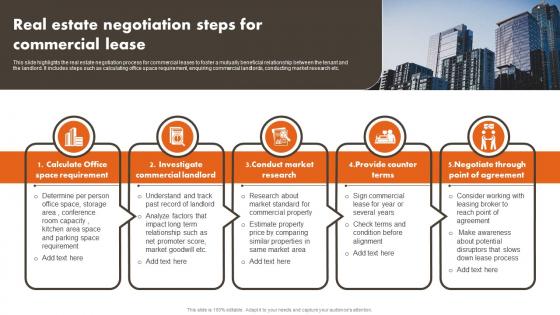
This slide highlights the real estate negotiation process for commercial leases to foster a mutually beneficial relationship between the tenant and the landlord. It includes steps such as calculating office space requirement, enquiring commercial landlords, conducting market research etc.
People who downloaded this PowerPoint presentation also viewed the following :
Real Estate Negotiation Steps For Commercial Lease with all 9 slides:
Use our Real Estate Negotiation Steps For Commercial Lease to effectively help you save your valuable time. They are readymade to fit into any presentation structure.








FAQs for Real Estate Negotiation Steps
Key elements include market research and comparable sales analysis, financial pre-approval documentation, property inspection reports, understanding seller motivations, and defining your negotiation boundaries. These preparation steps enhance your position by providing data-driven leverage, demonstrating serious buyer intent, and identifying potential deal structures, with many real estate professionals finding that thorough preparation ultimately delivers faster closings and more favorable terms.
Understanding market trends significantly influences real estate negotiation strategies by revealing pricing patterns, inventory levels, average days on market, and buyer-seller dynamics in specific areas. In seller's markets, buyers must act quickly with competitive offers, while buyer's markets enable more deliberative approaches with inspection contingencies and price negotiations, ultimately delivering strategic advantages through data-driven positioning.
Effective rapport-building techniques include active listening to understand their priorities, finding common ground through shared interests, maintaining respectful communication, asking open-ended questions about their needs, and demonstrating genuine empathy for their position. These approaches streamline negotiations by reducing tension, building trust, and creating collaborative environments, with many real estate professionals finding that strong rapport ultimately delivers faster closings and more favorable outcomes for all parties.
Buyers can effectively assess property value through comparative market analysis, professional appraisals, inspection reports, neighborhood trend research, and recent sales data analysis. These evaluation methods enable informed negotiation by identifying fair market ranges, potential repair costs, and local appreciation patterns, while many buyers find that combining multiple assessment approaches delivers stronger negotiating positions and more confident purchase decisions.
Timing significantly influences real estate negotiations through market conditions, seasonal trends, seller motivations, and buyer urgency, creating strategic leverage opportunities. Savvy negotiators capitalize on timing by identifying motivated sellers during slower seasons, leveraging inspection deadlines, and understanding market cycles, ultimately securing better prices, favorable terms, and competitive advantages in increasingly dynamic property markets.
Common psychological tactics include anchoring with extreme initial offers, creating artificial urgency through time pressure, emotional manipulation targeting dream home desires, scarcity claims about limited inventory, and reciprocity pressure through small concessions. These tactics can be countered by conducting thorough market research, setting firm budget limits beforehand, taking time for decision-making, and focusing on objective property values rather than emotional appeals, ultimately ensuring more strategic negotiation outcomes.
**INPUT**: How should one determine their walk-away point in a real estate negotiation? **OUTPUT**: Determining your walk-away point requires analyzing your maximum budget, minimum acceptable terms, comparable market prices, and long-term financial goals before negotiations begin. This strategic preparation enables buyers and sellers to make confident decisions under pressure, avoid emotional overspending, and ultimately secure deals that align with their financial capacity, with many real estate professionals finding that predetermined limits lead to more successful outcomes. **Word count: 60 words**
**Real Estate Negotiation Steps - Making a Compelling Offer** Best practices include researching comparable sales, understanding seller motivations, offering competitive pricing with flexible terms, including earnest money deposits, and presenting clean financing pre-approval. These strategies work by demonstrating serious buyer intent, reducing seller risk concerns, and creating win-win scenarios, with many real estate professionals finding that well-structured offers with personal touches often outperform higher-priced but generic proposals. *Word count: 60 words*
Agents represent clients' best interests by conducting thorough market research, preparing comprehensive negotiation strategies, and communicating transparently about all options and implications. Through active listening, respectful dialogue, and fact-based presentations, real estate professionals in residential and commercial sectors build trust with all parties, ultimately securing favorable outcomes while preserving long-term business relationships.
A real estate negotiation checklist should include property valuation research, comparable sales analysis, inspection contingencies, financing pre-approval documentation, and closing timeline requirements. These elements enable buyers and sellers to streamline discussions by establishing clear parameters, identifying potential deal-breakers early, and ultimately delivering faster transactions with reduced surprises, while ensuring all parties maintain realistic expectations throughout the process.
Contingencies can be strategically negotiated by adjusting timeframes, earnest money amounts, inspection scopes, and financing terms to balance buyer protection with seller appeal. Savvy negotiators often offer shorter inspection periods or higher deposits in competitive markets, while requesting extended financing contingencies in uncertain conditions, ultimately creating win-win scenarios that facilitate smoother transactions.
Using an intermediary in real estate negotiations offers professional expertise, market knowledge, emotional buffer, and strategic positioning while reducing direct confrontation between parties. However, this approach involves additional costs, potential communication delays, and less direct control over negotiations, with many property investors finding that skilled intermediaries ultimately deliver better terms and faster closings despite the added expense.
Sellers prepare effectively by researching comparable sales data, setting minimum acceptable prices, and understanding current market conditions, buyer motivations, and negotiation timelines. Through strategic pricing analysis and flexible terms consideration, real estate professionals enable sellers to respond confidently to counteroffers, maintain negotiating leverage, and ultimately secure favorable deals while adapting to market dynamics.
Common pitfalls include making emotional decisions, revealing your maximum budget early, skipping property inspections, ignoring market comparables, and failing to negotiate contingencies properly. These mistakes often lead to overpaying, missing critical property issues, or losing negotiating leverage, with many buyers and sellers finding that thorough preparation and professional guidance help avoid costly errors that can derail transactions entirely.
Emotional attachment significantly influences real estate negotiations by affecting decision-making objectivity, price flexibility, and timeline pressures for both buyers and sellers. While sellers may overprice due to sentimental value and buyers might overbid on dream homes, successful negotiations increasingly require emotional awareness and strategic communication, with experienced agents helping clients balance emotional needs with market realities to achieve favorable outcomes.
-
The slides are remarkable with creative designs and interesting information. I am pleased to see how functional and adaptive the design is. Would highly recommend this purchase!
-
My search for complete decks ended with SlideTeam. Such a surplus collection of HD PowerPoints. Moreover, their standard and widescreen formats have helped me in delivering bullseye presentations.