


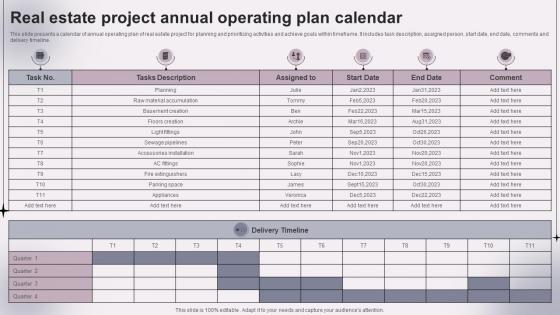
Real Estate Project Annual Operating Plan Calendar




Try Before you Buy Download Free Sample Product
 Impress Your
 Audience
 100%
100% Editable
 Save Hours
 of Time


This slide presents a calendar of annual operating plan of real estate project for planning and prioritizing activities and achieve goals within timeframe. It includes task description, assigned person, start date, end date, comments and delivery timeline.
People who downloaded this PowerPoint presentation also viewed the following :
Real Estate Project Annual Operating Plan Calendar with all 6 slides:
Use our Real Estate Project Annual Operating Plan Calendar to effectively help you save your valuable time. They are readymade to fit into any presentation structure.






FAQs for Real Estate Project Annual
Real Estate Annual Operating Plans include revenue forecasts, property maintenance schedules, capital expenditure budgets, tenant retention strategies, and market analysis assessments. These comprehensive components streamline property management by optimizing occupancy rates, reducing operational costs, and enhancing tenant satisfaction, with many commercial property owners finding that structured planning ultimately delivers improved cash flow and competitive positioning.
Market trends and economic indicators significantly influence real estate forecasting by shaping rental demand projections, occupancy rate expectations, and pricing strategies within annual operating plans. These factors enable property managers to anticipate market shifts, adjust revenue assumptions, and optimize capital allocation decisions, with many commercial real estate firms finding that incorporating local employment data, interest rate trends, and demographic changes ultimately delivers more accurate budget forecasts and competitive positioning.
Property valuation serves as the foundation for revenue forecasting, debt servicing calculations, and capital allocation decisions within an Annual Operating Plan. Through accurate market assessments, real estate organizations can project rental income potential, refinancing opportunities, and asset appreciation scenarios, while determining optimal investment timing and portfolio adjustments, ultimately delivering strategic positioning and enhanced returns.
Technology and data analytics enhance Real Estate Annual Operating Plan accuracy by providing predictive market modeling, automated financial forecasting, and real-time performance tracking capabilities. Through AI-powered analytics platforms, property managers can analyze tenant behavior patterns, optimize rental pricing strategies, and predict maintenance costs more precisely, ultimately delivering more reliable budget projections and strategic decision-making insights.
Tenant retention strategies include proactive maintenance programs, responsive customer service systems, competitive lease renewals, community engagement initiatives, and technology-enhanced communication platforms. These approaches streamline property management by reducing vacancy costs, minimizing turnover expenses, and enhancing tenant experiences, with many real estate organizations finding that strategic tenant satisfaction investments ultimately deliver higher occupancy rates and increased profitability.
Different property types require distinct Annual Operating Plan structures due to varying revenue models, operational complexities, and market dynamics, with commercial properties focusing on tenant retention and lease management, residential properties emphasizing occupancy rates and maintenance scheduling, and industrial properties prioritizing long-term contracts and specialized infrastructure needs. These structural differences enable property managers to optimize resource allocation, streamline sector-specific operations, and deliver targeted performance metrics that align with each property type's unique investment characteristics and market demands.
Risk management strategies for real estate annual operating plans include market volatility assessments, cash flow stress testing, property diversification analysis, regulatory compliance monitoring, and insurance coverage evaluation. These comprehensive approaches enable property managers and investors to mitigate financial exposure, anticipate market downturns, and maintain operational stability, with many real estate firms finding that proactive risk planning ultimately delivers enhanced portfolio performance and competitive advantage.
Annual Operating Plans should be formally reviewed quarterly, with monthly performance monitoring and immediate updates during significant market shifts, regulatory changes, or economic disruptions. Many real estate organizations find that quarterly assessments enable strategic pivots for interest rate fluctuations, demand changes, and competitive pressures, while monthly tracking ensures operational efficiency and investment performance remain aligned with evolving market conditions.
Key metrics for measuring Real Estate Annual Operating Plan success include occupancy rates, net operating income, rental growth percentages, tenant retention rates, and capital expenditure efficiency. These performance indicators enable property managers and investors to track revenue optimization, cost management, and asset appreciation, while many real estate organizations find that combining financial metrics with operational benchmarks delivers comprehensive insights for strategic decision-making and competitive positioning.
Environmental sustainability initiatives integrate into Real Estate Annual Operating Plans through energy efficiency upgrades, waste reduction programs, green building certifications, water conservation measures, and sustainable vendor partnerships. These strategic initiatives streamline operational costs, enhance property values, and attract environmentally conscious tenants, with many commercial real estate firms finding that sustainability investments deliver measurable cost savings while strengthening competitive positioning.
Effective budgeting techniques for optimizing cash flow include zero-based budgeting, rolling forecasts, scenario planning, capital expenditure prioritization, and variance analysis. These approaches enable property managers and real estate firms to streamline operational expenses, enhance revenue predictability, and allocate resources strategically, with many commercial and residential portfolio managers finding that proactive cash flow optimization ultimately delivers improved profitability and competitive advantage.
Stakeholder input can be incorporated through structured surveys, regular advisory meetings, tenant satisfaction assessments, and investor feedback sessions that identify operational priorities, market expectations, and performance concerns. These insights enable property managers to align budget allocations, maintenance schedules, and capital improvements with stakeholder needs, ultimately delivering enhanced tenant retention, improved asset performance, and stronger investor returns while maintaining competitive positioning.
Real estate professionals encounter challenges including market volatility affecting revenue projections, regulatory changes impacting development timelines, financing constraints limiting expansion plans, and workforce management across multiple properties. These obstacles often require strategic pivots, with many firms finding that flexible planning frameworks, diversified portfolio approaches, and enhanced technology integration help navigate uncertainties while maintaining operational efficiency and competitive positioning.
Capital expenditures and operational expenses directly influence profitability, cash flow, and asset valuation within the Annual Operating Plan by determining net operating income, return on investment, and long-term property appreciation. Strategic capital investments in HVAC systems, renovations, and technology infrastructure enhance property values and tenant retention, while optimized operational expenses through energy management and preventive maintenance ultimately deliver improved margins and competitive positioning in increasingly demanding real estate markets.
Marketing strategies serve as the primary revenue generation engine within Real Estate Annual Operating Plans, driving lead acquisition, brand positioning, property visibility, and sales conversion rates across multiple channels. These strategies directly impact occupancy targets, pricing optimization, and market share growth, with successful real estate firms finding that integrated digital marketing, targeted advertising, and strategic partnerships consistently deliver measurable ROI and accelerated achievement of annual financial objectives.
-
One-stop solution for all presentation needs. Great products with easy customization.
-
Unique design & color.