


Referral marketing program overview ppt samples
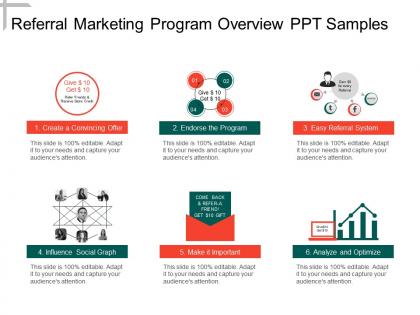




Try Before you Buy Download Free Sample Product
 Impress Your
 Audience
 100%
100% Editable
 Save Hours
 of Time


Develop a gutsy feel with our Referral Marketing Program Overview Ppt Samples. The adrenaline will begin to flow.
People who downloaded this PowerPoint presentation also viewed the following :
Referral marketing program overview ppt samples with all 5 slides:
Change is a certainty in the future. Our PT& enable you to benefit from it.

FAQs for Referral marketing program
Referral marketing programs for presentation template businesses deliver increased customer acquisition costs reduction, enhanced brand credibility through peer recommendations, higher conversion rates from qualified leads, expanded market reach, and improved customer lifetime value. These programs streamline growth by leveraging satisfied customers as authentic advocates, generating cost-effective leads, and building trust with prospects, with many template providers finding that referral customers demonstrate stronger loyalty and purchase frequency than traditional marketing channels.
Businesses can effectively incentivize referral participation through tiered reward systems, exclusive template access, commission structures, recognition programs, and gamified challenges. These approaches work particularly well for design agencies and consulting firms, with many finding that combining monetary incentives with exclusive premium templates, early access privileges, and public recognition creates sustainable referral momentum while enhancing customer loyalty and expanding market reach.
Tracking referral program success involves monitoring conversion rates, referral source attribution, customer lifetime value metrics, and template download-to-purchase ratios through analytics platforms and unique referral codes. These measurement strategies enable template businesses to optimize reward structures, identify high-performing referrers, and calculate program ROI, with many digital marketplaces finding that combining automated tracking with customer feedback surveys delivers comprehensive insights for strategic program refinement.
Digital marketing amplifies referral programs through social media campaigns, email automation, targeted ads, and influencer partnerships that showcase template collections. These integrated approaches streamline customer acquisition by leveraging existing satisfied customers, automating reward distribution, and expanding reach across multiple channels, ultimately delivering higher conversion rates and enhanced brand visibility in competitive template markets.
Customer experience serves as the foundation of referral marketing effectiveness, directly influencing referral generation rates, program participation, and advocate quality. Positive experiences across touchpoints like seamless onboarding, responsive support, and consistent service delivery naturally motivate customers to recommend brands, with many companies finding that superior experience creates authentic advocates who generate higher-converting referrals and sustained program growth.
Businesses can create seamless referral processes by implementing automated tracking systems, simplified sharing mechanisms, clear reward structures, and integrated customer dashboards that monitor referral progress. Through personalized referral links and streamlined onboarding, companies like design platforms and SaaS providers enhance customer experiences while reducing friction, ultimately delivering higher conversion rates and stronger customer loyalty with automated reward fulfillment.
The most appealing referral rewards include cash incentives, discount coupons, exclusive product access, loyalty points, and premium service upgrades. These rewards work effectively by providing immediate value, creating emotional connection, and encouraging repeat engagement, with many retail and subscription-based companies finding that tiered reward structures ultimately drive higher participation rates and sustained customer advocacy.
Social media amplifies referral marketing for presentation templates through shareable referral links, user-generated content showcasing template usage, and community-driven challenges that encourage sharing. Platforms like LinkedIn and Twitter enable professionals to demonstrate template results in real presentations, while Instagram Stories and Facebook posts create viral moments, ultimately expanding reach beyond traditional networks and driving higher conversion rates through visual proof of template effectiveness.
Common pitfalls include inadequate reward structures, complex referral processes, poor tracking systems, insufficient program promotion, and neglecting customer experience quality. These oversights significantly undermine program effectiveness by reducing participation rates, creating customer frustration, and limiting scalability, with many businesses finding that simplifying processes while enhancing reward transparency ultimately delivers higher engagement and sustainable referral growth.
Testimonials and success stories enhance referral marketing programs by building credibility, demonstrating tangible value, and providing social proof that motivates participation. These authentic narratives streamline trust-building with potential referrers and their networks, with many businesses finding that showcasing real customer experiences significantly increases referral conversion rates and program engagement.
Businesses should track referral conversion rates, customer acquisition costs, lifetime value of referred customers, referral program ROI, and revenue attribution from referrals. These metrics enable organizations to measure program effectiveness, optimize referral incentives, and quantify sales impact, with many companies finding that referred customers typically demonstrate higher retention rates and generate 25% more revenue than traditional acquisitions.
Businesses can segment their audience by purchase history, customer lifetime value, engagement levels, demographics, and behavioral patterns to create targeted referral incentives. High-value customers might receive premium rewards, while frequent purchasers get volume-based incentives, and new customers receive welcome bonuses, ultimately increasing program participation rates and driving more qualified referrals across different customer segments.
Niche markets like presentation templates face challenges including limited audience size, specialized user needs, longer purchase cycles, and difficulty creating viral referral content that resonates broadly. However, these markets benefit from highly engaged communities, targeted messaging opportunities, and strong word-of-mouth potential among professional networks, with many template businesses finding that industry-specific referral incentives and strategic partnerships ultimately deliver higher conversion rates than broad-market approaches.
Ensure referral program alignment by integrating consistent brand messaging, visual identity, and core values throughout all referral touchpoints, communications, and reward structures. This strategic combination maintains brand integrity while leveraging customer advocacy, with many companies finding that aligned programs enhance customer trust, amplify authentic brand experiences, and ultimately deliver stronger conversion rates and long-term customer loyalty.
Automated tools enhance referral program management by streamlining tracking systems, automating reward distribution, personalizing communications, and providing real-time analytics dashboards. These technologies enable businesses to monitor referral performance across multiple channels, reduce manual processing errors, and deliver faster reward fulfillment, with many companies finding that automation significantly increases participant engagement and program scalability.
-
Enough space for editing and adding your own content.
-
Amazing product with appealing content and design.