


Release management develop build test production lifecycle




Try Before you Buy Download Free Sample Product
 Impress Your
 Audience
 100%
100% Editable
 Save Hours
 of Time


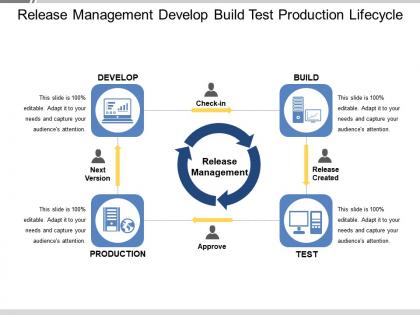
Release Management Develop Build Test Production Lifecycle is an effective virtual tool for release managers. You can use this highly visual PPT slide to consolidate your company’s release management plan. Apart from a few details, the release management process shares similar phases irrespective of organizational size. Hence, users across all industry verticals can take advantage of our engaging PowerPoint template. Demonstrate the setting up and following up of your release management system with appreciable ease through this PPT layout. Communicate key software release plan specifics like planning development, building the course of action, testing, production, and deployment. Use this PowerPoint slide to elucidate application release management tools. To boost the release velocity and minimize failures, you need to convey information coherently. This is where our PPT template comes to your rescue. Prepare an impactful presentation with the help of our software development life cycle PowerPoint theme. So, hit the download icon and start personalizing. Breed a bunch of heroes with our Release Management Develop Build Test Production Lifecycle. Delve on examples of indomitable courage.
People who downloaded this PowerPoint presentation also viewed the following :
Release management develop build test production lifecycle with all 5 slides:
Enter debates with our Release Management Develop Build Test Production Lifecycle. Your arguments will garner many a vote.



FAQs for Release management develop build
Key components of an effective release management process include release planning, change coordination, testing protocols, deployment automation, and rollback procedures. These elements work together by streamlining development cycles, minimizing deployment risks, and ensuring quality control, with many organizations finding that structured release management delivers faster time-to-market and enhanced operational reliability.
Determining optimal release frequency involves analyzing user feedback cycles, development team capacity, market competitiveness, and risk tolerance for your specific product context. Companies like Netflix deploy multiple times daily for rapid iteration, while enterprise software providers like SAP release quarterly for stability, with many organizations finding that balancing customer expectations with quality assurance ultimately delivers sustainable competitive advantage.
Traditional release management follows rigid, sequential phases with lengthy cycles and extensive documentation, while agile release management emphasizes iterative delivery, continuous integration, and flexible timelines. Agile approaches enable organizations to respond quickly to market changes, reduce time-to-market significantly, and deliver customer value incrementally, with many software companies finding that frequent releases enhance user satisfaction and competitive positioning.
Automation enhances release management by streamlining code deployment, reducing manual errors, and accelerating delivery cycles through continuous integration and automated testing pipelines. Organizations across sectors like banking, healthcare, and retail leverage these automated workflows to achieve faster time-to-market, improved quality control, and enhanced operational efficiency, ultimately delivering more reliable software releases.
Communication serves as the backbone of successful release management by coordinating stakeholders, managing expectations, establishing clear timelines, and ensuring transparency across development teams. Through structured communication protocols, organizations streamline deployment processes, minimize risks, and enhance collaboration between technical teams and business units, ultimately delivering faster releases and improved customer experiences.
Release planning in continuous integration requires automated scheduling, feature flagging, environment orchestration, risk assessment protocols, and stakeholder coordination frameworks. Through strategic branching and deployment pipelines, organizations streamline version control, minimize integration conflicts, and accelerate delivery cycles, while maintaining quality gates, ultimately enabling faster time-to-market and enhanced competitive advantage.
Key release management metrics include deployment frequency, lead time for changes, mean time to recovery, change failure rate, and release velocity. These metrics enhance operational visibility by measuring delivery speed, system reliability, and process efficiency, with many organizations finding that tracking these indicators enables faster deployments, reduced downtime, and ultimately delivers improved customer experiences while maintaining competitive advantage.
Release management practices reduce deployment failures by implementing automated testing pipelines, staged deployment environments, comprehensive rollback procedures, and thorough change documentation protocols. These systematic approaches enable organizations to catch issues early, validate functionality across multiple environments, and maintain deployment consistency, with many software teams finding that structured release processes decrease production incidents by up to 70% while accelerating delivery timelines.
A release calendar provides structured scheduling, stakeholder alignment, resource planning, risk mitigation, and dependency management across development cycles. This strategic approach enables teams to coordinate complex deployments, minimize conflicts between releases, and ensure adequate testing periods, while stakeholders gain predictable timelines for feature launches, ultimately delivering more reliable software and enhanced customer experiences.
Ensuring compliance and security requires automated security scanning, access controls, audit trails, regulatory checkpoints, and vulnerability assessments integrated throughout release pipelines. Through DevSecOps practices, organizations streamline compliance verification, enforce security policies at each stage, and maintain detailed documentation, with many financial services and healthcare institutions finding that automated security gates reduce risks while accelerating deployment cycles.
Release management tools include Jenkins, GitLab CI/CD, Azure DevOps, Jira, and Ansible, which automate deployment pipelines and coordinate software releases. These platforms streamline operations by enabling continuous integration, automated testing, and real-time tracking across development cycles, with many organizations finding that strategic tool combinations significantly reduce deployment time while enhancing reliability and operational efficiency.
Feedback loops in release management incorporate post-release monitoring, user feedback collection, performance analytics, and retrospective sessions with development teams. These mechanisms enable organizations to identify deployment bottlenecks, user experience issues, and operational inefficiencies, while many teams find that systematic feedback integration reduces future release risks and accelerates delivery cycles.
**INPUT**: What strategies can be employed to manage multiple concurrent releases? **OUTPUT**: Managing multiple concurrent releases requires strategic coordination through release trains, feature flagging, automated testing pipelines, cross-team communication protocols, and staggered deployment schedules. These approaches streamline delivery by minimizing conflicts, enabling selective feature rollouts, and maintaining quality standards, with many organizations finding that structured release orchestration ultimately delivers faster time-to-market and reduced deployment risks. [Word count: 54 words]
Stakeholder involvement significantly influences release management by ensuring alignment with business objectives, facilitating clear communication channels, and enabling informed decision-making throughout the development lifecycle. Through regular feedback loops and collaborative planning sessions, organizations streamline approval processes, minimize deployment risks, and accelerate time-to-market, while maintaining quality standards and ultimately delivering releases that meet user expectations and strategic goals.
Best practices for creating a release readiness checklist include defining clear acceptance criteria, establishing comprehensive testing protocols, documenting rollback procedures, coordinating stakeholder approvals, and validating infrastructure capacity. These practices streamline deployment processes by minimizing risks, ensuring quality standards, and facilitating seamless coordination across teams, with many organizations finding that structured checklists significantly reduce release failures while accelerating delivery timelines.
-
Awesome use of colors and designs in product templates.
-
Top Quality presentations that are easily editable.