


Release management showing development quality assurance production





Try Before you Buy Download Free Sample Product
 Impress Your
 Audience
 100%
100% Editable
 Save Hours
 of Time


Our Release Management Showing Development Quality Assurance Production ensure that they keep coming back. Their appetites will get a boost.
People who downloaded this PowerPoint presentation also viewed the following :
Content of this Powerpoint Presentation
Description:
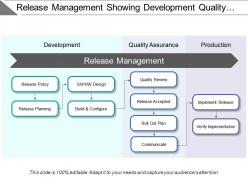
The image is a PowerPoint slide titled "Release Management Showing Development Quality Assurance Production", illustrating the phases of a release management process. The process is divided into three main stages: Development, Quality Assurance, and Production, each containing steps that flow from one to the next.
1. Development Phase:
Release Policy: Defining the guidelines and standards for the release.
Release Planning: Planning the details and schedule of the release.
SW/HW Design: Designing the software and hardware components.
Build & Configure: Constructing and setting up the software/hardware as per design specifications.
2. Quality Assurance Phase:
Quality Review: Evaluating the software/hardware to ensure it meets quality standards.
Release Accepted: The release is approved after meeting quality criteria.
Roll-Out Plan: Developing a plan for deploying the release.
Communicate: Informing relevant stakeholders about the release status.
3. Production Phase:
Implement Release: The actual deployment of the release into the production environment.
Verify Implementation: Checking to ensure the release functions correctly in the production setting.
The slide footer indicates that the template is "100% editable," allowing users to customize it to fit their specific process and information.
Use Cases:
This release management slide is versatile and can be used across various industries involved in product development and delivery:
1. Software Development:
Use: Outlining the software release cycle.
Presenter: Release Manager
Audience: Development Team, QA Team, Operations Team
2. Telecommunications:
Use: Managing the rollout of new network updates or hardware installations.
Presenter: Project Coordinator
Audience: Technical Teams, Stakeholders
3. Pharmaceuticals:
Use: Release process for new drugs from lab development to market release.
Presenter: QA/QC Director
Audience: Research Scientists, Regulatory Affairs
4. Automotive:
Use: Launching new vehicle models or technology updates.
Presenter: Product Manager
Audience: Engineering Team, Marketing Team, Dealerships
5. Consumer Electronics:
Use: Introduction of new gadgets or updates to existing devices.
Presenter: Product Release Lead
Audience: R&D Team, Marketing Team, Retail Partners
6. Aerospace:
Use: Release of new aircraft components or systems.
Presenter: Engineering Project Manager
Audience: Design Engineers, Safety Inspectors, Clients
7. Financial Services:
Use: Deployment of new banking software or updates to financial systems.
Presenter: IT Release Manager
Audience: IT Department, Compliance Officers, Bank Staff
Release management showing development quality assurance production with all 5 slides:
Increase your chances of having an impact with our Release Management Showing Development Quality Assurance Production. It discourages ineffectual ideas.



FAQs for Release management showing development
Key components of an effective release management strategy include comprehensive planning and scheduling, automated testing and deployment pipelines, robust rollback procedures, stakeholder communication protocols, and performance monitoring systems. These components work together by minimizing deployment risks, accelerating delivery cycles, and ensuring consistent quality, with many organizations finding that strategic release management ultimately delivers faster time-to-market and enhanced operational reliability.
Teams ensure smooth communication during releases by implementing daily standups, establishing clear escalation paths, using centralized communication tools, maintaining real-time dashboards, and conducting regular stakeholder updates. Through platforms like Slack or Microsoft Teams, organizations streamline coordination between development, testing, and operations teams, while automated notifications and shared documentation ultimately deliver faster deployments and reduced release risks.
Automation streamlines modern release management by enabling continuous integration, automated testing, deployment pipelines, rollback mechanisms, and monitoring systems. These technologies minimize human error, accelerate release cycles, and enhance consistency, with many organizations finding that automated processes reduce deployment time by 80% while delivering faster market responsiveness and competitive advantage.
Organizations measure release success through key performance indicators including deployment frequency, lead time, mean time to recovery, change failure rate, and user adoption metrics. These measurements enable teams to track operational efficiency, identify bottlenecks, and optimize future releases, with many enterprises finding that combining technical metrics with business outcomes delivers comprehensive visibility into release performance and strategic value.
Teams commonly face challenges including coordination across multiple departments, managing complex dependencies between features, ensuring adequate testing coverage, handling last-minute changes, and maintaining clear communication throughout the release cycle. These obstacles often result in delayed deployments, increased defect rates, and resource bottlenecks, with many organizations finding that streamlined processes and automated workflows significantly reduce risks while enhancing overall delivery efficiency.
Managing multiple releases simultaneously requires coordinated planning, clear communication protocols, dedicated release managers, shared documentation systems, and automated deployment pipelines. These practices streamline operations by minimizing conflicts between releases, establishing clear dependencies and timelines, and maintaining consistent quality standards, with many development teams finding that strategic resource allocation and cross-functional collaboration ultimately deliver faster deployment cycles and reduced operational risks.
Teams can effectively incorporate user feedback by implementing continuous feedback loops through beta testing programs, user surveys, analytics monitoring, and direct customer interviews throughout development phases. This strategic approach enables organizations to identify pain points early, prioritize feature enhancements based on actual user needs, and deliver more targeted releases, with many companies finding that regular feedback integration reduces post-release issues while significantly improving user satisfaction.
Release management tools include Jenkins, GitLab CI/CD, Azure DevOps, Octopus Deploy, and Spinnaker, each offering distinct automation capabilities and integration approaches. These platforms streamline deployment processes by providing pipeline orchestration, environment management, and rollback mechanisms, with many organizations finding that Jenkins excels in flexibility while Azure DevOps delivers comprehensive Microsoft ecosystem integration, ultimately enhancing deployment reliability and reducing time-to-market.
Common release management pitfalls include inadequate testing, poor communication between teams, insufficient rollback planning, lack of automated deployment processes, and skipping change documentation. These challenges often result from rushed timelines and siloed operations, with many organizations finding that implementing comprehensive testing protocols, clear communication channels, and automated workflows ultimately delivers more reliable releases and reduced deployment risks.
Change management principles enhance the release process by establishing clear communication channels, structured approval workflows, and stakeholder engagement protocols that minimize resistance and ensure smooth transitions. Through systematic change control, organizations streamline deployment cycles, reduce rollback incidents, and improve user adoption rates, with many enterprises finding that proactive change management ultimately delivers faster implementations and enhanced operational stability.
DevOps culture significantly enhances release management efficiency by fostering collaboration between development and operations teams, automating deployment pipelines, and emphasizing continuous integration and delivery practices. This cultural shift enables organizations to achieve faster release cycles, reduced manual errors, and improved system reliability, with many technology companies finding that streamlined communication ultimately delivers competitive advantage through accelerated time-to-market.
Organizations balance speed and quality through automated testing pipelines, continuous integration practices, feature flags, risk-based testing strategies, and phased rollout approaches. These methodologies streamline deployment processes while maintaining rigorous quality standards, with many technology companies finding that strategic automation and parallel development workflows ultimately deliver faster time-to-market and enhanced product reliability.
**INPUT**: What strategies can be employed to ensure compliance during releases? **OUTPUT**: Compliance strategies during releases include automated testing pipelines, regulatory checkpoint reviews, audit trail documentation, role-based approval workflows, and continuous monitoring systems. These approaches streamline compliance by embedding regulatory requirements into development processes, maintaining transparent documentation, and enabling real-time validation, with many organizations finding that automated compliance checks significantly reduce deployment risks while accelerating release cycles. **Word count: 58 words**
Post-release support is critical for maintaining system stability, user satisfaction, and long-term software success, involving bug fixes, performance monitoring, user assistance, and feature updates. This ongoing commitment enables organizations to address issues quickly, minimize downtime, and enhance user experiences, with many companies finding that robust post-release strategies significantly reduce operational costs while strengthening customer loyalty.
Emerging trends in release management include automated deployment pipelines, feature flagging, progressive delivery techniques, infrastructure as code, and AI-driven release orchestration. These approaches streamline software delivery by reducing manual errors, enabling faster rollbacks, and supporting continuous integration, with many organizations finding that automated release processes ultimately deliver 60% faster deployment cycles and significantly enhanced operational efficiency.
-
Unique design & color.
-
Awesomely designed templates, Easy to understand.