


Renewable energy power transmission grid system icon




Try Before you Buy Download Free Sample Product
 Impress Your
 Audience
 100%
100% Editable
 Save Hours
 of Time


Our Renewable Energy Power Transmission Grid System Icon are topically designed to provide an attractive backdrop to any subject. Use them to look like a presentation pro.
People who downloaded this PowerPoint presentation also viewed the following :
Content of this Powerpoint Presentation
Description:
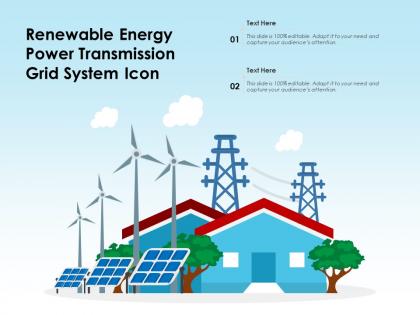
The image is a graphical representation of a renewable energy power transmission grid system icon. It features wind turbines and solar panels situated near a building, which indicates a focus on clean energy generation. Overhead power transmission towers suggest the distribution of electricity generated from these renewable sources. The design is simple yet effective at conveying the concept of sustainable energy infrastructure.
Use Cases:
The following industries could use this type of slide in their presentations:
1. Energy:
Use: To explain renewable energy integration into power grids
Presenter: Energy policy advocate or sustainability officer
Audience: Government officials, investors, or energy sector professionals
2. Education:
Use: For teaching students about renewable energy sources and infrastructure
Presenter: Educator or lecturer
Audience: Students or participants in educational programs
3. Environmental Consulting:
Use: To illustrate sustainable energy solutions to clients
Presenter: Environmental consultant
Audience: Corporate clients or environmental stakeholders
4. Infrastructure Development:
Use: To propose renewable energy projects in urban planning
Presenter: Urban planner or infrastructure developer
Audience: City council members or planning commission officials
5. Technology:
Use: To showcase innovations in renewable energy technology
Presenter: Tech entrepreneur or research scientist
Audience: Venture capitalists, industry peers, or researchers
6. Utility Companies:
Use: To communicate the transition towards renewable energy sources in services offered
Presenter: Utility company executive
Audience: Customers, shareholders, or regulatory bodies
7. Marketing and Advertising:
Use: To create campaigns promoting renewable energy products or services
Presenter: Marketing strategist or advertising creative
Audience: Potential customers or the general public
Renewable energy power transmission grid system icon with all 2 slides:
Use our Renewable Energy Power Transmission Grid System Icon to effectively help you save your valuable time. They are readymade to fit into any presentation structure.
FAQs for Renewable energy power transmission
Key components for a resilient renewable energy grid include smart inverters, energy storage systems, advanced forecasting technologies, grid-scale batteries, and flexible demand response mechanisms. These technologies enhance grid stability by managing variable renewable inputs, storing excess energy, and automatically balancing supply with demand, ultimately delivering reliable clean power and reduced operational costs.
Energy storage systems significantly enhance renewable energy grid efficiency by smoothing intermittency, enabling peak demand management, and optimizing resource allocation across transmission networks. Through advanced battery technologies and smart grid integration, utilities deliver more reliable power distribution, reduce operational costs, and maximize renewable asset utilization, ultimately providing customers with consistent energy access while minimizing grid instability.
Solar photovoltaic systems, wind turbines, hydroelectric power, battery storage technologies, and smart grid infrastructure represent the most integrated renewable sources in contemporary grid designs. These technologies enhance grid stability by providing distributed generation, real-time demand response, and energy storage capabilities, with utilities increasingly finding that strategic combinations deliver improved resilience and operational efficiency.
Grid interconnectivity enhances renewable energy reliability by enabling load balancing across regions, facilitating backup power sharing, and optimizing resource distribution during peak demand periods. Through smart grid technologies, utilities can seamlessly redirect power from wind-rich areas to solar-dependent regions, while interconnected systems deliver reduced outages, improved stability, and ultimately greater operational efficiency for energy providers.
Smart grids play a crucial role in managing renewable energy by enabling real-time monitoring, automated load balancing, predictive analytics, and seamless integration of distributed sources like solar and wind. These technologies streamline energy distribution by optimizing supply-demand matching, minimizing waste, and enhancing grid stability, with utility companies finding that smart infrastructure ultimately delivers improved efficiency and reduced operational costs.
Government policies significantly influence renewable energy grid development through financial incentives, regulatory frameworks, infrastructure investments, and market mechanisms like feed-in tariffs and renewable portfolio standards. These policies accelerate deployment by reducing financial barriers, streamlining permitting processes, and creating long-term market certainty, with many utilities and developers finding that supportive policy environments ultimately deliver faster grid modernization and enhanced energy security.
Rural renewable energy grids face infrastructure limitations, transmission distances, and maintenance accessibility challenges, while urban grids contend with space constraints, grid complexity, and higher demand variability. These geographic differences require tailored approaches, with rural areas needing robust transmission solutions and urban environments leveraging distributed generation, ultimately enabling both settings to optimize renewable integration and enhance energy resilience.
Community solar projects integrate into renewable energy grids through distributed energy management systems, smart inverters, grid-tie connections, and advanced metering infrastructure that enables bidirectional power flows. These installations streamline energy distribution by reducing transmission losses, enhancing grid resilience, and providing localized power generation, with many utilities finding that community solar delivers cost-effective renewable capacity while strengthening grid stability.
Emerging technologies include advanced energy storage systems, smart grid analytics, AI-powered demand forecasting, distributed energy resource management, and blockchain-based energy trading platforms. These innovations streamline grid stability by predicting energy fluctuations, automating load balancing, and optimizing storage deployment, with utilities increasingly finding that integrated smart systems deliver enhanced reliability and operational efficiency.
Renewable energy intermittency creates grid stability challenges through unpredictable power fluctuations, requiring advanced forecasting, energy storage systems, and demand response management to maintain consistent electricity supply. However, utilities increasingly leverage smart grid technologies, battery storage solutions, and predictive analytics to balance these variations, ultimately delivering more resilient energy networks while reducing operational costs and enhancing system reliability.
Smart grid technologies, advanced energy storage systems, demand response platforms, grid-scale battery installations, and predictive analytics are revolutionizing renewable integration capabilities. These innovations enhance grid stability by managing intermittency, optimizing energy distribution, and enabling real-time demand balancing, with utilities increasingly finding that modern grid infrastructure delivers improved reliability and operational efficiency.
International energy markets significantly influence renewable energy grid deployment through pricing dynamics, cross-border energy trading agreements, and investment flows that determine project feasibility. Fluctuating fossil fuel prices, international carbon credit systems, and regional energy partnerships create both competitive pressures and opportunities, with many countries finding that strategic market positioning and grid interconnection projects ultimately deliver energy security and economic advantages in an increasingly interconnected global landscape.
Grid retrofitting strategies include smart grid technology implementation, energy storage system integration, demand response programs, transmission line upgrades, and advanced forecasting systems. These approaches streamline renewable integration by enhancing grid flexibility, minimizing voltage fluctuations, and optimizing energy distribution, with many utilities finding that strategic combinations ultimately deliver improved operational efficiency and reduced carbon footprints.
Climate change significantly impacts renewable energy grid planning by requiring enhanced resilience measures, adaptive infrastructure designs, and diversified energy portfolios to withstand extreme weather patterns. Grid planners increasingly incorporate climate modeling, redundant transmission pathways, and weather-resistant technologies, with utilities in hurricane-prone regions and wildfire areas finding that strategic geographical distribution and advanced forecasting systems ultimately deliver more reliable renewable energy networks.
Microgrids in renewable energy systems offer enhanced energy independence, improved grid resilience, reduced transmission losses, localized power generation, and greater integration of solar and wind sources. While these systems deliver significant cost savings and sustainability benefits, they also present challenges including higher initial investment costs, complex management requirements, and integration complexities, with many communities finding that strategic implementation ultimately provides long-term competitive advantages.
-
Awesome use of colors and designs in product templates.
-
Unique and attractive product design.
-
Easily Understandable slides.