


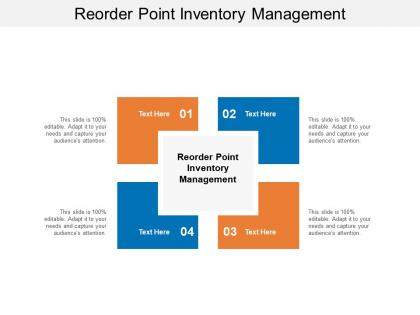
Reorder point inventory management ppt powerpoint presentation template cpb




Try Before you Buy Download Free Sample Product
 Impress Your
 Audience
 100%
100% Editable
 Save Hours
 of Time


Our Reorder Point Inventory Management Ppt Powerpoint Presentation Template Cpb are topically designed to provide an attractive backdrop to any subject. Use them to look like a presentation pro.
People who downloaded this PowerPoint presentation also viewed the following :
Reorder point inventory management ppt powerpoint presentation template cpb with all 2 slides:
Use our Reorder Point Inventory Management Ppt Powerpoint Presentation Template Cpb to effectively help you save your valuable time. They are readymade to fit into any presentation structure.
FAQs for Reorder point inventory management ppt powerpoint
The reorder point is the inventory level at which a new order should be placed to replenish stock before it runs out. It's crucial for inventory management because it helps prevent stockouts, which can disrupt operations, lose sales, and damage customer relationships. By establishing an optimal reorder point, businesses can balance holding costs with the risk of stockouts, ensuring a steady supply of materials while minimizing excess inventory.
Calculating the reorder point for a specific product involves determining the optimal time to replenish inventory to avoid stockouts. It considers factors like lead time, average daily demand, and safety stock. By analyzing historical sales data, businesses can estimate the average number of units sold daily and multiply that by the lead time in days to determine the reorder point. Adding a safety stock buffer accounts for unexpected demand fluctuations or delays in supply, ensuring sufficient inventory to meet customer needs even in challenging circumstances.
Setting an optimal reorder point involves considering lead time, demand variability, and safety stock needs. Lead time encompasses the duration between placing an order and receiving inventory, while demand variability reflects fluctuations in customer orders. Safety stock acts as a buffer against unexpected surges in demand or delays in supply, ensuring continuous operations even during disruptions. Financial services firms, for example, might prioritize a tighter reorder point to minimize holding costs while retail businesses might opt for a larger safety stock to mitigate stockouts during peak seasons.
Lead time directly influences the reorder point because it determines how long it takes for new inventory to arrive after an order is placed. A longer lead time necessitates a higher reorder point to ensure sufficient stock is available to meet demand during the extended waiting period, preventing stockouts and service disruptions. Many businesses, particularly those in retail and manufacturing, find that optimizing lead times and reorder points is crucial for maintaining operational efficiency and customer satisfaction.
Safety stock is a buffer of inventory held in reserve to mitigate the risk of stockouts due to unforeseen demand fluctuations or supply chain disruptions. It plays a crucial role in reorder point calculation by adding a cushion to the calculated reorder quantity, ensuring a sufficient inventory level is available even when lead times are longer than anticipated or demand spikes unexpectedly. This buffer enables businesses, particularly in sectors like retail and manufacturing, to maintain consistent operations and meet customer demands, ultimately minimizing lost sales and enhancing customer satisfaction.
Forecasting demand accurately helps optimize reorder points by predicting future needs and minimizing stockouts or overstocking. By analyzing historical sales data, market trends, and seasonality, businesses can establish reorder points that align with anticipated demand, ensuring sufficient inventory to meet customer needs while preventing excessive carrying costs. This strategic approach, often used in sectors like retail and manufacturing, enables organizations to streamline operations, enhance customer satisfaction, and ultimately improve profitability.
Reorder point inventory management software tools typically include inventory management systems (IMS), enterprise resource planning (ERP) software, and dedicated supply chain management (SCM) platforms. These tools streamline inventory tracking, automate reorder calculations, and provide real-time insights into stock levels, enabling businesses to optimize inventory turnover and minimize stockouts while reducing carrying costs. With many retailers and manufacturers finding that automated reorder points lead to improved operational efficiency, these solutions are increasingly adopted across various industries.
Businesses should review and adjust their reorder points regularly, ideally every [period, e.g., quarter or six months], to ensure optimal inventory levels. This dynamic process considers fluctuating demand patterns, lead times, and safety stock requirements, enabling businesses to minimize stockouts while preventing excess inventory and associated costs. In an increasingly volatile market, proactive reorder point management, with many retailers finding success through this approach, ultimately delivers operational efficiency and cost savings.
Setting a reorder point too high or too low can have significant consequences for inventory management. A reorder point that's too high can lead to excess inventory, tying up valuable capital and increasing storage costs, while a reorder point that's too low risks stockouts, lost sales, and damaged customer relationships. Organizations in manufacturing, for example, might experience production delays with a too-low reorder point, while retailers could face lost revenue and dissatisfied customers if they can't fulfill orders. Optimizing the reorder point requires careful analysis of demand patterns, lead times, and service level targets to strike a balance between minimizing inventory costs and ensuring product availability.
Reorder point inventory management involves determining the stock level at which a new order should be placed to avoid stockouts. While the fundamental concept remains consistent, the specific reorder point calculation varies significantly across industries due to differences in demand patterns, lead times, and operational complexities. For example, fast-moving consumer goods (FMCG) companies often have shorter lead times and higher demand variability, requiring more frequent reorder points compared to industries like heavy machinery manufacturing, which typically have longer lead times and more stable demand. These tailored approaches ensure optimal inventory levels, minimizing both stockouts and excess inventory costs, ultimately driving operational efficiency and customer satisfaction.
Reorder point inventory management involves setting a minimum inventory level that triggers a new order, helping businesses avoid stockouts and excess inventory. Many retail businesses, such as grocery stores and clothing retailers, have successfully implemented reorder point strategies to optimize their supply chains. For example, a supermarket chain might set a reorder point for milk based on historical sales data and delivery lead times, ensuring shelves are always stocked while minimizing spoilage.
Transitioning to a reorder point inventory system presents both challenges and opportunities for companies. While it can streamline inventory management and reduce carrying costs, businesses often face difficulties accurately forecasting demand, setting appropriate reorder points, and integrating the system with existing operations. Financial services companies, for example, may struggle with fluctuating customer demand, while manufacturers dealing with complex supply chains might find it challenging to account for lead times and potential disruptions. Successfully implementing a reorder point system requires careful planning, data analysis, and ongoing monitoring to optimize inventory levels and minimize stockouts or overstocking.
Seasonality and trends directly impact reorder point calculations by influencing demand fluctuations. While a stable demand pattern might call for a fixed reorder point, businesses experiencing seasonal peaks or emerging trends need to adjust their calculations accordingly. For example, a retailer anticipating a surge in demand for winter clothing would raise their reorder point during the fall, while a company selling summer products would lower it during the off-season. This dynamic approach ensures inventory levels align with anticipated demand, minimizing stockouts during peak periods and excess inventory during lulls.
Reorder point inventory management involves monitoring several key metrics beyond the reorder point itself to ensure optimal stock levels. These metrics include inventory turnover, lead time, safety stock, and demand variability. By analyzing these metrics, businesses can fine-tune reorder points, minimize stockouts and excess inventory, and ultimately enhance operational efficiency and customer satisfaction.
Combining just-in-time inventory practices with reorder point systems offers several advantages for businesses. These approaches streamline operations by minimizing warehousing costs, reducing storage space requirements, and enabling quicker response times to fluctuating demand. By optimizing inventory levels, organizations can enhance operational efficiency, minimize stockouts, and ultimately deliver cost savings and improved customer satisfaction.
No Reviews