


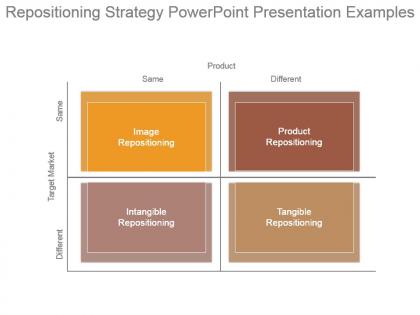
Repositioning strategy powerpoint presentation examples




Try Before you Buy Download Free Sample Product
 Impress Your
 Audience
 100%
100% Editable
 Save Hours
 of Time


Effectively argue your case with our Repositioning Strategy Powerpoint Presentation Examples. Folks are bound to give consent.
People who downloaded this PowerPoint presentation also viewed the following :
Repositioning strategy powerpoint presentation examples with all 7 slides:
Fight back hard with our Repositioning Strategy Powerpoint Presentation Examples. The advantage will be yours again.
FAQs for Repositioning strategy
Key elements include market research and competitor analysis, target audience redefinition, brand messaging evolution, visual identity updates, and stakeholder alignment across all touchpoints. These components work together by ensuring strategic consistency, validating market opportunities, and maintaining brand authenticity, with many organizations finding that successful repositioning ultimately delivers enhanced market relevance and competitive differentiation.
Market research informs repositioning by revealing customer perceptions, competitor positioning, market gaps, emerging trends, and target audience preferences through surveys, focus groups, and competitive analysis. Through comprehensive market insights, companies can identify strategic opportunities, validate repositioning concepts, and measure brand perception shifts, ultimately enabling data-driven positioning decisions that resonate with target markets and deliver competitive advantage.
Customer feedback serves as the foundation for effective repositioning strategies by revealing market perceptions, identifying unmet needs, highlighting competitive gaps, and validating messaging resonance. Through surveys, focus groups, and social listening, companies can uncover authentic customer pain points and preferences, enabling them to craft repositioning approaches that truly resonate with target audiences, ultimately delivering stronger market positioning and enhanced competitive advantage.
Changes in consumer behavior directly drives repositioning needs by shifting preferences, expectations, and purchasing patterns that can render current brand positioning obsolete or less relevant. When consumers increasingly prioritize sustainability, digital experiences, or value-focused offerings, companies must realign their messaging, product features, and market positioning to maintain competitive advantage, with many retail and automotive brands finding that proactive repositioning delivers enhanced customer loyalty and market share growth.
Common repositioning pitfalls include insufficient market research, unclear messaging that confuses customers, rushing timelines without proper testing, alienating existing loyal customers, and inconsistent execution across all touchpoints. Many companies also underestimate resource requirements or fail to secure internal buy-in, with retail and technology firms finding that successful repositioning requires sustained commitment, comprehensive stakeholder alignment, and careful balance between innovation and brand equity preservation.
Digital marketing and social media insights enhance repositioning strategies by providing real-time consumer sentiment analysis, demographic targeting data, and competitive landscape mapping through analytics platforms. These insights enable brands to identify market gaps, test messaging effectiveness across different audience segments, and monitor repositioning campaign performance, ultimately delivering more precise brand positioning and faster market adaptation in an increasingly data-driven business environment.
Repositioning strategy enhances customer loyalty by realigning brand perception with evolving customer values, improving product-market fit, and creating stronger emotional connections through refined messaging and positioning. Through strategic repositioning, companies like Apple transitioning from computers to lifestyle technology or McDonald's emphasizing fresh ingredients have successfully deepened customer relationships, increased engagement rates, and ultimately delivered sustained competitive advantage in increasingly crowded markets.
Companies should measure repositioning success through brand perception surveys, market share analysis, customer acquisition metrics, revenue growth from target segments, and competitive positioning studies. These measurements enable organizations to track shifts in customer attitudes, monitor market penetration in new segments, and assess whether repositioning delivers enhanced competitive advantage, ultimately ensuring strategic objectives align with measurable business outcomes.
Repositioning significantly transforms a company's marketing strategy by requiring new messaging frameworks, updated target audience definitions, revised competitive positioning, and altered channel strategies. This strategic shift enables organizations to capture different market segments, differentiate from competitors more effectively, and align communications with evolved business objectives, ultimately delivering enhanced brand relevance and competitive advantage.
Storytelling enhances repositioning strategy by creating emotional connections, simplifying complex brand changes, and making new positioning memorable through relatable narratives. These stories humanize brand transformation by showcasing customer journeys, highlighting problem-solving capabilities, and demonstrating authentic value propositions, with many organizations finding that narrative-driven campaigns increase audience engagement and accelerate market acceptance.
**INPUT**: What are the best practices for communicating a brand's new positioning to stakeholders? **OUTPUT**: Best practices include developing clear messaging frameworks, conducting stakeholder-specific presentations, creating comprehensive training materials, implementing phased communication rollouts, and establishing feedback mechanisms. These approaches streamline alignment by ensuring consistent understanding across departments, enabling seamless implementation, and maintaining stakeholder buy-in, with many organizations finding that structured communication sequences ultimately deliver faster adoption and stronger market repositioning success. **Word count: 60 words**
Companies can differentiate themselves during repositioning by identifying unique value propositions, targeting underserved market segments, emphasizing distinctive capabilities, and communicating authentic brand stories that resonate with specific audiences. Through strategic messaging and competitive analysis, businesses in sectors like retail and technology streamline market positioning, enhance customer perception, and ultimately deliver stronger brand recognition while capturing previously untapped opportunities.
Visual identity serves as the primary vehicle for communicating repositioning changes through logos, color schemes, typography, packaging design, and brand imagery that reflect new market positioning. These visual elements enable companies to signal transformation to customers, differentiate from competitors, and reinforce new brand messages across touchpoints, with many organizations finding that cohesive visual redesigns accelerate market acceptance and strengthen repositioning efforts.
Partnerships and collaborations aid brand repositioning by providing access to new audiences, enhancing credibility through association, and leveraging complementary strengths to reinforce desired brand attributes. Through strategic alliances, companies can accelerate market penetration, share repositioning costs, and gain valuable customer insights, with many organizations finding that collaborative approaches deliver faster brand transformation and stronger competitive positioning.
Indicators include declining market share, changing consumer preferences, increased competition, outdated brand perception, and shifts in industry trends or demographics. These warning signs often manifest when brands struggle to differentiate themselves, experience reduced customer loyalty, or find their messaging no longer resonates, with many organizations discovering that proactive repositioning delivers renewed relevance and competitive advantage.
-
Enough space for editing and adding your own content.
-
Unique research projects to present in meeting.