


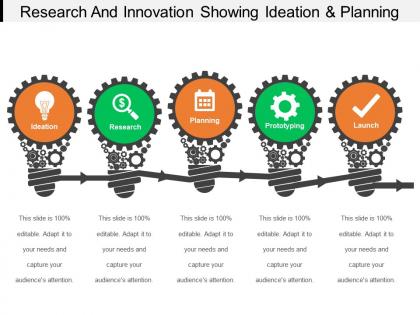
Research and innovation showing ideation and planning




Try Before you Buy Download Free Sample Product
 Impress Your
 Audience
 100%
100% Editable
 Save Hours
 of Time


Our Research And Innovation Showing Ideation And Planning ensure eyeballs are glued. Their attractive designs are fascinating.
People who downloaded this PowerPoint presentation also viewed the following :
Research and innovation showing ideation and planning with all 5 slides:
Deliver good financial advice with our Research And Innovation Showing Ideation And Planning. Enable folks to handle the effects of inflation.



FAQs for Research and innovation showing
Key trends driving research and innovation include artificial intelligence integration, sustainability-focused solutions, digital transformation acceleration, biotechnology advancement, and collaborative cross-sector partnerships. These developments streamline operations, enhance decision-making capabilities, and deliver competitive advantages across industries like healthcare, manufacturing, and financial services, with many organizations finding that strategic innovation investments ultimately reduce costs while improving customer experiences and market positioning.
Organizations foster innovation culture through open communication channels, cross-functional collaboration, dedicated time for experimental projects, risk tolerance policies, and recognition systems for creative contributions. Through strategic resource allocation and flexible research environments, teams can explore unconventional approaches, with many technology companies and pharmaceutical organizations finding that autonomy combined with clear innovation metrics ultimately delivers breakthrough discoveries and sustained competitive advantage.
Collaboration enhances research outcomes by combining diverse expertise, sharing resources, accelerating discovery timelines, and reducing development costs across organizations. Through strategic partnerships, research institutions, pharmaceutical companies, and technology firms leverage complementary strengths, access broader datasets, and minimize redundant efforts, ultimately delivering breakthrough innovations and competitive advantages in increasingly complex markets.
AI and machine learning revolutionize research methodologies by automating data collection, accelerating pattern recognition, and enabling predictive modeling at unprecedented scales. These technologies streamline hypothesis testing, enhance statistical analysis, and facilitate real-time insights across sectors like pharmaceuticals, finance, and healthcare, ultimately delivering faster discoveries and more robust conclusions.
Ethical considerations include informed consent protocols, data privacy protection, equitable access to treatments, risk-benefit assessment frameworks, and regulatory compliance standards. These safeguards enhance research integrity by ensuring patient safety, maintaining public trust, and promoting responsible innovation, with many medical institutions finding that robust ethical frameworks ultimately accelerate breakthrough discoveries while protecting vulnerable populations.
Intellectual property rights present both challenges and opportunities for research innovation, as they incentivize investment through patent protection while potentially slowing knowledge sharing and collaborative development. These frameworks enable organizations to secure competitive advantages and funding for breakthrough technologies, with many research institutions and pharmaceutical companies finding that strategic IP management ultimately accelerates market-ready innovations.
Metrics for measuring research and innovation's societal impact include economic indicators like GDP growth and job creation, health outcomes such as disease reduction rates, educational advancement measures, environmental sustainability indices, and quality of life assessments. These comprehensive evaluations enable organizations to demonstrate tangible value through improved healthcare delivery, enhanced educational access, and streamlined public services, ultimately delivering measurable social progress and competitive advantage for innovative institutions.
Funding agencies can better support innovative research by offering flexible grant structures, multi-year funding commitments, interdisciplinary collaboration incentives, and streamlined application processes that reduce administrative burden. These approaches enable researchers to pursue breakthrough discoveries while fostering cross-sector partnerships, with many institutions finding that sustained funding ultimately delivers faster innovation cycles and stronger competitive advantages.
Universities and industry partners collaborate effectively through joint research initiatives, shared funding models, technology transfer offices, co-located innovation hubs, and structured intellectual property agreements. These partnerships streamline the path from laboratory to market by combining academic expertise with commercial insights, regulatory knowledge, and distribution channels, with many institutions finding that embedded industry liaisons and milestone-based development frameworks ultimately deliver faster innovation cycles and stronger competitive positioning.
Researchers face challenges including intense competition for limited grants, lengthy application processes, risk-averse funding committees, unclear evaluation criteria, and pressure for immediate commercial viability. These obstacles often discourage groundbreaking research, with many institutions finding that strategic partnerships with private sectors and government initiatives help streamline funding access while enabling researchers to pursue transformative innovations.
Open-source research accelerates global innovation by enabling collaborative knowledge sharing, reducing research duplication, and democratizing access to scientific discoveries across institutions worldwide. Through platforms facilitating transparent data exchange, universities, pharmaceutical companies, and technology firms streamline development cycles, minimize costs, and enhance breakthrough potential, ultimately delivering faster solutions to complex challenges.
Researchers can communicate innovative findings through visual presentations, plain-language summaries, social media engagement, industry partnerships, and public speaking opportunities. These strategies streamline complex concepts by eliminating jargon, incorporating storytelling elements, and focusing on practical applications, with many academic institutions finding that multimedia approaches and sector-specific case studies ultimately deliver broader impact and enhanced knowledge transfer.
Diverse research teams drive innovation by combining varied perspectives, experiences, cultural backgrounds, methodologies, and problem-solving approaches that challenge conventional thinking. These multidisciplinary collaborations enhance creativity and reduce groupthink, with many pharmaceutical companies, technology firms, and academic institutions finding that inclusive teams consistently develop more breakthrough solutions, identify overlooked market opportunities, and ultimately deliver competitive advantages through comprehensive innovation strategies.
Government policies significantly impact research funding through budget allocations, tax incentives, grant programs, regulatory frameworks, and public-private partnerships. These policies enable organizations to accelerate innovation timelines, reduce development costs, and enhance competitive positioning, with many institutions finding that strategic policy alignment delivers sustained research capabilities and breakthrough discoveries across sectors.
Integrating sustainability into research and innovation requires embedding environmental and social considerations throughout project lifecycles, from initial design to implementation and evaluation. Organizations achieve this by establishing green innovation frameworks, incorporating circular economy principles, partnering with sustainability-focused institutions, and measuring long-term environmental impact, ultimately delivering competitive advantage while meeting increasingly stringent regulatory requirements.
-
The Designed Graphic are very professional and classic.
-
Graphics are very appealing to eyes.