


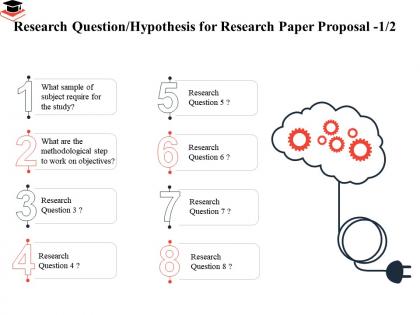
Research question hypothesis for research paper proposal work objectives ppt example file




Try Before you Buy Download Free Sample Product
 Impress Your
 Audience
 100%
100% Editable
 Save Hours
 of Time


Our Research Question Hypothesis For Research Paper Proposal Work Objectives Ppt Example File are topically designed to provide an attractive backdrop to any subject. Use them to look like a presentation pro.
People who downloaded this PowerPoint presentation also viewed the following :
Research question hypothesis for research paper proposal work objectives ppt example file with all 2 slides:
Use our Research Question Hypothesis For Research Paper Proposal Work Objectives Ppt Example File to effectively help you save your valuable time. They are readymade to fit into any presentation structure.
FAQs for Research question hypothesis for research paper proposal work objectives
A well-formulated research question demonstrates specificity, feasibility, relevance, and clarity while addressing a significant gap in existing knowledge. These characteristics enable researchers to design focused methodologies, collect meaningful data, and generate actionable insights, with academic institutions and industry organizations finding that precise questions ultimately streamline research processes and deliver more impactful, measurable outcomes.
The specificity of a research question directly determines methodology selection, sample size requirements, data collection methods, and analytical approaches needed for valid conclusions. A narrowly focused question enables targeted experimental designs and precise measurements, while broader questions require comprehensive frameworks, larger samples, and mixed methodologies, with many researchers finding that overly broad questions compromise study feasibility and analytical depth.
Literature review serves as the foundation for refining research questions by identifying knowledge gaps, revealing methodological approaches, highlighting conflicting findings, and establishing theoretical frameworks that guide inquiry direction. Through systematic examination of existing studies, researchers can narrow overly broad questions, strengthen weak hypotheses, and position their work strategically within academic discourse, ultimately delivering more focused investigations and significant contributions to their field.
Research paradigms significantly influence hypothesis development by shaping methodological approaches, data interpretation frameworks, and analytical perspectives. Positivist paradigms typically generate testable, quantitative hypotheses focused on measurable relationships, while interpretive paradigms develop exploratory propositions examining human behavior and social contexts, with mixed-methods research increasingly combining both approaches to deliver comprehensive insights and strategic understanding across diverse organizational studies.
A poorly constructed hypothesis can skew research findings through confirmation bias, inadequate variable definition, overly narrow scope, and flawed causal assumptions. These methodological weaknesses lead researchers to misinterpret data, overlook critical variables, and draw invalid conclusions, with many academic institutions and research organizations finding that hypothesis refinement ultimately delivers more accurate insights and reliable outcomes.
Researchers can ensure testable hypotheses by defining clear, measurable variables, establishing specific operational definitions, creating observable predictions, and designing controlled experimental conditions. Through systematic variable identification, precise measurement criteria, and structured testing protocols, research teams streamline validation processes while minimizing ambiguity, with many academic institutions finding that well-defined hypotheses ultimately deliver more reliable results and enhanced research credibility.
Variable independence and dependence directly determine hypothesis structure by establishing clear cause-and-effect relationships, with independent variables serving as predictors and dependent variables as measured outcomes. This framework enables researchers to formulate testable predictions about how manipulating specific factors influences results, with many academic institutions and research organizations finding that well-defined variable relationships ultimately deliver more rigorous studies and actionable insights.
Ethical considerations in developing research questions and hypotheses include ensuring participant safety, obtaining informed consent, maintaining confidentiality, avoiding bias, and respecting cultural sensitivities. These principles guide researchers by promoting transparency, protecting vulnerable populations, and ensuring data integrity, with many academic institutions and healthcare organizations finding that ethical frameworks ultimately enhance research credibility and stakeholder trust.
Interdisciplinary approaches enhance research question formulation by integrating diverse methodologies, theoretical frameworks, and analytical perspectives from multiple fields, creating more comprehensive and nuanced inquiries. These collaborative methods enable researchers to address complex problems through varied lenses, with fields like healthcare, environmental science, and business strategy finding that cross-disciplinary questions ultimately deliver deeper insights and more innovative solutions.
Research question feasibility depends on resource availability, timeline constraints, access to data or participants, ethical considerations, and methodological requirements. Researchers must evaluate whether they possess necessary expertise, funding, and institutional support, while considering scope manageability and potential barriers, with many academic institutions finding that preliminary feasibility assessments significantly enhance project success rates and research outcomes.
Context and population characteristics fundamentally shape research question relevance by determining applicability, generalizability, and practical value across different settings and demographics. Cultural factors, socioeconomic conditions, geographic locations, and population-specific traits influence how findings translate into actionable insights, with many researchers finding that questions designed for specific contexts ultimately deliver more meaningful outcomes and strategic research advantages.
Research question assessment methods include peer review consultations, the FINER criteria evaluation, specificity analysis, feasibility studies, and alignment checks with research objectives. These approaches streamline question refinement by identifying scope issues, methodological constraints, and measurable outcomes, with many academic institutions and research organizations finding that systematic evaluation processes ultimately deliver more focused investigations and stronger analytical frameworks.
Pilot studies enhance research question and hypothesis refinement by revealing methodological gaps, identifying measurement issues, and exposing unforeseen variables that require adjustment. Through small-scale testing, researchers streamline data collection procedures, validate survey instruments, and refine theoretical assumptions, with many academic institutions and corporate research teams finding that pilot phases ultimately deliver more focused hypotheses and significantly improved study designs.
Aligning research questions with research objectives ensures focused methodology, efficient resource allocation, and meaningful outcomes that directly address the study's core purpose. This strategic alignment enables researchers across academic institutions, healthcare organizations, and corporate environments to streamline data collection, minimize scope creep, and deliver actionable insights, ultimately enhancing research validity and practical applicability.
Research questions and hypotheses naturally evolve through iterative refinement as preliminary data reveals unexpected patterns, identifies new variables, or challenges initial assumptions about relationships between factors. This adaptive approach enables researchers to refine their focus, adjust methodological approaches, and develop more targeted hypotheses, with many finding that flexibility ultimately delivers more robust and meaningful research outcomes.
-
Informative presentations that are easily editable.