


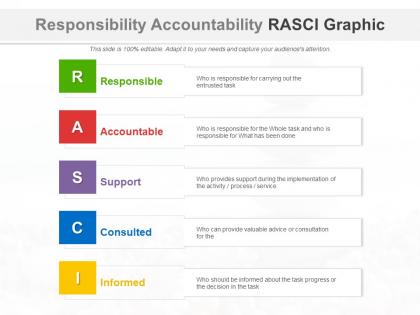
Responsibility accountability rasci graphic




Try Before you Buy Download Free Sample Product
 Impress Your
 Audience
 100%
100% Editable
 Save Hours
 of Time


Inspire a burning desire to achieve with our Responsibility Accountability RASCI Graphic. It will fan the intensity.
People who downloaded this PowerPoint presentation also viewed the following :
Responsibility accountability rasci graphic with all 5 slides:
Be an effective intermediary with our Responsibility Accountability RASCI Graphic. Get folks to agree to a common agenda.




FAQs for Responsibility
Key components of personal responsibility in professional settings include accountability for decisions, ownership of mistakes, proactive communication, meeting deadlines consistently, and maintaining ethical standards. These elements enhance workplace trust and efficiency by fostering transparent collaboration, reducing supervisory overhead, and building stronger team dynamics, with many organizations finding that responsible employees drive innovation and deliver superior customer experiences.
Organizations foster accountability by establishing clear expectations, implementing regular performance reviews, creating transparent communication channels, and linking individual goals to company objectives. Through structured feedback systems and recognition programs, companies across sectors like healthcare and finance find that employees take greater ownership of outcomes, ultimately delivering improved performance, stronger team collaboration, and enhanced operational efficiency.
Responsibility can be integrated into leadership training through scenario-based decision making, accountability frameworks, ethical case studies, mentorship programs, and real-world project ownership. These approaches enable leaders to practice stakeholder management, transparent communication, and consequence ownership, with many organizations finding that hands-on responsibility exercises ultimately enhance decision-making capabilities and build sustainable leadership effectiveness.
Social responsibility significantly enhances brand reputation by demonstrating authentic commitment to societal values, environmental stewardship, and ethical business practices, which resonates strongly with modern consumers. Companies implementing robust CSR initiatives, particularly in retail, technology, and financial services, consistently experience increased customer trust, improved brand perception, and stronger emotional connections, ultimately delivering enhanced loyalty and competitive differentiation.
Ethics establishes the moral framework guiding responsible business decisions, defining acceptable practices, stakeholder obligations, and accountability standards across operations. This foundation enables organizations to navigate complex situations involving customer data, environmental impact, and employee welfare, while building trust and sustainable competitive advantage in increasingly conscious markets.
Individuals can balance personal and professional obligations through strategic time management, clear boundary setting, effective delegation, and open communication with stakeholders about priorities and limitations. While this requires consistent effort and occasional trade-offs, many professionals find that structured scheduling, technology tools for efficiency, and regular reassessment of commitments ultimately delivers reduced stress, improved relationships, and enhanced performance across both domains.
Lack of responsibility in teams creates missed deadlines, decreased accountability, reduced trust among members, finger-pointing, and declining overall performance. These breakdowns particularly impact project-based environments like consulting firms, healthcare teams, and manufacturing operations, where interdependence is critical, ultimately eroding team cohesion and organizational effectiveness while increasing operational costs.
Educational institutions can teach civic responsibility through community service programs, mock elections, debate clubs, volunteer partnerships with local organizations, and project-based learning focused on social issues. These approaches enable students to experience democratic participation firsthand while developing critical thinking skills, with many schools finding that combining classroom theory with real-world civic engagement ultimately delivers more informed citizens and stronger community connections.
Businesses can enhance CSR efforts through stakeholder engagement, environmental sustainability initiatives, ethical supply chain practices, community investment programs, and transparent impact reporting. These strategies deliver competitive advantage by building brand trust, attracting top talent, and improving customer loyalty, with many organizations finding that comprehensive CSR programs ultimately drive both social impact and long-term profitability.
Cultural differences significantly influence workplace responsibility perceptions through varying attitudes toward hierarchy, individual versus collective accountability, communication styles, and decision-making processes. In hierarchical cultures like Japan, responsibility flows upward through management chains, while individualistic cultures like the US emphasize personal accountability, with many organizations finding that understanding these differences enhances team collaboration and operational efficiency.
**INPUT**: What are the long-term benefits of practicing environmental responsibility for companies? **OUTPUT**: Environmental responsibility delivers cost reduction through energy efficiency, enhanced brand reputation, regulatory compliance advantages, improved stakeholder relationships, and access to sustainable financing options. Companies across manufacturing, retail, and financial services find that these practices ultimately drive competitive advantage, attract top talent, and create operational resilience while positioning them favorably in increasingly environmentally-conscious markets. **Word count: 54 words**
Technology can promote responsibility through sustainability tracking systems, automated compliance monitoring, transparent supply chain management, and real-time impact reporting tools. These solutions enable organizations to measure environmental footprints, ensure regulatory adherence, and demonstrate accountability to stakeholders, with many companies finding that integrated responsibility platforms enhance operational transparency while delivering competitive advantage in increasingly conscious markets.
**INPUT**: What frameworks can be used to assess the level of responsibility in different industries? **OUTPUT**: Responsibility assessment frameworks include ESG (Environmental, Social, Governance) metrics, ISO 26000 social responsibility standards, GRI sustainability reporting guidelines, B-Corp certification criteria, and industry-specific compliance frameworks. These methodologies enable organizations across sectors like manufacturing, financial services, and healthcare to measure accountability through stakeholder impact analysis, transparency reporting, and ethical performance indicators, ultimately delivering competitive advantage and enhanced stakeholder trust.
Effective communication enhances responsible decision-making by ensuring stakeholders have access to complete information, diverse perspectives, and transparent processes. Through open dialogue and structured feedback mechanisms, organizations can identify potential risks, address ethical considerations, and build consensus around sustainable solutions, ultimately delivering more thoughtful outcomes and stronger stakeholder trust.
Responsibility in crisis management implies clear accountability chains, transparent decision-making processes, stakeholder communication protocols, resource allocation authority, and post-crisis evaluation frameworks. These elements enable organizations to respond swiftly while maintaining public trust, with many financial institutions and healthcare systems finding that defined responsibility structures minimize response delays, enhance coordination effectiveness, and ultimately strengthen organizational resilience.
No Reviews