


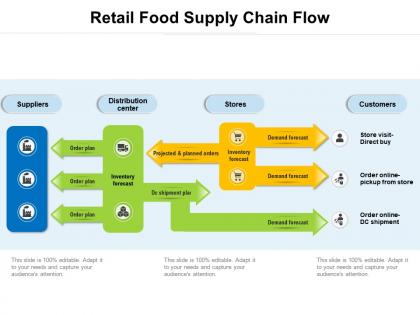
Retail food supply chain flow




Try Before you Buy Download Free Sample Product
 Impress Your
 Audience
 100%
100% Editable
 Save Hours
 of Time


Our Retail Food Supply Chain Flow are topically designed to provide an attractive backdrop to any subject. Use them to look like a presentation pro.
People who downloaded this PowerPoint presentation also viewed the following :
Retail food supply chain flow with all 2 slides:
Use our Retail Food Supply Chain Flow to effectively help you save your valuable time. They are readymade to fit into any presentation structure.
FAQs for Retail food
The retail food supply chain faces challenges like ensuring food safety and security across complex networks, managing fluctuating demand and unpredictable events, and optimizing logistics for efficiency and sustainability. These factors present both challenges and opportunities for retailers, as they leverage technology and data analytics to streamline processes, enhance transparency, and ultimately deliver fresher, safer food to consumers while minimizing waste and costs.
Technology can significantly enhance product traceability in the retail food supply chain by implementing blockchain, RFID tags, and sensor networks. These technologies track products from farm to shelf, providing real-time visibility into their journey, enabling faster identification and recall of potentially contaminated goods, and ultimately improving food safety and consumer trust. With many retailers finding that increased transparency leads to stronger brand loyalty, this technology allows for a more resilient and accountable food system.
Consumer demand significantly shapes retail food supply chain dynamics by driving product assortment, inventory levels, and logistical operations. For instance, surging demand for organic produce prompts retailers to source more from specialized farms, while increased preference for local products encourages partnerships with regional suppliers, ultimately impacting transportation routes and delivery schedules.
Sustainability practices play a crucial role in optimizing the retail food supply chain by reducing waste, minimizing environmental impact, and enhancing brand reputation. These practices encompass everything from efficient transportation and storage to ethical sourcing and packaging, ultimately leading to cost savings, improved customer loyalty, and a more resilient supply chain that can adapt to evolving consumer demands and regulations.
Balancing cost efficiency with quality in retail food supply chains requires a strategic combination of technologies and operational practices. Retailers can streamline logistics by leveraging data analytics to optimize routes and inventory management, minimizing waste and transportation costs. Simultaneously, investing in blockchain technology can enhance traceability and transparency, ensuring product quality and safety while building consumer trust. This dual approach not only reduces expenses but also strengthens brand reputation and customer loyalty, ultimately leading to increased profitability.
The COVID-19 pandemic significantly disrupted the retail food supply chain structure, presenting both challenges and opportunities. Increased demand for online grocery shopping accelerated the adoption of e-commerce solutions, while labor shortages and logistical bottlenecks highlighted the need for greater supply chain resilience. Many retailers, particularly in the grocery sector, found that streamlining logistics, optimizing inventory management, and strengthening partnerships with suppliers were crucial for navigating these disruptions and ultimately delivering seamless customer experiences.
The integration of AI and machine learning significantly improves inventory management in retail food supply chains by optimizing stock levels, predicting demand, and minimizing waste. Through advanced algorithms, AI analyzes historical sales data, seasonal trends, and external factors like weather patterns to forecast future demand with greater accuracy. This allows retailers to proactively adjust inventory levels, ensuring products are available when needed while reducing overstocking and spoilage, ultimately leading to cost savings and improved customer satisfaction.
Best practices for ensuring food safety throughout the retail food supply chain include rigorous supplier vetting, implementation of robust temperature control measures, adherence to strict sanitation protocols, comprehensive traceability systems, and ongoing employee training. These practices minimize contamination risks, ensure product integrity, and ultimately deliver safe and wholesome food to consumers, building trust and loyalty in an increasingly health-conscious market.
Collaboration with local producers can significantly enhance the resilience of the retail food supply chain by diversifying sourcing, reducing reliance on long-distance transportation, and shortening lead times. Through partnerships with local farms and suppliers, retailers can mitigate disruptions caused by weather events, geopolitical instability, or logistical bottlenecks, ultimately ensuring a more stable and reliable supply of fresh produce and other essential food items. These localized networks foster greater transparency and traceability, while also empowering local economies and supporting sustainable agricultural practices.
Strategies to mitigate food waste in the retail food supply chain include optimizing inventory management systems, implementing smart storage technologies, leveraging data analytics for demand forecasting, and promoting consumer awareness campaigns. These practices help reduce overstocking, spoilage, and consumer waste, ultimately leading to cost savings, improved sustainability, and enhanced brand reputation, with many retailers finding that reducing food waste significantly improves operational efficiency and customer perception.
Regulatory compliance issues, such as food safety standards and traceability requirements, can significantly impact the efficiency of the retail food supply chain. These regulations necessitate meticulous documentation, rigorous inspections, and robust tracking systems, which can increase operational costs and processing times. For instance, implementing blockchain technology to ensure product traceability can streamline processes and reduce delays, while simultaneously enhancing consumer trust and meeting compliance mandates.
Retailers should focus on metrics like order fill rate, inventory turnover, shelf-space availability, and delivery lead times to assess their food supply chain performance. These metrics, when analyzed together, paint a comprehensive picture of efficiency, stock management, and customer satisfaction, enabling retailers to identify bottlenecks and optimize processes for improved operational efficiency and ultimately, increased profitability.
Omnichannel retailing reshapes the traditional food supply chain by streamlining inventory management, optimizing delivery routes, and personalizing the customer experience. Through integrated online and offline channels, retailers can gather real-time demand data, enabling agile adjustments to sourcing and distribution, ultimately reducing waste and delivering fresher products directly to consumers. With many grocery chains finding success in this model, omnichannel retailing presents a strategic opportunity to enhance operational efficiency and customer satisfaction, ultimately leading to increased market share and profitability.
Consumer transparency plays a crucial role in building trust within the retail food supply chain by providing insights into sourcing, production, and handling practices. This empowers consumers to make informed choices, fostering confidence in the safety and quality of the food they purchase. With many retailers now offering detailed product information, traceability features, and ethical sourcing certifications, consumers can directly connect with the origins of their food, leading to increased brand loyalty and a strengthened sense of shared responsibility.
Data analytics empowers retailers to optimize demand forecasting in the food supply chain by analyzing historical sales data, weather patterns, social media trends, and promotional campaigns. Through predictive modeling, retailers can identify patterns and correlations, enabling them to anticipate future demand with greater accuracy. This, in turn, leads to reduced food waste, minimized stockouts, and improved inventory management, ultimately enhancing operational efficiency and customer satisfaction.
No Reviews