


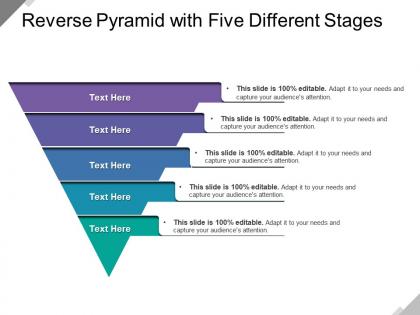
Reverse pyramid with five different stages




Try Before you Buy Download Free Sample Product
 Impress Your
 Audience
 100%
100% Editable
 Save Hours
 of Time


Earth is your arena with our Reverse Pyramid With Five Different Stages. They are applicable anywhere.
People who downloaded this PowerPoint presentation also viewed the following :
Reverse pyramid with five different stages with all 5 slides:
Focus on irrational beliefs with our Reverse Pyramid With Five Different Stages. Address the cause of illogical conclusions.


FAQs for Reverse pyramid with
The reverse pyramid structure presents information in descending order of importance, starting with key conclusions, main findings, or critical recommendations before providing supporting details and background context. This approach proves particularly effective in executive presentations, project updates, and client proposals, where decision-makers need immediate access to essential insights, enabling faster strategic decisions and maintaining audience engagement throughout complex business communications.
The reverse pyramid structure enhances audience engagement by delivering key findings first, creating immediate value and attention retention, followed by supporting details and background context. This approach mirrors modern information consumption patterns, with many presenters finding that audiences stay more focused when critical insights are front-loaded, ultimately reducing cognitive load and increasing message retention.
Presentations that benefit from reverse pyramid structure include executive briefings, crisis communications, project status updates, sales pitches, and research findings. This approach proves particularly effective for board meetings, investor presentations, and client consultations, where busy stakeholders need immediate key insights, with many organizations finding that leading with conclusions significantly improves decision-making speed and audience engagement.
The reverse pyramid structure delivers immediate impact by presenting key conclusions first, enabling faster decision-making, enhanced audience retention, and clearer message prioritization compared to traditional build-up formats. This approach streamlines executive presentations, investor pitches, and client proposals by frontloading critical insights, with many organizations finding that audiences stay engaged longer and absorb essential information more effectively.
The reverse pyramid structure facilitates better information retention by presenting the most critical information first, followed by supporting details and background context. This approach enables audiences to grasp key messages immediately, process information hierarchically, and retain essential points even with limited attention spans, with many presenters finding that audiences demonstrate significantly improved recall and engagement when core concepts are frontloaded strategically.
Visual aids within reverse pyramid structures enhance comprehension by reinforcing key messages upfront, supporting detailed explanations with charts and infographics, and providing visual breaks between information layers. These elements streamline complex data presentation, enable faster audience processing, and maintain engagement throughout the progression, with many presenters finding that strategic visual placement ultimately delivers clearer communication and stronger audience retention.
Potential challenges include audience confusion from unconventional flow, difficulty maintaining engagement after revealing key points early, reduced narrative tension, and presenter struggles with transitioning between inverted sections. While this structure delivers immediate clarity and suits time-constrained business environments, many organizations find that combining reverse pyramid openings with traditional storytelling elements ultimately enhances audience retention and decision-making effectiveness.
**INPUT**: How can speakers effectively transition between different sections of content within the reverse pyramid framework? **OUTPUT**: Speakers effectively transition within reverse pyramid frameworks by using clear signaling phrases, summarizing key points before moving deeper, and maintaining logical flow through connecting statements. These techniques help audiences follow the progression from broad conclusions to detailed evidence, with many presenters finding that explicit transitions like "diving deeper into this data" or "examining the underlying factors" enhance comprehension and engagement. [Word count: 60]
Storytelling in reverse pyramid presentations serves as compelling evidence and emotional reinforcement after delivering key conclusions upfront. While the structure prioritizes immediate impact through main points first, strategic narratives, case studies, and real-world examples enhance audience engagement, making abstract concepts tangible and memorable, ultimately strengthening persuasion and retention.
The reverse pyramid structure adapts to executives through ultra-concise conclusions and strategic implications upfront, while student versions require foundational context and detailed explanations following the main points. Executives benefit from immediate actionable insights and competitive advantages, whereas students need comprehensive background information and step-by-step reasoning, with both approaches ultimately delivering enhanced comprehension and practical application tailored to their decision-making needs.
Common pitfalls include overwhelming audiences with too much detail upfront, failing to create logical flow between supporting points, and neglecting to reinforce key messages throughout the presentation. Many organizations find that rushing through conclusions without adequate context, burying critical data in later slides, and losing audience engagement through poor transitions ultimately undermines the structure's effectiveness and reduces presentation impact.
Speakers can ensure clarity and conciseness by leading with their core conclusion, eliminating unnecessary details, and structuring supporting points in descending order of importance. This approach enables audiences to grasp key messages immediately while allowing speakers to adapt content length based on time constraints, with many presenters finding that this format significantly enhances audience retention and engagement.
Effective summarization techniques for reverse pyramid presentations include strategic recapping of main conclusions, reinforcing decision-critical data points, highlighting actionable next steps, and connecting insights to broader business implications. These approaches streamline audience retention by crystallizing complex information into digestible outcomes, enabling faster decision-making processes, and ultimately delivering clearer strategic direction for stakeholders across various organizational levels.
Audience feedback for reverse pyramid presentations can be gathered through post-presentation surveys focusing on key message clarity, follow-up interviews about information hierarchy effectiveness, and real-time polling during delivery. These methods help presenters assess whether their most critical points landed first, while enabling strategic refinements to opening impact, supporting detail relevance, and overall message flow for enhanced audience engagement.
Resources for reverse pyramid presentations include presentation software templates, storytelling frameworks, content mapping tools, audience analysis guides, and structured outline generators. These tools streamline development by organizing key messages first, supporting details second, and background information last, with many corporate trainers finding that systematic content hierarchy templates significantly enhance audience engagement and message retention.
-
Excellent template with unique design.
-
Amazing product with appealing content and design.