


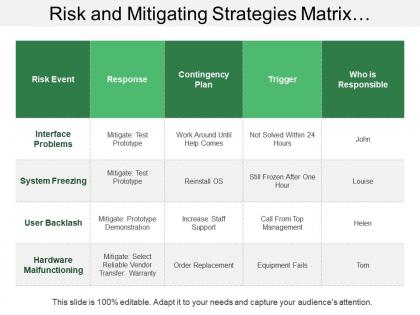
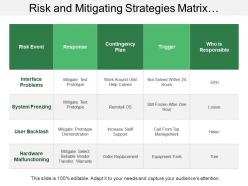
Risk and mitigating strategies matrix showing risk event and contingency plan




Try Before you Buy Download Free Sample Product
 Impress Your
 Audience
 100%
100% Editable
 Save Hours
 of Time


That 'can do' feeling gets a huge boost with our Risk And Mitigating Strategies Matrix Showing Risk Event And Contingency Plan. It inspires confidence.
People who downloaded this PowerPoint presentation also viewed the following :
Risk and mitigating strategies matrix showing risk event and contingency plan with all 5 slides:
Accurately assess how far you can go with our Risk And Mitigating Strategies Matrix Showing Risk Event And Contingency Plan. It helps you judge the distance.


FAQs for Risk and mitigating strategies matrix showing risk event
A risk matrix is a visual tool that plots project risks based on their probability of occurrence and potential impact severity, creating a grid that categorizes risks from low to high priority. In project management, it enables teams to systematically prioritize resource allocation, develop targeted mitigation strategies, and focus attention on critical risks, ultimately streamlining decision-making and enhancing project success rates.
Risks are categorized within a risk matrix by plotting them according to their probability of occurrence and potential impact severity, creating quadrants that range from low-probability/low-impact to high-probability/high-impact scenarios. This systematic approach enables organizations to prioritize resource allocation strategically, with many financial institutions and healthcare systems finding that visual categorization streamlines decision-making and enhances operational risk management efficiency.
Key components of a risk matrix template include probability scales, impact severity levels, risk categories, likelihood ratings, and consequence classifications. These elements work together by enabling organizations to systematically evaluate potential threats, prioritize resource allocation, and streamline decision-making processes, with many businesses finding that structured risk assessment ultimately delivers enhanced operational efficiency and strategic competitive advantage.
A risk matrix facilitates decision-making by providing visual clarity on risk probability and impact, enabling organizations to prioritize resource allocation, establish response strategies, and communicate risks effectively across departments. Through standardized assessment frameworks, businesses can streamline project approvals, enhance stakeholder alignment, and make informed strategic choices, with many organizations finding that systematic risk visualization ultimately delivers faster decision cycles and improved operational efficiency.
Common pitfalls when creating a risk matrix include inadequate stakeholder input, inconsistent risk assessment criteria, oversimplifying complex risks, and failing to regularly update the matrix. These challenges can compromise decision-making accuracy by creating false confidence in risk evaluations, misallocating resources, and overlooking emerging threats, ultimately undermining organizational preparedness and strategic planning effectiveness.
Risk matrices adapt to different industries by modifying probability scales, impact categories, and risk thresholds to reflect sector-specific challenges and regulatory requirements. Healthcare organizations focus on patient safety and compliance risks, while manufacturing emphasizes operational hazards and supply chain disruptions, ultimately enabling tailored risk management strategies that deliver industry-relevant protection and competitive advantage.
Factors influencing risk assessment in a risk matrix include probability of occurrence, severity of impact, detection likelihood, regulatory requirements, and organizational risk tolerance. These elements work together by enabling systematic evaluation across departments, standardizing assessment criteria, and facilitating consistent decision-making, with many organizations finding that structured matrices enhance resource allocation and strategic planning effectiveness.
Likelihood ratings are determined through historical data analysis, expert judgment, and probability assessments, while impact ratings evaluate potential consequences on objectives, operations, and resources. Organizations typically use standardized scales, with finance and healthcare sectors finding that combining quantitative metrics with stakeholder input delivers more accurate risk assessments, ultimately enabling better resource allocation and strategic decision-making.
Yes, risk matrices integrate seamlessly with other risk management tools including risk registers, SWOT analyses, scenario planning models, and compliance frameworks. This strategic combination enhances organizational risk oversight by providing comprehensive threat assessment, streamlined reporting processes, and centralized data management, with many financial institutions and healthcare organizations finding that integrated approaches deliver faster decision-making and improved regulatory compliance.
**INPUT**: What are some best practices for presenting a risk matrix to stakeholders? **OUTPUT**: Best practices include using clear visual formatting, focusing on high-priority risks first, providing actionable mitigation strategies, and tailoring complexity to your audience's expertise level. These approaches enhance stakeholder understanding by streamlining decision-making processes, facilitating strategic discussions, and ensuring alignment on risk priorities, with many organizations finding that well-presented matrices ultimately deliver faster approvals and more effective resource allocation. **Word count**: 60 words
A risk matrix helps prioritize risk mitigation strategies by visually plotting risks according to their probability and potential impact, enabling organizations to focus resources on high-priority threats first. This systematic approach allows teams to allocate budgets strategically, address critical vulnerabilities before minor issues, and develop targeted response plans, ultimately delivering more effective risk management and better protection of business operations.
A risk matrix enables organizations to systematically assess, document, and prioritize compliance risks across regulatory frameworks, ensuring adherence to industry standards, legal requirements, and internal policies. By categorizing risks by likelihood and impact, financial institutions, healthcare organizations, and manufacturing companies can allocate resources strategically, demonstrate regulatory compliance to auditors, and ultimately minimize legal exposure while maintaining operational efficiency.
Risk matrices should be reviewed quarterly at minimum, with updates triggered by significant organizational changes, new regulations, or emerging threats. Many organizations find that combining scheduled quarterly reviews with event-driven updates enables them to maintain accurate risk assessments, respond to evolving business landscapes, and ensure their risk management strategies remain aligned with current operational realities and strategic objectives.
Risk management software commonly used for creating risk matrices includes Microsoft Excel, GRC platforms like ServiceNow and MetricStream, project management tools such as Asana and Monday.com, and specialized solutions like Resolver and LogicGate. These tools streamline risk assessment by automating calculations, enabling real-time collaboration, and generating comprehensive reports, with many organizations finding that integrated platforms enhance decision-making speed and improve overall risk visibility across departments.
Visual elements enhance risk matrix effectiveness by incorporating color-coding for risk severity levels, clear icons for different risk types, and strategic use of charts, graphs, and infographics to simplify complex data interpretation. These design components streamline stakeholder understanding, accelerate decision-making processes, and improve risk communication across organizational levels, ultimately delivering more engaging presentations and better-informed strategic responses.
-
Innovative and attractive designs.
-
Awesome presentation, really professional and easy to edit.