

Risk assessment process powerpoint graphics




Try Before you Buy Download Free Sample Product
 Impress Your
 Audience
 100%
100% Editable
 Save Hours
 of Time


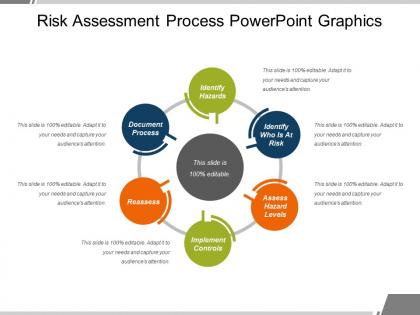
Control your company risk with our professionally designed risk assessment process PowerPoint Presentation slides. This risk control PowerPoint template is developed with the research on the concept to include all the essential components related with the concept for its potential users. Use this risk assessment matrix PPT slide to measure as well as evaluate the various types of risk like financial risk, economical risks and more. You can also identify the various appropriate measures which may help in managing your organizational risk. You can also describe the importance of risk identification for the business. Also, define the process of risk management with this risk matrix Presentation template. The stages like risk identification till the stage of reviewing the risk control parameters. Also graphically, represent the various risk factors which may affect your business success. Such as market fluctuations, competitions, customer demands, business objectives and many more. So therefore, start working over this exclusive risk control matrix PPT image now. Our Risk Assessment Process Powerpoint Graphics are dedicated to going the distance. You will certainly acquire durability.
People who downloaded this PowerPoint presentation also viewed the following :
Risk assessment process powerpoint graphics with all 5 slides:
Heighten interest in doing a good job with our Risk Assessment Process Powerpoint Graphics. Institute incentives for creditable effort.




FAQs for Risk assessment
Essential steps in a comprehensive risk assessment process include risk identification, analysis, evaluation, treatment planning, and continuous monitoring. These methodologies enhance organizational resilience by systematically cataloging potential threats, quantifying their impact and likelihood, and developing mitigation strategies, with many financial institutions and healthcare organizations finding that structured approaches ultimately deliver improved decision-making and regulatory compliance.
Qualitative methods evaluate risks through descriptive assessments using categories like high, medium, and low, while quantitative methods use numerical data, statistical models, and probability calculations to measure risk likelihood and impact. While qualitative approaches enable faster initial screenings across departments, quantitative analysis delivers precise financial projections and regulatory compliance metrics, with many organizations combining both methods for comprehensive risk management.
Stakeholder communication ensures comprehensive risk identification, facilitates informed decision-making, and maintains organizational alignment throughout the assessment process. Through regular updates, collaborative workshops, and transparent reporting, organizations enhance risk visibility, secure necessary resources, and build consensus on mitigation strategies, with many companies finding that proactive stakeholder engagement significantly improves risk management effectiveness.
Organizations can effectively identify potential risks through continuous environmental scanning, stakeholder engagement, scenario planning, cross-functional risk committees, and leveraging predictive analytics tools. These approaches enable companies to monitor emerging threats across supply chains, regulatory changes, and market volatility, while fostering collaborative risk identification, ultimately delivering proactive risk management and sustained competitive advantage.
Effective risk assessment tools include GRC platforms like MetricStream and ServiceNow, specialized software such as RiskWatch and Resolver, Monte Carlo simulation tools, vulnerability scanners, and integrated ERP modules. These technologies streamline identification, analysis, and monitoring by automating data collection, providing real-time dashboards, and enabling scenario modeling, with many organizations finding significantly improved accuracy and faster decision-making across their operations.
Risk assessment integrates with overall risk management strategy by providing foundational data for decision-making, establishing risk tolerance thresholds, and enabling proactive resource allocation across departments. Through systematic evaluation processes, organizations can prioritize mitigation efforts, align operational policies with strategic objectives, and create comprehensive response frameworks, ultimately delivering enhanced organizational resilience and competitive advantage in increasingly complex business environments.
Inherent risk represents the natural level of risk present in a process or activity before any controls or mitigation measures are applied, while residual risk is what remains after implementing safeguards, controls, and risk reduction strategies. This distinction enables organizations to measure control effectiveness, prioritize resource allocation, and demonstrate risk management value to stakeholders, with many financial institutions and healthcare organizations finding that tracking both metrics significantly enhances their strategic decision-making capabilities.
Common risk assessment challenges include inadequate data quality, resource constraints, subjective bias in evaluation, difficulty quantifying intangible risks, and rapidly changing threat landscapes. These obstacles often lead to incomplete assessments, with many organizations finding that insufficient stakeholder engagement and outdated methodologies ultimately compromise decision-making accuracy and strategic risk management effectiveness.
Regulatory requirements significantly shape risk assessment practices by mandating specific evaluation frameworks, compliance standards, and reporting protocols tailored to industry risks. Financial institutions follow Basel III guidelines for capital adequacy, healthcare organizations adhere to HIPAA for data protection, and manufacturing companies comply with OSHA safety standards, with many organizations finding that regulatory alignment ultimately enhances operational efficiency and competitive positioning.
Key metrics for evaluating risk assessment effectiveness include risk identification completeness, assessment accuracy rates, mitigation implementation timelines, residual risk levels, and stakeholder compliance scores. These measurements enable organizations to streamline their risk management processes by tracking prediction accuracy, reducing response times, and enhancing operational resilience, with many financial institutions and healthcare organizations finding that comprehensive metrics ultimately deliver stronger regulatory compliance and competitive advantage.
Employee training is critically important for effective risk management, as trained employees serve as the first line of defense in identifying potential threats, understanding reporting protocols, and recognizing subtle warning signs that automated systems might miss. Organizations with comprehensive training programs experience significantly fewer incidents and faster response times, with many finding that well-trained staff can prevent minor issues from escalating into major operational disruptions.
Risk prioritization techniques include probability-impact matrices, risk scoring models, qualitative assessments, quantitative analysis, and stakeholder impact evaluations. These methods enable organizations to systematically rank threats by combining likelihood with potential consequences, while considering resource constraints and strategic objectives, ultimately delivering focused mitigation strategies that protect critical business operations and competitive positioning.
Emerging technological risks should be approached through continuous monitoring, cross-functional expertise integration, scenario-based modeling, and adaptive assessment frameworks that evolve with technological developments. Organizations increasingly combine traditional risk methodologies with specialized tech evaluations, predictive analytics, and stakeholder collaboration, with many finding that proactive assessment strategies enable faster threat response, reduced vulnerabilities, and sustained competitive advantage.
Best practices for ongoing risk assessment include establishing regular review cycles, implementing automated monitoring systems, maintaining dynamic risk registers, conducting scenario planning exercises, and fostering cross-departmental collaboration. These approaches streamline risk management by enabling real-time threat detection, facilitating proactive response strategies, and enhancing organizational resilience, with many enterprises finding that continuous monitoring delivers competitive advantage.
Organizations ensure dynamic risk assessment processes by implementing continuous monitoring systems, regular framework updates, cross-functional collaboration, and agile methodologies that respond to emerging threats. Through real-time data analytics and stakeholder feedback loops, companies in sectors like financial services and healthcare can quickly adapt their risk strategies, ultimately delivering enhanced resilience and competitive advantage in an increasingly volatile business environment.
-
Great product with highly impressive and engaging designs.
-
Great quality slides in rapid time.