

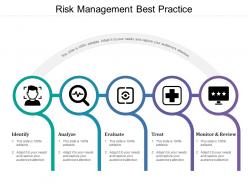
Risk Management Best Practice





Try Before you Buy Download Free Sample Product
 Impress Your
 Audience
 100%
100% Editable
 Save Hours
 of Time


Our Risk Management Best Practice are completely captivating. They bring about a dramatic experience.
People who downloaded this PowerPoint presentation also viewed the following :
Risk Management Best Practice with all 5 slides:
Get folks alert for frequent changes with our Risk Management Best Practice. Be able to forecast any instability.




FAQs for Risk
An effective risk management framework includes risk identification processes, assessment methodologies, mitigation strategies, monitoring systems, and governance structures. These components work together by establishing clear risk ownership, implementing automated tracking tools, and creating regular reporting mechanisms, with many organizations finding that integrated frameworks significantly enhance operational efficiency while reducing potential losses and regulatory compliance costs.
Organizations identify and prioritize risks through comprehensive risk assessments, stakeholder consultations, data analysis, scenario planning, and regular monitoring systems. These methodologies streamline decision-making by evaluating probability and impact, mapping vulnerabilities across departments, and establishing clear escalation protocols, with many financial services and healthcare institutions finding that systematic risk frameworks ultimately deliver enhanced operational resilience and strategic competitive advantage.
Leadership drives risk-aware culture by modeling transparent risk discussions, establishing clear risk governance frameworks, and integrating risk considerations into strategic decision-making processes. Through consistent communication and accountability measures, executives enable organizations to proactively identify vulnerabilities, encourage cross-departmental risk reporting, and ultimately create environments where risk management becomes embedded in daily operations rather than isolated compliance activities.
Technology enhances risk management processes by automating threat detection, providing real-time monitoring capabilities, and enabling predictive analytics for proactive decision-making. Through AI-powered systems and advanced data analytics, organizations streamline compliance reporting, minimize human error, and accelerate response times, with financial institutions and healthcare providers finding that these integrated solutions ultimately deliver enhanced operational efficiency and competitive advantage.
Common risk assessment methodologies include quantitative analysis, qualitative frameworks, Monte Carlo simulations, scenario planning, and failure mode analysis. These approaches streamline risk identification by evaluating probability, impact, and mitigation strategies across sectors, with financial services leveraging quantitative models while manufacturing emphasizes failure analysis, ultimately delivering enhanced operational efficiency and strategic decision-making capabilities.
Organizations effectively communicate risk management strategies through regular stakeholder meetings, comprehensive risk dashboards, tailored reporting formats, and transparent documentation processes. These approaches enhance organizational transparency by providing clear risk assessments, actionable mitigation plans, and performance metrics, with many financial institutions and healthcare organizations finding that structured communication ultimately delivers improved stakeholder confidence and strategic alignment.
**INPUT**: What metrics should be used to measure the effectiveness of risk management practices? **OUTPUT**: Risk management effectiveness metrics include risk-adjusted return on capital, incident frequency rates, time-to-detection of threats, regulatory compliance scores, and cost of risk as percentage of revenue. These measurements enable organizations to track operational resilience, financial impact mitigation, and strategic decision-making capabilities, with many financial institutions and healthcare systems finding that comprehensive metrics ultimately deliver enhanced stakeholder confidence and competitive advantage.
Businesses integrate risk management into strategic planning by conducting comprehensive risk assessments during planning phases, embedding risk considerations into decision-making frameworks, and establishing cross-functional risk committees that align with strategic objectives. Through systematic risk identification and mitigation strategies, organizations streamline operations, enhance competitive positioning, and protect long-term value, with many enterprises finding that proactive integration ultimately delivers sustained growth and stakeholder confidence.
Risk audit best practices include establishing clear audit scope and objectives, maintaining independence from audited processes, using standardized assessment frameworks, documenting findings comprehensively, and implementing systematic follow-up procedures. These approaches enhance organizational resilience by identifying emerging threats, evaluating control effectiveness, and ensuring compliance adherence, with many financial institutions and healthcare organizations finding that regular audits ultimately deliver improved risk visibility and regulatory confidence.
Organizations balance risk tolerance with business opportunities by establishing clear risk appetite frameworks, conducting comprehensive risk-return analyses, and implementing diversified portfolio approaches across ventures. Through scenario planning and phased implementation strategies, companies can pursue growth initiatives while maintaining operational stability, with many financial services and manufacturing firms finding that structured risk assessment processes enable calculated expansion while protecting core business operations.
Employee training and awareness serve as critical frontline defenses in risk management, equipping staff to identify potential threats, follow compliance protocols, respond appropriately to incidents, and maintain security standards across daily operations. Through comprehensive programs, organizations significantly reduce human error, enhance incident response times, and strengthen overall risk posture, with many companies finding that well-trained employees become their most effective risk mitigation asset.
Companies adapt risk management strategies to changing regulations by implementing continuous monitoring systems, establishing cross-functional compliance teams, and conducting regular regulatory impact assessments. Through automated compliance tracking and scenario planning, organizations streamline regulatory alignment while enhancing operational flexibility, with many financial services and healthcare institutions finding that proactive adaptation ultimately delivers competitive advantage and reduced compliance costs.
Reputational risk significantly threatens business sustainability by eroding customer trust, reducing market value, limiting access to capital, and deterring top talent acquisition. A damaged reputation can result in decreased sales, higher operational costs, regulatory scrutiny, and long-term competitive disadvantage, with many organizations finding that recovery often takes years and substantial investment.
Scenario analysis enhances risk preparedness by modeling potential future events, identifying vulnerabilities across operations, and testing response strategies before crises occur. Through systematic evaluation of various risk scenarios, organizations in banking, healthcare, and manufacturing can strengthen contingency plans, optimize resource allocation, and improve decision-making frameworks, ultimately delivering greater resilience and competitive advantage.
Emerging risk management trends include AI-powered predictive analytics, real-time monitoring systems, integrated ESG risk frameworks, cyber resilience strategies, and supply chain transparency tools. These technologies enhance organizational preparedness by automating threat detection, streamlining compliance processes, and delivering comprehensive risk visibility, with many financial services and manufacturing companies finding that proactive digital approaches significantly reduce operational vulnerabilities while improving strategic decision-making.
-
Easy to edit slides with easy to understand instructions.
-
Easily Understandable slides.