


Risks and mitigation strategies man tightrope sharks powerpoint slide rules




Try Before you Buy Download Free Sample Product
 Impress Your
 Audience
 100%
100% Editable
 Save Hours
 of Time


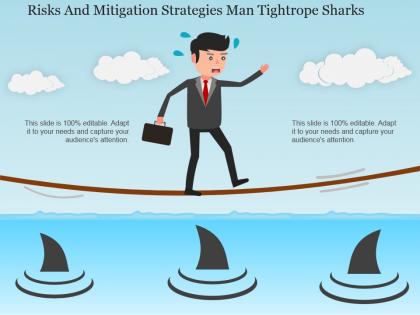
Are you looking to present business plan risks and mitigation strategies in PowerPoint? We are presenting our fully featured, business oriented risks and mitigation strategies man tightrope sharks PowerPoint slide rules PPT template to do it efficiently. Use this intelligently designed PPT diagram to identify potential risk, impact on business performance, accept, minimize, share and transfer the risk according to your business requirements. Implement the risk and mitigation strategies to minimize risk or impact of risk on business with this powerful risk management PowerPoint template. PPT design is highly useful as you can work on all of the risk factors in advance so that it will not hamper your project execution. You can also display important benefits and risks including types of risk e.g. operational, structural, financial, technical risk associated with the project, tolerance with this tightrope PowerPoint template. So, just download by clicking on download button and display important risks and mitigation strategies, tightrope challenges in most impressive manner. Increase the impact you have in your field with our Risks And Mitigation Strategies Man Tightrope Sharks Powerpoint Slide Rules. Enhance the influence of your institution.
People who downloaded this PowerPoint presentation also viewed the following :
Risks and mitigation strategies man tightrope sharks powerpoint slide rules with all 5 slides:
Our Risks And Mitigation Strategies Man Tightrope Sharks Powerpoint Slide Rules are aware of customer aspirations. Be able to anticipate their choice.




FAQs for Risks and mitigation strategies man tightrope sharks
Essential tightrope walking safety equipment includes safety harnesses, balance poles, protective padding, proper footwear, and rigging hardware like tensioning systems and anchor points. This equipment streamlines risk management by providing fall protection, enhancing balance control, and ensuring structural integrity, with many performance venues and training facilities finding that comprehensive safety systems ultimately deliver greater performer confidence and operational liability reduction.
Balance training significantly enhances tightrope walking safety by developing core stability, proprioceptive awareness, and controlled muscle responses that prevent falls. Through progressive exercises, performers strengthen stabilizing muscles, improve reaction times to perturbations, and build confidence in recovery movements, ultimately delivering enhanced performance control and reduced injury risk for circus professionals and recreational practitioners.
Best practices for tightrope setup include ensuring proper anchor points, maintaining appropriate tension, selecting suitable rope diameter, establishing correct height, and implementing comprehensive safety measures. These fundamentals enhance performer confidence by minimizing equipment failure risks, optimizing balance conditions, and creating controlled practice environments, with many circus schools and performance venues finding that systematic setup protocols ultimately deliver safer training experiences and more reliable performances.
Weather conditions significantly impact tightrope walking safety through wind interference, surface moisture, temperature effects, and visibility challenges. Strong winds can destabilize balance and create dangerous lateral forces, while rain or humidity makes cables slippery, and extreme temperatures affect both equipment flexibility and performer grip strength, ultimately requiring comprehensive weather monitoring and adaptive safety protocols for professional performances.
Common tightrope walking injuries include falls resulting in fractures, sprains, and head trauma, muscle strains from balance corrections, and abrasions from rope contact. These risks can be minimized through comprehensive safety harnesses, progressive training protocols, proper conditioning programs, and consistent use of safety nets, with many professional performers and circus schools finding that systematic preparation and equipment maintenance ultimately delivers safer performances and enhanced performer confidence.
Psychological preparation plays a crucial role in tightrope walking safety by building mental resilience, enhancing focus under pressure, and developing visualization techniques for successful crossings. Through consistent mental training, performers cultivate confidence, manage fear responses, and maintain concentration during challenging sequences, ultimately reducing accident risk and enabling more controlled, precise movements across increasingly complex routines.
A support team enhances tightrope walking safety by positioning spotters below the wire, maintaining safety nets, monitoring weather conditions, and ensuring proper equipment checks before performances. These protocols work together by providing immediate response capabilities, minimizing fall impact risks, and creating redundant safety layers, with many professional circus operations finding that systematic team coordination reduces performance injuries while maintaining audience engagement.
Tightrope walking regulations in public spaces typically include permit requirements, safety equipment mandates, insurance coverage, crowd control measures, and emergency access protocols. These guidelines vary by municipality and venue type, with many performers finding that working with experienced event coordinators and local authorities streamlines compliance while ensuring public safety and professional credibility.
Beginners can safely start tightrope walking by practicing on low lines with safety mats, wearing proper footwear, and starting with basic balance exercises on ground-level beams. Many circus schools and recreational programs provide structured instruction with professional spotters, progressive skill development, and proper harness systems, ultimately building confidence and foundational techniques while minimizing injury risks.
Tightrope walking at height requires comprehensive safety harnesses, professional rigging systems, multiple backup lines, and emergency rescue protocols, while ground-level practice primarily needs basic spotting and protective mats. Height performances demand specialized training in fall arrest systems, weather assessment, and medical standby services, with many circus organizations finding that systematic safety protocols ultimately enable more ambitious performances while minimizing risk.
Experience level significantly influences tightrope walking safety protocols through equipment selection, height progression, and supervision requirements, with beginners requiring safety harnesses, lower practice lines, and constant instruction. Professional performers can work at greater heights with minimal safety gear, while intermediate walkers gradually transition between protocols, ultimately enabling each skill level to develop safely while minimizing injury risk.
Effective tightrope walking training programs include progressive height conditioning, balance beam fundamentals, core strengthening exercises, fall recovery techniques, and equipment safety protocols. These comprehensive approaches enhance performer stability through systematic skill building, muscle memory development, and risk assessment training, with many circus schools and performance academies finding that structured progression significantly reduces injury rates while building performer confidence.
Proper nutrition and fitness significantly enhance tightrope walking performance by improving balance, core strength, muscle endurance, and mental focus, while reducing injury risk through better coordination and recovery. Professional circus performers and acrobatic training centers increasingly emphasize strategic nutritional timing, cardiovascular conditioning, and flexibility programs, ultimately delivering sustained concentration, precise muscle control, and enhanced safety margins during high-altitude performances.
Safety technologies for tightrope walking include stabilization harnesses, tension monitoring systems, fall arrest equipment, balance assistance wires, and real-time motion sensors. These systems enhance performer safety by providing immediate feedback on rope stability, automated emergency responses, and precise balance corrections, with many circus organizations and performance venues finding that integrated safety technology significantly reduces accident rates while enabling more ambitious performances.
Cultural variations significantly influence tightrope walking safety through different training methodologies, equipment preferences, risk assessment approaches, and community support systems. Traditional Chinese wire walking emphasizes gradual skill building with bamboo poles, while circus traditions prioritize safety nets and harnesses, ultimately delivering diverse yet effective safety frameworks that enhance performer protection and audience confidence.
-
Awesomely designed templates, Easy to understand.
-
Attractive design and informative presentation.