


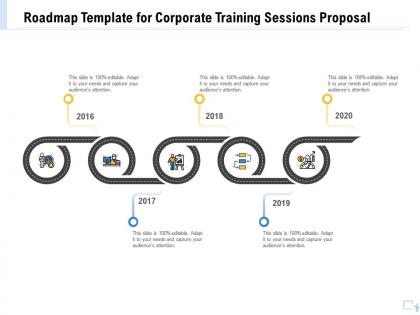
Roadmap template for corporate training sessions proposal ppt templates




Try Before you Buy Download Free Sample Product
 Impress Your
 Audience
 100%
100% Editable
 Save Hours
 of Time


Our Roadmap Template For Corporate Training Sessions Proposal Ppt Templates are topically designed to provide an attractive backdrop to any subject. Use them to look like a presentation pro.
People who downloaded this PowerPoint presentation also viewed the following :
Roadmap template for corporate training sessions proposal ppt templates with all 2 slides:
Use our Roadmap Template For Corporate Training Sessions Proposal Ppt Templates to effectively help you save your valuable time. They are readymade to fit into any presentation structure.
FAQs for Roadmap template for corporate training sessions
So for your training roadmap, start with clear learning objectives and skill milestones. Timeline estimates are crucial too - people need to know what they're signing up for. Don't forget assessment methods to track progress and prerequisites for advanced stuff. Resources for each stage, obviously. Most templates I see are way overcomplicated though, which drives me nuts. Keep it simple. Build in flexibility since everyone learns differently - some people fly through modules, others need more time. Mix formal training with hands-on practice opportunities. Pro tip: map your end goals first, then work backwards. Way easier than starting from scratch.
Start with figuring out what your industry actually needs - compliance stuff, skills your team's missing, business goals. Healthcare companies need HIPAA training, manufacturing is all about safety protocols. Basic stuff, but tons of companies somehow miss this step (honestly baffling). Build your modules around real scenarios from your field. Timeline matters too - you might have regulatory deadlines or busy seasons to work around. Oh, and definitely audit what you've got now versus what you actually need. That gap analysis will save you from building redundant content later.
Track your learning basics first - completion rates, test scores, how fast people get up to speed. But here's the thing: those numbers are pretty useless if nobody's actually performing better at work. So dig into the real stuff too - are people more productive? Staying longer? Actually using what they learned? I always tell people to find 3-4 metrics your boss actually cares about and stick with those. The magic happens when you can point to your training and say "look, this directly improved X." Way easier said than done though.
Look, feedback is literally everything when you're building training templates. Without it, you're just guessing what people need. Ask employees about their skill gaps and how they like to learn - then actually use that info to create roadmaps that make sense. People will engage way more when they had a say in it. I learned this the hard way at my last job. Build feedback loops right into your templates too, like surveys after each session or quarterly check-ins. That's how you keep things fresh instead of using the same boring stuff forever.
So basically tech turns those boring static training docs into something that actually tracks progress. LMS platforms auto-assign courses when people get promoted and show completion rates in real-time - which is honestly pretty satisfying to watch. AI can customize learning paths for each person (though sometimes it gets a bit too aggressive with the recommendations lol). Mobile apps are clutch for learning during commutes. Analytics tell you exactly where people bail out. Just make sure whatever tools you pick talk to each other - nobody wants to check five different dashboards every morning.
So first thing - directly connect your training to actual business goals. Like if they want 20% more sales, focus on sales skills or product knowledge. I literally write down how each module connects to real outcomes (sounds nerdy but it works). Get leadership involved early so they actually care about the results. Oh and track metrics that executives give a damn about, not just "90% completed the course." The whole point is proving ROI - that your training roadmap actually moves numbers, not just checks boxes. Otherwise you'll always be fighting for budget.
Honestly, the worst thing you can do is make your roadmap way too rigid. Business priorities shift constantly, and you'll need to pivot based on what people actually tell you. Skip the skills gap analysis upfront and you're basically building training for fake problems. I've seen roadmaps that look like absolute nightmares - these giant flowcharts that scare people instead of helping them. Keep it modular and simple. Oh, and don't just create it and walk away. You've got to review and update regularly or it becomes useless pretty fast.
Honestly, you need way more flexibility than those cookie-cutter templates give you. Swap the in-person workshops for interactive virtual sessions. Add modules people can do whenever - asynchronous stuff works great. Regular check-ins through video or messaging keep everyone connected. The engagement thing is tough when people are all over the place, not gonna lie. Collaborative tools help though - shared workspaces, peer mentoring, that kind of thing. Oh, and if you've got different time zones, plan around that mess early. I'd start by looking at your current template and replacing anything that needs physical presence with digital alternatives that hit the same goals.
Honestly, just survey your team first - I was shocked when I found out half my people are total visual learners while I'm all about podcasts and discussions. Mix up your content big time: videos, hands-on workshops, reading stuff, group work. Some folks need diagrams and charts, others learn by doing. Throw in self-paced options too since not everyone processes at the same speed. I used to assume everyone learned like me (huge mistake). Interactive simulations work great if you can swing it. Short story: variety is everything.
Honestly? Quarterly reviews are ideal but who has time for that. I shoot for twice a year minimum - once to check if your training still matches what the business actually needs, and again to see if people are finishing the courses or just clicking through. Industries move crazy fast now, so waiting a whole year means you're always playing catchup. New skills pop up, employees complain about outdated stuff, completion rates tank. Set those calendar reminders though because I guarantee this'll be the first thing you postpone when deadlines hit.
Honestly, leadership support is everything when it comes to training programs. If your bosses aren't backing it, people just won't show up or they'll half-ass it. But when leaders actually participate? Game changer. Suddenly everyone's paying attention and actually applying what they learned. Here's the thing - managers control the budget and can kill roadblocks that would otherwise torpedo your whole plan. I've seen too many good programs die because "we can't afford the software" or whatever. Also, if supervisors aren't reinforcing the concepts day-to-day, people forget everything within a week. Get leadership involved from day one, not as an afterthought.
Honestly, templates are a game changer for L&D stuff. You'll save so much time not starting from scratch every single time. Consistency becomes automatic across all your teams too. ROI tracking gets way simpler when everything follows the same format. New people can jump in without you explaining the whole system - they just get it. Oh and you won't forget those random but important details that always slip through the cracks. I'd start basic and then tweak it for whatever weird quirks your company has. Trust me on this one.
Honestly? Set up quarterly reviews right from the beginning - otherwise you'll hate yourself later. Assign someone to actually own each module (like, make it part of their job description). Check if your stuff still matches industry standards and current company processes. Oh, and definitely grab feedback from people who just went through the training - they'll tell you exactly what sucks. I learned this the hard way when we had modules teaching outdated software for like six months. Short version: build the review process in upfront or you'll be scrambling to fix broken content later.
Here's the deal - onboarding roadmaps are super focused and time-sensitive. You've got maybe 90 days to get someone functional with basic job stuff and company culture. Development roadmaps? Totally different beast. They're long-term and way more flexible, focusing on career growth over months or years. I always think of it like this: onboarding teaches "don't die on day one" skills, while development is about actually getting good at your job. Oh, and when you're making templates - onboarding needs those rigid checkpoints and milestones, but development should let people choose their own adventure a bit.
Honestly, getting other departments involved kills so much guesswork. You'll actually find out what people need instead of just assuming. Like, sales might be drowning with the new CRM while IT's panicking about everyone clicking sketchy links - stuff you'd never know otherwise. The best part? When teams help build the roadmap, they actually show up to training instead of finding excuses to skip. I mean, nobody wants to sit through random courses that don't help them do their job better. You end up with something that actually moves the needle company-wide, not just checking boxes.
-
Perfect template with attractive color combination.