


Role Of NLP In Text Summarization And Generation Powerpoint Presentation Slides AI CD V




Try Before you Buy Download Free Sample Product
 Impress Your
 Audience
 100%
100% Editable
 Save Hours
 of Time


Unlock the power of Natural Language Processing NLP for Artificial Intelligence with our comprehensive template titled, Role of NLP in Text Summarization and Generation. This resource delves into the intricate details of NLP, showcasing its evolution, key concepts, applications, and the growing demand for NLP solutions in recent times. The Tokenization deck explores various facets of NLP, providing insights into its historical evolution, core concepts, applications, training of NLP models, and future advancements. Discover the subsegments of NLP, including Natural Language Understanding NLU and Natural Language Generation NLG, as well as technologies such as deep learning, machine learning, NLP libraries, and programming languages, through our Text Summarization PPT. Moreover, the presentation highlights the application of NLP in customer feedback management and diverse sectors like marketing, finance, legal, healthcare, education, government, and more. Gain access to this powerful template now and elevate your understanding of how NLP is shaping the landscape of artificial intelligence.
People who downloaded this PowerPoint presentation also viewed the following :
Content of this Powerpoint Presentation
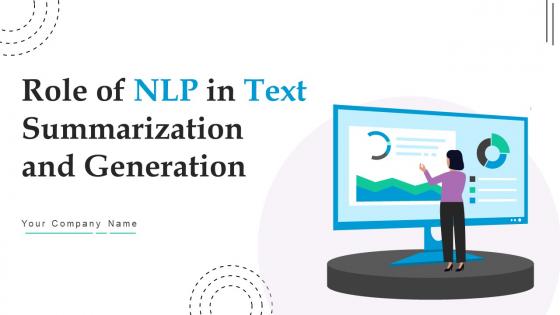
Slide 1: This slide introduces Role of NLP in Text Summarization and Generation. Commence by stating Your Company Name.
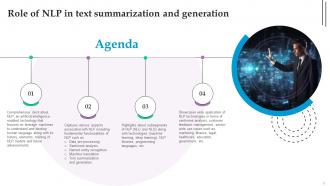
Slide 2: This slide depicts the Agenda of the presentation.
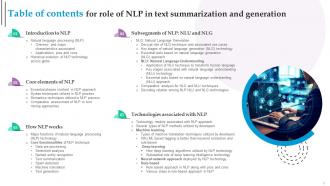
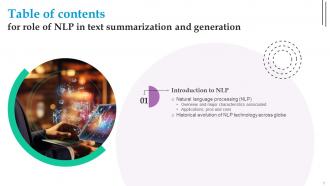
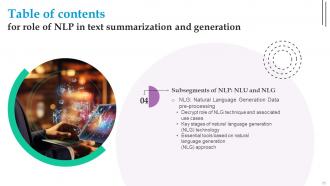
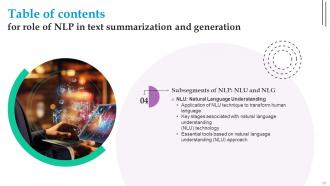
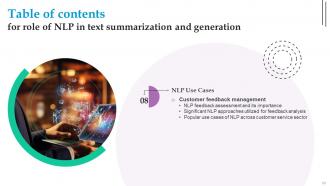
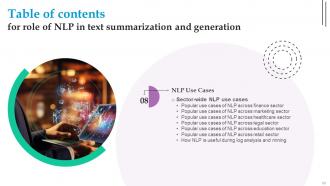
Slide 3: This slide includes the Table of contents.
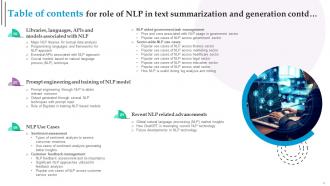
Slide 4: This slide further includes the Table of contents.
Slide 5: This slide highlights the Title for the Topics to be discussed further.
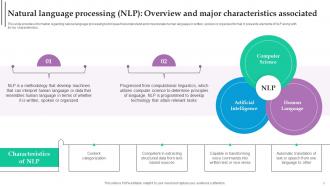
Slide 6: This slide provides information regarding natural language processing techniques.
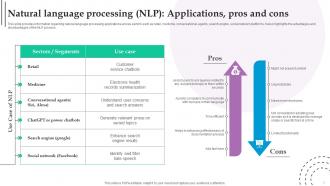
Slide 7: This slide states the natural language processing applications.
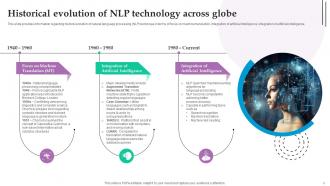
Slide 8: This slide reveals the Historical evolution of NLP technology across globe.
Slide 9: This slide indicates the Heading for the Contents to be covered further.
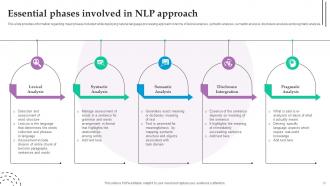
Slide 10: This slide showcases the Essential phases involved in NLP approach.
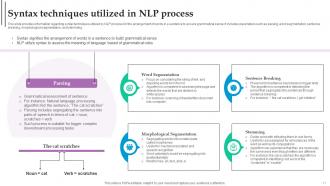
Slide 11: This slide highlights the Syntax techniques utilized in NLP process.
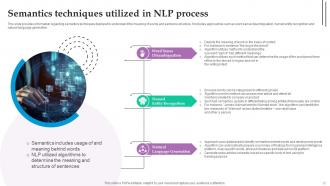
Slide 12: This slide reveals the Semantics techniques utilized in NLP process.
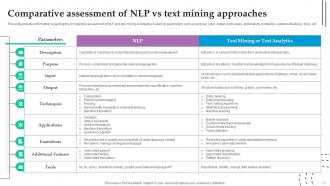
Slide 13: This slide shows the Comparative assessment of NLP vs text mining approaches.
Slide 14: This slide includes the Title for the Ideas to be discussed next.
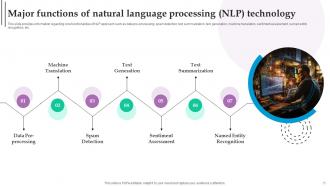
Slide 15: This slide exhibits the Major functions of natural language processing.
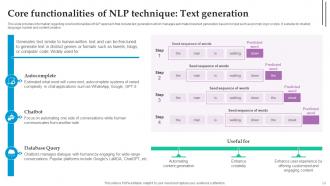
Slide 16: This slide shows the Core functionalities of NLP technique.
Slide 17: This slide continues the Core functionalities of NLP technique.
Slide 18: This slide continues the Core functionalities of NLP technique.
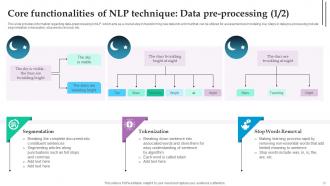
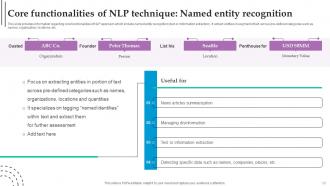
Slide 19: This slide highlights the Core functionalities of NLP technique.
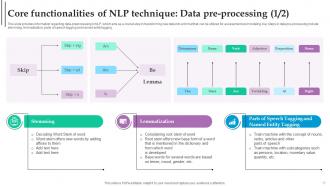
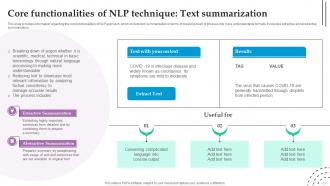
Slide 20: This slide portrays the Core functionalities of NLP technique.
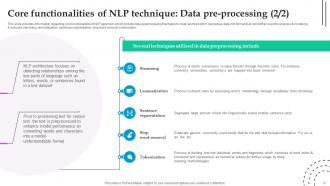
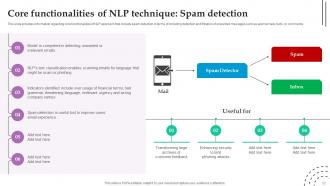
Slide 21: This slide exhibits the core functionalities of NLP approach.
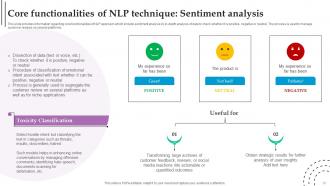
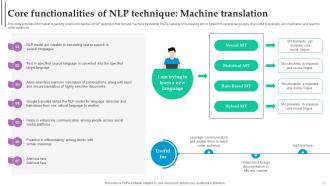
Slide 22: This slide displays the Core functionalities of NLP technique.
Slide 23: This slide provides information regarding core functionalities of NLP approach.
Slide 24: This slide exhibits the Core functionalities of NLP technique.
Slide 25: This slide contains the Heading for the Ideas to be covered further.
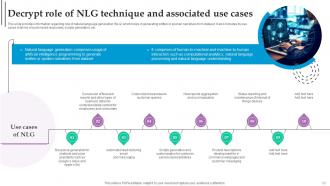
Slide 26: This slide showcases the Decrypt role of NLG technique and associated use cases.
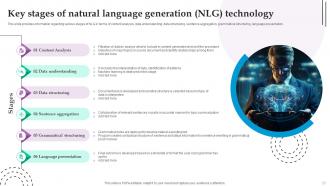
Slide 27: This slide highlights the Key stages of natural language generation (NLG) technology.
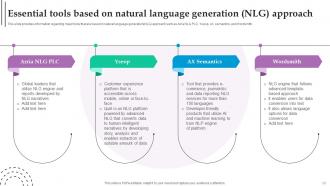
Slide 28: This slide displays the Essential tools based on natural language generation (NLG) approach.
Slide 29: This slide contains the Title for the Contents to be discussed next.
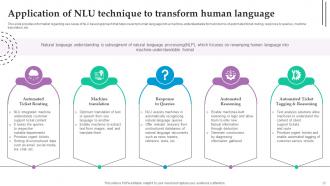
Slide 30: This slide presents the Application of NLU technique to transform human language.
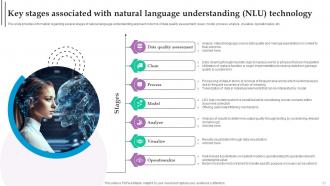
Slide 31: This slide states the Key stages associated with natural language understanding (NLU) technology.
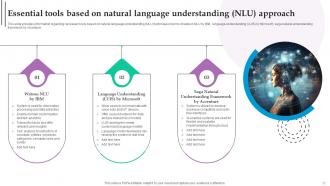
Slide 32: This slide depicts the Essential tools based on natural language understanding (NLU) approach.
Slide 33: This slide indicates the Heading for the Topics to be covered in the upcoming template.
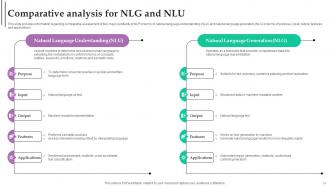
Slide 34: This slide reveals the Comparative analysis for NLG and NLU.
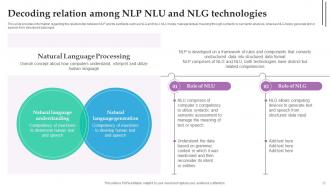
Slide 35: This slide talks about Decoding relation among NLP NLU and NLG technologies.
Slide 36: This slide exhibits the Title for the Topics to be discussed next.
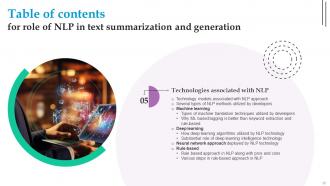
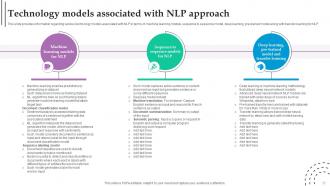
Slide 37: This slide provides information regarding various technology models associated with NLP.
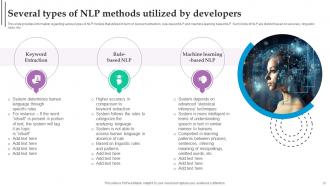
Slide 38: This slide depicts the Several types of NLP methods utilized by developers.
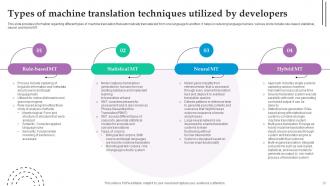
Slide 39: This slide provides information regarding different types of machine translation that automatically translate text from one language to another.
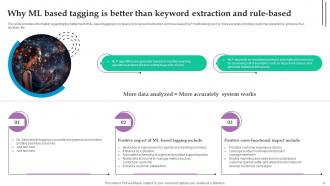
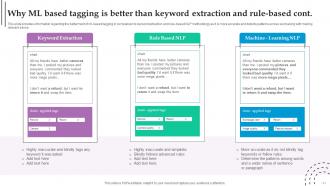
Slide 40: This slide shows the betterment of ML-based tagging in comparison to keyword extraction and rule-based NLP methodology.
Slide 41: This slide continues the comparison and betterment of ML tagging over keyword extraction.
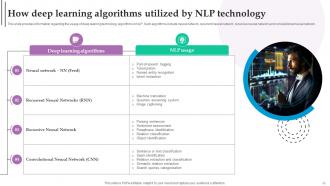
Slide 42: This slide provides information regarding the usage of deep learning technology algorithms in NLP.
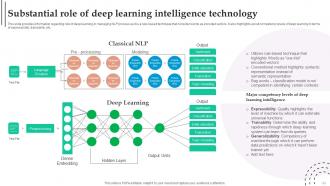
Slide 43: This slide highlights the Substantial role of deep learning intelligence technology.
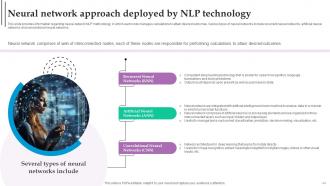
Slide 44: This slide contains the Neural network approach deployed by NLP technology.
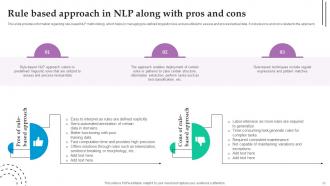
Slide 45: This slide talks about the Rule based approach in NLP along with pros and cons.
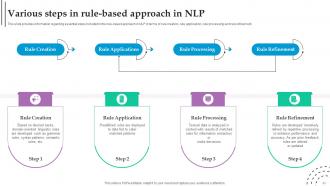
Slide 46: This slide states the Various steps in rule-based approach.
Slide 47: This slide indicates the Heading for the Contents to be covered further.
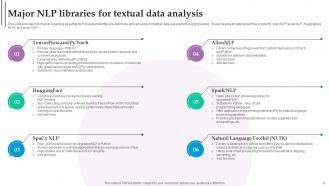
Slide 48: This slide exhibits the Major NLP libraries for textual data analysis.
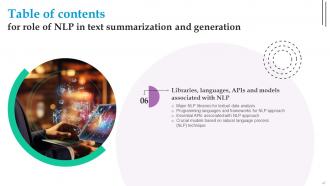
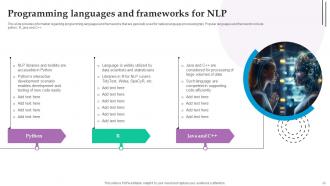
Slide 49: This slide deals with Programming languages and frameworks for NLP.
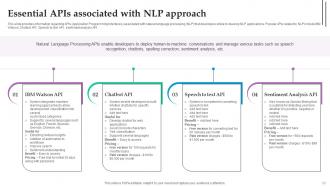
Slide 50: This slide highlights the Essential APIs associated with NLP approach.
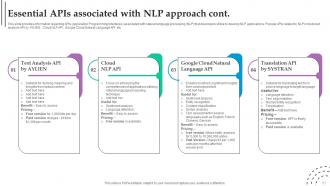
Slide 51: This slide continues the Essential APIs associated with NLP approach.
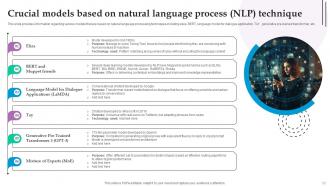
Slide 52: This slide shows the Crucial models based on natural language process (NLP) technique.
Slide 53: This slide portrays the Title for the Ideas to be discussed next.
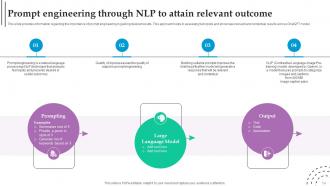
Slide 54: This slide talks about Prompt engineering through NLP to attain relevant outcome.
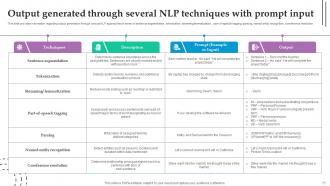
Slide 55: This slide provides information regarding output generation through various NLP approaches.
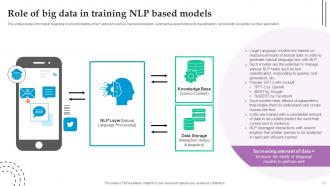
Slide 56: This slide shows the Role of Big data in training NLP based models.
Slide 57: This slide includes the Heading for the Ideas to be covered in the upcoming template.
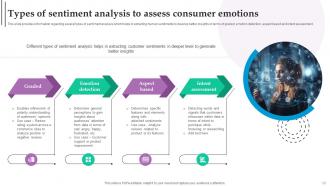
Slide 58: This slide states the Types of sentiment analysis to assess consumer emotions.
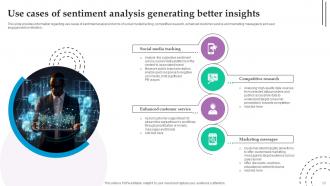
Slide 59: This slide represents the Use cases of sentiment analysis generating.
Slide 60: This slide includes the Title for the Contents to be discussed next.
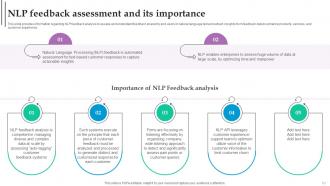
Slide 61: This slide provides information regarding NLP feedback analysis.
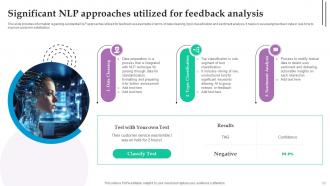
Slide 62: This slide presents the Significant NLP approaches utilized for feedback analysis.
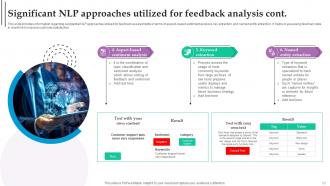
Slide 63: This slide continues the Significant NLP approaches utilized for feedback analysis.
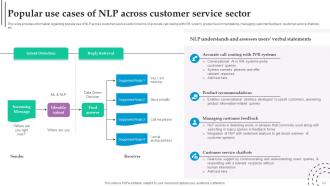
Slide 64: This slide reveals the Popular use cases of NLP across customer service sector.
Slide 65: This slide exhibits the Heading for the Topics to be coveerd further.
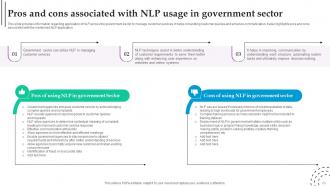
Slide 66: This slide highlights the Pros and cons associated with NLP usage in government sector.
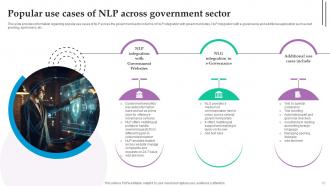
Slide 67: This slide provides information regarding popular use cases of NLP across the government sector.
Slide 68: This slide includes the Title for the Topics to be discussed next.
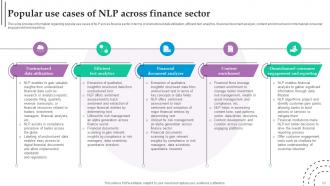
Slide 69: This slide talks about the Popular use cases of NLP across finance sector.
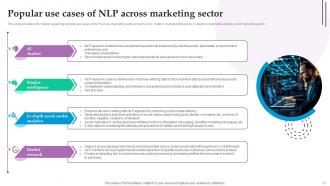
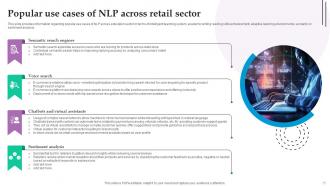
Slide 70: This slide deals with Popular use cases of NLP across marketing sector.
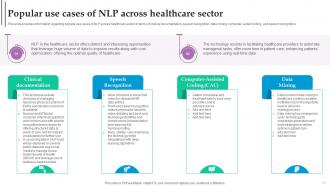
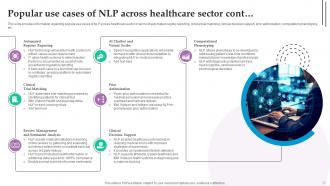
Slide 71: This slide shows the Popular use cases of NLP across healthcare sector.
Slide 72: This slide continues the Popular use cases of NLP across healthcare sector.
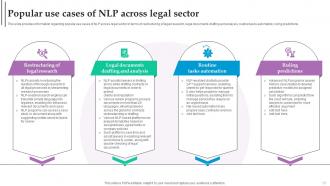
Slide 73: This slide provides information regarding popular use cases of NLP across legal sector.
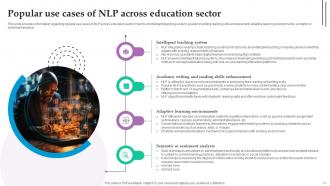
Slide 74: This slide indicates the Popular use cases of NLP across education sector.
Slide 75: This slide reveals the Popular use cases of NLP across.
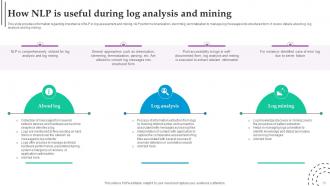
Slide 76: This slide provides information regarding importance of NLP in log assessment and mining.
Slide 77: This slide states the Heading for the Contents to be covered further.
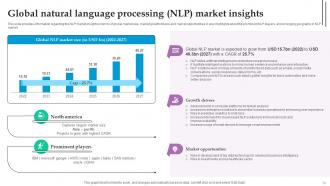
Slide 78: This slide portrays the Global natural language processing (NLP) market insights.
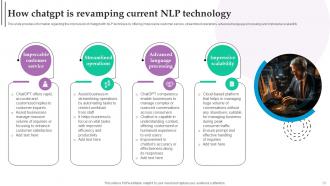
Slide 79: This slide provides information regarding the improvision of chatgpt with NLP technique.
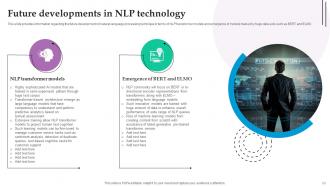
Slide 80: This slide talks about the Future developments in NLP technology.
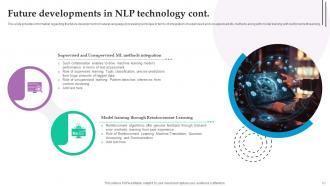
Slide 81: This slide continues the Future developments in NLP technology.
Slide 82: This is the Icons slide containing all the Icons used in the plan.
Slide 83: This slide is used for depicting some Additional information.
Slide 84: This is the About us slide. State your company-related information here.
Slide 85: This is Meet our team slide. State your team-related ifnormation here.
Slide 86: This slide incorporates the organization's mission, vision, and goals.
Slide 87: This is the Puzzle slide with related imagery.
Slide 88: This is the Thank you slide for acknowledgement.
Role Of NLP In Text Summarization And Generation Powerpoint Presentation Slides AI CD V with all 96 slides:
Use our Role Of NLP In Text Summarization And Generation Powerpoint Presentation Slides AI CD V to effectively help you save your valuable time. They are readymade to fit into any presentation structure.









FAQs for Role Of NLP In Text Summarization And Generation Powerpoint Presentation Slides
Extractive summarization selects and combines existing sentences from the original text, while abstractive summarization generates new sentences that capture the main ideas using different wording and structure. Extractive methods deliver faster processing and maintain source accuracy, whereas abstractive approaches enable more natural, coherent summaries that can paraphrase and synthesize information, with many organizations finding that combining both methods enhances content efficiency.
NLP improves complex document summarization accuracy through advanced techniques like transformer models, contextual embeddings, attention mechanisms, semantic analysis, and multi-document processing capabilities. These technologies enable systems to identify key themes, maintain context across lengthy texts, and preserve critical relationships between concepts, with legal firms and research institutions finding significantly enhanced precision in contract analysis and literature reviews.
Deep learning revolutionizes text generation through neural networks like transformers, recurrent neural networks, and attention mechanisms, enabling models to understand context, maintain coherence, and produce human-like content. These architectures empower organizations across sectors, from financial services generating automated reports to healthcare creating patient summaries, ultimately delivering scalable content solutions and enhanced operational efficiency.
Sentiment analysis integrates into text summarization by identifying emotional tone, weighting positive and negative content, and prioritizing emotionally significant passages during the summarization process. Through sentiment-aware algorithms, organizations in customer service, financial analysis, and market research can generate summaries that preserve critical emotional context, ultimately delivering more nuanced insights and better-informed decision-making capabilities.
Common challenges include data quality issues, computational resource requirements, maintaining coherence across long passages, handling bias in training datasets, and achieving contextual relevance. These obstacles can significantly impact model performance, with many organizations finding that strategic data preprocessing, robust infrastructure investment, and careful bias mitigation ultimately deliver more reliable text generation capabilities and competitive advantage.
Context and tone significantly influence summarization outcomes by determining which information algorithms prioritize, how key themes are interpreted, and what stylistic elements are preserved or emphasized. In technical documentation, summarizers focus on procedural elements and specifications, while in marketing materials they emphasize value propositions and benefits, with many organizations finding that tone-aware summarization delivers more accurate, contextually relevant summaries for their specific business communications.
Common approaches include ROUGE metrics measuring overlap with reference summaries, BLEU scores assessing n-gram precision, semantic similarity measures, readability assessments, and human evaluation protocols. These methodologies enable organizations across sectors like news media, financial services, and research institutions to validate summary accuracy, coherence, and relevance, ultimately delivering reliable automated content generation and enhanced information processing capabilities.
NLP algorithms can be fine-tuned for specific industries through domain-specific training data, specialized vocabularies, regulatory compliance frameworks, and sector-focused model architectures. Healthcare organizations leverage these customized models for medical record summarization and clinical documentation, while financial institutions enhance fraud detection reports and regulatory filings, ultimately delivering faster processing times and improved accuracy.
Ethical considerations in NLP text summarization include bias amplification, information distortion, attribution transparency, privacy protection, and potential job displacement for content creators. These challenges present both risks and opportunities, with many organizations finding that implementing diverse training data, human oversight protocols, and clear disclosure practices ultimately delivers more trustworthy automated content while maintaining competitive advantages.
**INPUT**: How do variations in language, such as slang or dialects, impact text generation models? **OUTPUT**: Language variations like slang, dialects, and colloquialisms present both challenges and opportunities for text generation models, affecting accuracy, context understanding, and output relevance. These linguistic nuances require diverse training datasets and adaptive algorithms, with many organizations finding that models incorporating regional language patterns deliver more authentic customer interactions, enhanced localization capabilities, and improved user engagement across different demographic segments. **Word count: 58 words**
Effective text summarization metrics include ROUGE scores, BLEU scores, semantic similarity measures, coherence ratings, and human evaluation assessments. These evaluation methods streamline performance analysis by measuring content overlap, readability, and information retention, with many organizations finding that combining automated metrics with human judgment delivers more comprehensive accuracy assessment and ultimately enhances summarization system optimization.
User feedback can be incorporated through reinforcement learning from human feedback (RLHF), preference ranking systems, active learning approaches, and iterative model fine-tuning based on quality assessments. These methods enable organizations to continuously refine summarization accuracy, with financial institutions and healthcare providers finding that user-validated models deliver significantly more relevant summaries, ultimately enhancing decision-making processes and operational efficiency.
Transfer learning revolutionizes text summarization by leveraging pre-trained models like BERT and GPT, which understand language patterns, context, and semantic relationships from vast datasets. This approach enables organizations to develop high-quality summarization systems with minimal training data, significantly reducing development time and computational costs while delivering more accurate, contextually-aware summaries for applications like document processing and content curation.
Using pre-trained models for text generation presents both significant advantages and important considerations, including reduced development time, enhanced accuracy, improved scalability, and lower computational costs during training. While these models streamline content creation across industries like journalism, marketing, and customer service, they also require careful evaluation for bias, domain-specific customization, and quality control, ultimately delivering competitive advantages when implemented strategically.
Emerging trends in NLP, including transformer architectures, attention mechanisms, and large language models, revolutionize automated content summarization by enabling contextual understanding, maintaining semantic coherence, and generating human-like abstracts. These advancements streamline content processing across industries like media, research, and legal services, with organizations finding significantly faster document analysis, enhanced information extraction, and ultimately delivering competitive advantage through accelerated decision-making.
-
Satisfied with the way SlideTeam resolved my query regarding the right business PPTs that I was having difficulty finding. I found the perfect match with their assistance.
-
“Easy to use. I always wanted to have a quick search for products and SlideTeam has helped me have it.”