


Sales Close Plan To Define Objectives And Targets Top Sales Closing Techniques SA SS




Try Before you Buy Download Free Sample Product
 Impress Your
 Audience
 100%
100% Editable
 Save Hours
 of Time


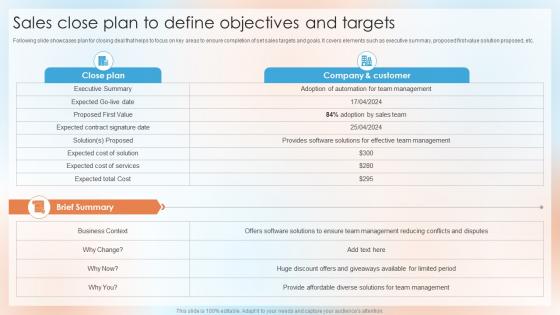
Following slide showcases plan for closing deal that helps to focus on key areas to ensure completion of set sales targets and goals. It covers elements such as executive summary, proposed first value solution proposed, etc.
People who downloaded this PowerPoint presentation also viewed the following :
Sales Close Plan To Define Objectives And Targets Top Sales Closing Techniques SA SS with all 9 slides:
Use our Sales Close Plan To Define Objectives And Targets Top Sales Closing Techniques SA SS to effectively help you save your valuable time. They are readymade to fit into any presentation structure.








FAQs for Sales Close Plan To Define Objectives And Targets Top Sales Closing
Effective closing techniques include the assumptive close, alternative choice close, urgency close, summary close, and question close, each tailored to specific buyer behaviors and decision-making styles. These approaches work by building momentum through assumption, simplifying decisions with options, and creating compelling reasons to act, with many sales professionals finding that matching closing techniques to customer personality types and purchase complexity ultimately delivers higher conversion rates and stronger client relationships.
Understanding customer psychology enhances closing techniques by identifying decision-making triggers, emotional motivators, and trust-building factors that influence purchasing behavior. Through psychological insights, sales professionals can tailor their approach, address specific concerns, and time their closing strategies more effectively, ultimately delivering higher conversion rates and stronger customer relationships.
Active listening plays a crucial role in sales closing by enabling salespeople to identify customer pain points, understand objections, and tailor solutions accordingly. Through attentive listening, sales professionals can address specific concerns, build trust and rapport, and position their offerings strategically, with many finding that customers feel more valued and confident in their purchasing decisions.
Sales professionals can tailor their closing techniques by identifying client personality types through communication style, decision-making patterns, and behavioral cues during conversations. Analytical buyers respond to data-driven closes with detailed ROI calculations, while relationship-oriented clients prefer consultative approaches emphasizing trust and partnership, ultimately enabling faster deal closure and stronger customer relationships.
Common objections during closing include price concerns, timing hesitancy, decision-maker absence, competitor comparisons, and feature uncertainties. Sales professionals overcome these by addressing price through value demonstration, creating urgency for timing objections, scheduling follow-ups with key stakeholders, and providing competitive differentiators, ultimately converting hesitation into commitment through strategic objection handling.
Timing significantly impacts closing success, as premature closes can damage rapport while delayed attempts risk losing momentum and buyer interest. Effective salespeople recognize buying signals like budget discussions, implementation questions, and stakeholder involvement, strategically positioning closes when prospects demonstrate readiness, ultimately improving conversion rates and maintaining positive customer relationships throughout the sales cycle.
Hard close techniques involve direct pressure and urgency, including assumptive closes and deadline ultimatums, while soft close techniques use consultative approaches, trial closes, and relationship-building methods. Hard closes work effectively with decisive buyers and time-sensitive deals, whereas soft closes enhance trust with hesitant prospects, ultimately delivering stronger long-term relationships and higher conversion rates.
Storytelling serves as a powerful closing technique by creating emotional connections, demonstrating real-world success, and helping prospects visualize positive outcomes with your solution. Through compelling customer narratives, sales professionals can address objections naturally, build trust through relatable scenarios, and guide prospects toward confident purchasing decisions, with many finding that well-crafted stories significantly reduce hesitation and accelerate deal completion.
Emotional appeals significantly influence purchasing decisions by connecting products to customer values, aspirations, and pain points, creating urgency and personal relevance that logic alone cannot achieve. Through storytelling, social proof, and benefit visualization, sales professionals help prospects envision positive outcomes, with many finding that emotional connections ultimately drive purchase decisions even when rational factors support the choice.
Follow-up communication improves closing rates by maintaining engagement, addressing lingering concerns, and demonstrating commitment to client success. Through strategic touchpoints, sales professionals can provide additional value, clarify solutions, and reinforce key benefits, with many organizations finding that consistent, personalized follow-up ultimately converts hesitant prospects into committed buyers.
Virtual sales closing best practices include maintaining eye contact through the camera, using interactive screen sharing, creating urgency with limited-time offers, asking direct closing questions, and leveraging digital tools for seamless contract signing. These techniques enhance engagement by building personal connection, demonstrating value visually, and streamlining the purchase process, with many sales teams finding that virtual presentations actually increase closing rates through focused, distraction-free environments.
Cultural differences significantly influence international sales closing by affecting communication styles, decision-making processes, relationship expectations, and negotiation timelines. While Western markets often favor direct approaches and quick decisions, Asian and Middle Eastern cultures typically require extended relationship-building phases, consensus-driven approvals, and indirect communication patterns, with many multinational companies finding that adapting closing techniques to local cultural norms ultimately delivers higher conversion rates and stronger client partnerships.
Sales professionals should track conversion rates, average deal size, sales cycle length, close ratio by technique, and customer lifetime value to evaluate closing effectiveness. These metrics enable teams to identify which approaches deliver faster conversions, higher-value deals, and stronger customer relationships, with many organizations finding that data-driven closing strategies ultimately enhance revenue performance and competitive positioning.
Building rapport establishes trust, reduces customer resistance, creates emotional connections, and transforms transactions into collaborative conversations. When customers feel understood and valued, they're more comfortable sharing concerns and budget constraints, enabling sales professionals to address objections proactively and tailor solutions effectively, ultimately accelerating decision-making and increasing closing success rates.
B2B sales benefit from consultative closes like the summary close, assumption close, and trial close, which address complex decision-making processes and multiple stakeholders. These techniques work by building consensus, addressing specific business outcomes, and allowing longer evaluation periods, while B2C sales often rely on urgency-based closes, with many B2B organizations finding that relationship-focused approaches ultimately deliver higher conversion rates.
-
Use of icon with content is very relateable, informative and appealing.
-
I was never satisfied with my own presentation design but SlideTeam has solved that problem for me. Thank you SlideTeam!