


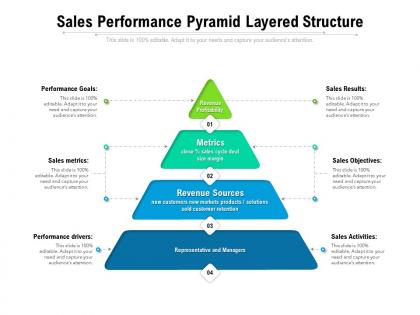
Sales performance pyramid layered structure




Try Before you Buy Download Free Sample Product
 Impress Your
 Audience
 100%
100% Editable
 Save Hours
 of Time


Our Sales Performance Pyramid Layered Structure are topically designed to provide an attractive backdrop to any subject. Use them to look like a presentation pro.
People who downloaded this PowerPoint presentation also viewed the following :
Sales performance pyramid layered structure with all 2 slides:
Use our Sales Performance Pyramid Layered Structure to effectively help you save your valuable time. They are readymade to fit into any presentation structure.
FAQs for Sales performance
So the Sales Performance Pyramid has four layers that stack on each other. Your foundation is basic skills - prospecting, qualifying, all that fundamental stuff. Layer two is knowledge about your product, market, competitors. Then comes behaviors and activities, which is honestly where most salespeople fall apart because staying consistent is hard as hell. Results sit at the top - your actual numbers. It's like building a house, you know? Weak foundation means everything else crumbles. I'd figure out which layer you're struggling with most and start there. The behavior layer usually needs the most work though, just saying.
Honestly, the pyramid is perfect for figuring out where your team's screwing up. Break down sales into levels - activities at bottom, results at top. See someone making tons of calls but zero meetings? Their pitch sucks or they can't qualify prospects. Way better than staring at crappy revenue numbers wondering wtf happened. You can actually trace problems backward through each layer. Skills issue? Activity problem? Bad process? You'll know exactly what's broken. Just map everyone's numbers against each pyramid level first - that's where you'll spot who needs help.
Map each rep's numbers against the pyramid to see exactly where they're falling short. Sometimes it's just call volume (I've watched managers overthink this when people literally weren't making enough calls). Other times their activity looks solid but conversions are trash - that's when you know it's a skills thing, not effort. Focus coaching on whatever pyramid level they're actually stuck at. Don't waste time teaching qualifying techniques to someone who needs to double their outreach first. We use it in team meetings too - turn moving up levels into friendly competition. People love seeing their progress that way.
Check your current numbers first - activity levels, conversion rates, pipeline quality, deal size, and how fast you're closing deals. Compare them to industry benchmarks or your past performance. Most people hate this part because the truth usually stings. Find your weakest area - that's where you're getting stuck. I've seen too many sales teams who think they're crushing it until they actually look at the data. Track everything consistently going forward. Then tackle your worst-performing level first before moving up the pyramid.
Think of data analytics as your GPS for the sales pyramid. Track 2-3 key metrics at each level - call volume at the bottom, revenue at the top. Weekly reviews work best (I tried daily but honestly got overwhelmed). The cool part? You'll spot patterns that completely change how you think about what actually works. Generic best practices are usually garbage for your specific situation. Your data will tell you which activities actually move the needle for YOUR team. Once you get hooked on the insights, it's hard to go back to guessing.
Yeah, just swap out those basic metrics for stuff that actually moves the needle in your sales process. Enterprise sales? Ditch "calls made" for "discovery meetings booked" or "demos completed." Map your real buyer journey to each pyramid level. If prospects need three touches before they'll meet, work that into your activity tracking. Different product lines might need their own pyramids too - I learned that one the hard way. Start by writing down what actually drives revenue for you, then stack it from high-volume activities at the bottom up to closed deals.
Dude, motivation is like the secret sauce that affects every level differently. Your bottom-tier reps? They need it just to do the boring stuff - cold calls, follow-ups, all that tedious work nobody wants to do. Skills-wise, it's what separates people who actually practice from those just phoning it in. Then you've got your strategic thinkers at the top who use motivation to pivot and try new approaches instead of staying stuck in their comfort zone. I've seen this so many times - when someone's numbers tank, nine times out of ten it's a motivation issue first. Everything else just crumbles from there.
So basically, you want to connect all your tech tools so they actually talk to each other. Your CRM should automatically track pipeline stuff - saves tons of time. Sales enablement platforms are clutch for coaching your team. Analytics tools will show you what's actually working (and what isn't, which is honestly more useful sometimes). Set up dashboards that flag when someone's struggling so you can jump in. The trick is making everything flow together seamlessly. Oh, and start with connecting your CRM to whatever training platform you're using first - that integration usually gives you the biggest bang for your buck.
Honestly, you'll want to track stuff at each level of your pyramid. Activity metrics at the bottom - calls, emails, meetings booked. Middle layer is your process stuff like conversion rates and how fast deals move through. Top level is the big picture - revenue, deal size, win rates. Here's the thing though - most teams obsess over just the revenue numbers, which is basically like driving while staring at your rearview mirror. Pretty useless for actually fixing problems. The real magic happens when you can pinpoint exactly where your process breaks down. I'd start simple - pick 2-3 key metrics per level that actually matter for your business specifically.
So the Sales Performance Pyramid basically lines up with your CRM setup - they're both about managing relationships through different phases. Your foundation stuff (prospecting, qualifying leads) connects straight to contact management and lead scoring in the CRM. Middle sections work with opportunity tracking and pipeline management. Here's what most people miss though - your CRM data can actually guide how you structure your pyramid approach! The closing deals part at the top ties into reporting and retention features. I'd start by checking how your current CRM stages match up with pyramid levels. You'll probably spot some weird gaps to fix.
Sales teams hate change, period. They'll fight you on new metrics because nobody wants to learn different ways of being judged. Your CRM data being a mess is another huge problem - if the info going in sucks, your whole pyramid falls apart. Leadership needs to actually care about this stuff or your reps will just ignore it completely. Oh, and don't try rolling out everything at once. Pick like one or two metrics first. Way easier to stomach that way, plus you can figure out what works before going all-in on the rest.
Talk to your reps monthly about what's actually working. They'll tell you straight up if those conversion rates are realistic or total BS from your spreadsheet. Maybe they're crushing the call volume but prospects aren't biting because the market shifted - stuff you wouldn't see from your desk. Listen when they say where they're getting stuck. Honestly, most sales metrics look great on paper but fall apart in real conversations. Their feedback helps you tweak things so the pyramid actually motivates people instead of just pissing them off. Set up those check-ins and actually use what they tell you.
So basically, explain the chain: behaviors → activities → results → outcomes. Everyone's obsessed with pyramid diagrams for some reason, so use one. Don't dump everything on them at once though - break it into smaller chunks. Your top performers need to buy in first because honestly, everyone else just follows them anyway. Skip the generic sales examples and use stuff from your actual team. The trick is explaining WHY they're tracking each level, not just what to track. Give them clear metrics for each part. When they nail the bottom levels, the top ones improve automatically. It's pretty straightforward once they see it.
Honestly, I'd check it monthly if you can manage it. Markets change so fast these days - way faster than people think. Do the big quarterly reviews for trend analysis and bigger process changes, but those monthly check-ins? They'll save your butt when things start going sideways. Annual planning is basically useless at this point, everything moves too quick. Oh and here's the thing - just block out 30 minutes next month to look at what metrics are actually working. Don't overthink it. Most people wait too long and miss obvious problems that could've been fixed early.
Look, you're the one setting the whole vibe here. If your team doesn't feel safe admitting they suck at cold calling or whatever, the pyramid thing is just wall decoration. Model what you want to see - like actually do your own prospecting instead of just talking about it. When performance tanks, fight that itch to jump straight into "try this tactic!" mode. Boring foundations work better long-term, even if it feels slower. Oh, and check your coaching convos - are you fixing the real problem or just slapping band-aids on symptoms? Your reps will call out any BS immediately anyway.
-
Commendable slides with attractive designs. Extremely pleased with the fact that they are easy to modify. Great work!
-
Content of slide is easy to understand and edit.
-
Unique research projects to present in meeting.
-
Innovative and attractive designs.
-
Unique and attractive product design.
-
It saves your time and decrease your efforts in half.