


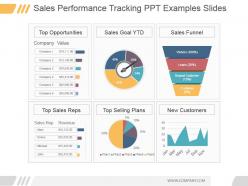
Sales performance tracking ppt examples slides





Try Before you Buy Download Free Sample Product
 Impress Your
 Audience
 100%
100% Editable
 Save Hours
 of Time


Consider all the different angles with our Sales Performance Tracking Ppt Examples Slides. You will achieve a good balance.
People who downloaded this PowerPoint presentation also viewed the following :
Sales performance tracking ppt examples slides with all 5 slides:
Get the break you deserve with our Sales Performance Tracking Ppt Examples Slides. They assure you the best chance ever.
FAQs for Sales performance tracking
Essential KPIs include conversion rates, average deal size, sales cycle length, lead response time, and revenue per salesperson, alongside pipeline velocity and customer acquisition costs. These metrics enable sales teams to identify bottlenecks, optimize processes, and forecast accurately, with many organizations finding that comprehensive tracking ultimately delivers improved quota attainment and strategic resource allocation.
Data visualization enhances sales performance understanding by transforming complex metrics into intuitive charts, graphs, and dashboards that reveal patterns, trends, and outliers instantly. Through interactive visualizations, sales teams can identify top performers, spot seasonal fluctuations, and track progress against targets in real-time, ultimately enabling faster decision-making and strategic adjustments that drive revenue growth.
Machine learning analyzes historical sales data, customer behaviors, market conditions, and seasonal patterns to forecast future performance trends with remarkable accuracy. These algorithms enable sales teams to identify emerging opportunities, predict pipeline outcomes, and optimize resource allocation, with many organizations finding that predictive insights ultimately deliver improved forecasting precision and competitive advantage.
Sales performance reviews should be conducted monthly for comprehensive assessments, with weekly check-ins for pipeline updates and quarterly reviews for strategic planning and goal adjustments. This multi-tiered approach enables managers to address issues promptly, recognize achievements consistently, and maintain momentum, while sales teams receive regular feedback and course corrections, ultimately delivering improved conversion rates, enhanced accountability, and sustained revenue growth across organizations.
Common challenges include inconsistent data collection across teams, lack of real-time visibility into pipeline metrics, difficulty integrating multiple sales platforms, and inadequate performance benchmarking systems. These obstacles often result in delayed decision-making and missed revenue opportunities, with many organizations finding that fragmented tracking systems ultimately hinder their ability to identify top performers, optimize sales processes, and maintain competitive advantage in increasingly dynamic markets.
CRM software enhances sales performance tracking by centralizing customer data, automating lead scoring, monitoring conversion rates, and providing real-time analytics dashboards. Through integrated reporting tools, sales teams can identify bottlenecks, track individual representative performance, and optimize pipeline management, with many organizations finding that streamlined data visibility ultimately delivers faster deal closures and improved revenue forecasting.
Comparing sales performance across different time periods enables businesses to identify trends, measure growth trajectories, assess seasonal impacts, and evaluate strategic initiatives' effectiveness. This temporal analysis helps organizations optimize resource allocation, refine forecasting accuracy, and adjust sales strategies proactively, with many companies finding that historical comparisons ultimately deliver improved decision-making and sustainable competitive advantage.
Effectively communicating sales performance results involves presenting data through visual dashboards, conducting regular team meetings with clear metrics breakdowns, and providing individual feedback sessions that highlight both achievements and improvement areas. This approach enables sales managers to foster transparency, motivate team members through recognition, and address performance gaps proactively, ultimately delivering enhanced team cohesion and accelerated revenue growth.
Sales training significantly enhances performance tracking by teaching teams to utilize CRM systems, interpret analytics dashboards, set measurable goals, and identify key performance indicators more effectively. Well-trained sales professionals consistently demonstrate improved conversion rates, shorter sales cycles, and higher quota attainment, with many organizations finding that structured training programs ultimately deliver 15-20% performance improvements across their teams.
Sales forecasting integrates into performance tracking by comparing predicted revenues against actual results, analyzing pipeline conversion rates, and monitoring deal progression velocity. This strategic combination enables sales teams to identify performance gaps early, adjust tactics proactively, and optimize resource allocation, with many organizations finding that integrated forecasting delivers more accurate predictions and enhanced team accountability.
Methods to ensure data accuracy in sales performance tracking include automated data validation, real-time CRM integration, standardized input protocols, regular audit procedures, and cross-verification systems. These approaches streamline reporting by minimizing human error, establishing consistent data entry standards, and enabling immediate error detection, with many organizations finding that automated validation ultimately delivers more reliable insights and faster decision-making capabilities.
Cultural factors significantly influence sales performance tracking through varying communication styles, relationship-building approaches, individual versus team recognition preferences, and differing attitudes toward hierarchy and feedback mechanisms. Organizations operating globally must adapt their tracking methodologies to accommodate cultural nuances, with many multinational companies finding that localized performance metrics and culturally sensitive reporting structures ultimately enhance both employee engagement and sales outcomes.
Benchmarks in sales performance analysis provide objective measurement standards, identify performance gaps, enable competitive positioning, facilitate goal setting, and drive accountability across teams. Through industry comparisons and historical data analysis, sales organizations can pinpoint improvement opportunities, motivate underperformers, and replicate successful strategies, ultimately delivering enhanced productivity and strategic advantage in increasingly competitive markets.
Lead conversion rates should be measured across multiple funnel stages, tracking leads-to-opportunities, opportunities-to-proposals, and proposals-to-closed deals, along with velocity metrics and source attribution. Financial services firms and software companies increasingly analyze conversion data by lead source, sales rep performance, and timeline patterns, enabling targeted coaching interventions and resource allocation adjustments that ultimately enhance pipeline predictability and revenue outcomes.
Employee feedback enhances sales performance tracking by providing qualitative insights into customer interactions, identifying process bottlenecks, and revealing training needs that numbers alone cannot capture. Sales representatives can share real-time market intelligence, highlight system inefficiencies, and suggest process improvements, while managers gain deeper context behind performance metrics, ultimately creating more accurate assessments and targeted development strategies.
-
Awesome use of colors and designs in product templates.
-
Innovative and attractive designs.