


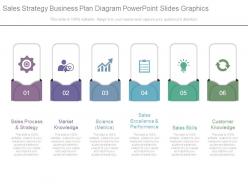
Sales strategy business plan diagram powerpoint slides graphics





Try Before you Buy Download Free Sample Product
 Impress Your
 Audience
 100%
100% Editable
 Save Hours
 of Time


Your ideas have an immediate impact due to our Sales Strategy Business Plan Diagram Powerpoint Slides Graphics. You will get across in a jiffy.
People who downloaded this PowerPoint presentation also viewed the following :
Sales strategy business plan diagram powerpoint slides graphics with all 7 slides:
Facilitate convergence of cultures with our Sales Strategy Business Plan Diagram Powerpoint Slides Graphics. Highlight the essentially common concepts.

FAQs for Sales strategy business plan diagram
Key components of an effective sales strategy include clear target market identification, comprehensive competitor analysis, defined value propositions, structured sales processes, and performance measurement systems. These elements work together by aligning sales teams with customer needs, streamlining lead qualification and conversion processes, and enabling data-driven decisions, with many organizations finding that integrated approaches deliver higher close rates and sustainable revenue growth.
Businesses leverage data analytics to enhance sales strategy by identifying customer behavior patterns, predicting purchase trends, optimizing pricing models, and personalizing outreach campaigns. Through predictive analytics and CRM integration, organizations streamline lead scoring, improve conversion rates, and allocate resources more effectively, ultimately delivering higher revenue growth and competitive advantage in increasingly data-driven markets.
Customer segmentation plays a fundamental role in sales strategy by enabling organizations to tailor their approach, messaging, and resource allocation to specific customer groups based on demographics, behavior, and needs. This strategic segmentation allows sales teams to personalize outreach, prioritize high-value prospects, and optimize conversion rates, with many companies finding that targeted approaches deliver significantly higher ROI and stronger customer relationships.
Adapting sales strategy for digital-first environments involves leveraging CRM automation, social selling platforms, virtual meeting tools, data analytics, and personalized content delivery systems. These technologies streamline lead generation, enhance customer engagement, and accelerate deal closure through targeted outreach, with many organizations finding that digital integration reduces sales cycles while improving conversion rates and customer experiences.
Key metrics include conversion rates, customer acquisition cost, average deal size, sales cycle length, and customer lifetime value. These indicators enable organizations to assess revenue efficiency, resource allocation effectiveness, and long-term profitability, with many companies finding that tracking pipeline velocity and win rates delivers clearer insights into strategic performance and competitive positioning.
Storytelling transforms sales presentations by incorporating customer success narratives, problem-solution scenarios, and relatable case studies that resonate emotionally with prospects. Through strategic narrative frameworks, sales teams create memorable connections, build trust, and demonstrate value propositions more effectively, with many organizations finding that story-driven presentations significantly increase engagement rates and conversion outcomes.
Sales teams can overcome objections through active listening, empathy-driven responses, evidence-based rebuttals, strategic questioning, and collaborative problem-solving techniques. These approaches enable representatives to address concerns by acknowledging client perspectives, presenting relevant case studies, and reframing objections as opportunities, with many organizations finding that this consultative methodology significantly improves conversion rates and builds stronger client relationships.
Competitor analysis and market research inform sales strategy by identifying market gaps, customer pain points, pricing benchmarks, and competitive positioning opportunities. Through comprehensive market intelligence, sales teams can differentiate their value propositions, target underserved segments, and craft compelling messaging that addresses specific customer needs, ultimately delivering higher conversion rates and sustainable competitive advantage.
Marketing and sales alignment strategies include shared metrics and KPIs, collaborative content creation, unified customer journey mapping, regular cross-team communication, and integrated CRM systems. These approaches streamline lead generation and nurturing by ensuring consistent messaging, improving lead quality, and accelerating conversion rates, with many organizations finding that aligned teams deliver 36% higher customer retention and significantly faster revenue growth.
CRM systems optimize sales strategies by centralizing customer data, automating follow-ups, tracking lead progression, and providing detailed analytics for informed decision-making. Through advanced features like predictive analytics and automated workflows, sales teams streamline prospecting, enhance customer relationships, and accelerate deal closures, ultimately delivering improved conversion rates and sustained revenue growth.
A customer-centric sales approach significantly improves closing rates by focusing on buyer needs, pain points, and desired outcomes rather than product features. This strategy builds stronger relationships and trust, with sales teams in sectors like software, financial services, and healthcare finding that personalized solutions and consultative selling ultimately deliver higher conversion rates and increased deal values.
Sales teams can effectively utilize social media by leveraging platforms for lead generation, relationship building, social listening, content sharing, and prospect research. Through LinkedIn outreach, Twitter engagement, and Facebook community building, sales professionals enhance customer interactions, identify buying signals, and build trust with potential clients, ultimately delivering stronger conversion rates and deeper customer relationships.
Best practices for training sales staff include structured onboarding programs, hands-on simulations, peer mentoring systems, regular coaching sessions, and continuous feedback mechanisms. Through role-playing exercises and real-world case studies, organizations streamline knowledge transfer, enhance skill adoption, and accelerate performance improvements, with many finding that ongoing reinforcement and personalized coaching ultimately deliver higher conversion rates and stronger customer relationships.
Companies can ensure scalable sales strategies by standardizing processes, investing in CRM systems, developing repeatable training programs, and establishing clear performance metrics across teams. Through documented methodologies and automated tools, growing organizations streamline lead management, enhance sales forecasting, and maintain consistent customer experiences, ultimately delivering predictable revenue growth while reducing per-acquisition costs.
Follow-up plays a crucial role in successful sales strategies by nurturing relationships, addressing concerns, and maintaining momentum throughout lengthy sales cycles. Through systematic follow-up processes, sales teams convert more prospects, reduce customer churn, and build lasting partnerships, with many organizations finding that consistent follow-up increases close rates by maintaining trust and demonstrating commitment.
-
Really like the color and design of the presentation.
-
Very unique and reliable designs.