


Sales Team Skills Assessment Matrix Sales Performance Improvement Plan





Try Before you Buy Download Free Sample Product
 Impress Your
 Audience
 100%
100% Editable
 Save Hours
 of Time


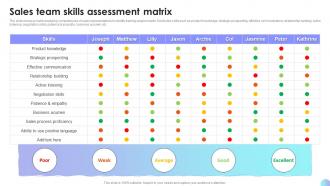
The slide shows a matrix analyzing competencies of sales representatives to identify training requirements. It includes skills such as product knowledge, strategic prospecting, effective communication, relationship building, active listening, negotiation skills, patience and empathy, business acumen, etc.
People who downloaded this PowerPoint presentation also viewed the following :
Sales Team Skills Assessment Matrix Sales Performance Improvement Plan with all 6 slides:
Use our Sales Team Skills Assessment Matrix Sales Performance Improvement Plan to effectively help you save your valuable time. They are readymade to fit into any presentation structure.





FAQs for Sales Team Skills Assessment Matrix Sales
Key sales performance KPIs include conversion rates, average deal size, sales cycle length, customer acquisition cost, and revenue per salesperson. These metrics work together by tracking efficiency, profitability, and growth velocity, with many organizations finding that combining leading indicators like pipeline quality with lagging indicators delivers comprehensive performance insights and sustainable competitive advantage.
Sales training programs can be tailored by conducting performance assessments, analyzing individual skill deficiencies, customizing content delivery methods, and focusing on role-specific competencies like negotiation or product knowledge. Through targeted modules addressing specific gaps, organizations streamline skill development, enhance conversion rates, and accelerate revenue growth, with many sales teams finding that personalized training approaches ultimately deliver measurable performance improvements and competitive advantage.
Technology enhances sales performance through CRM systems, automation tools, analytics platforms, AI-powered insights, and mobile solutions that streamline workflows and optimize customer interactions. These technologies enable sales teams to track leads more effectively, automate repetitive tasks, and access real-time data, ultimately delivering faster response times, improved conversion rates, and enhanced productivity across organizations.
Sales teams leverage data analytics to identify improvement areas by analyzing conversion rates, pipeline velocity, customer acquisition costs, lead quality metrics, and performance benchmarks across territories and representatives. Through predictive analytics and real-time dashboards, organizations can pinpoint bottlenecks in their sales processes, optimize resource allocation, and enhance targeting strategies, ultimately delivering faster deal closure and increased revenue growth.
Effective strategies include recognition programs, competitive incentives, professional development opportunities, transparent communication, and collaborative goal-setting initiatives. Through regular coaching sessions and team-building activities, sales organizations enhance performance, reduce turnover, and create positive work cultures, with many companies finding that motivated teams consistently exceed targets while delivering superior customer experiences.
Market trends significantly influence sales performance by shifting customer preferences, altering buying behaviors, and creating new competitive landscapes that directly impact revenue outcomes. Sales teams can adapt by leveraging data analytics to identify emerging patterns, adjusting their messaging strategies, and realigning product positioning, with many organizations finding that proactive trend monitoring and agile response strategies ultimately deliver enhanced customer engagement and sustained competitive advantage.
Best practices for setting achievable sales goals include analyzing historical performance data, incorporating market conditions and seasonal trends, aligning targets with available resources, establishing incremental milestones, and ensuring goals support broader business objectives. These approaches enhance performance by creating realistic benchmarks, maintaining team motivation through attainable targets, and enabling strategic resource allocation, with many organizations finding that well-calibrated goals ultimately deliver sustained revenue growth and improved sales team retention.
Customer feedback refines sales strategies by identifying pain points in the buying process, revealing product positioning gaps, and highlighting successful relationship-building approaches. Through systematic analysis of client responses, sales teams can adjust their messaging, streamline proposal processes, and enhance follow-up practices, ultimately delivering more personalized experiences and higher conversion rates.
Collaboration between sales and marketing enhances performance through shared lead qualification processes, unified customer messaging, coordinated campaign strategies, and integrated data analytics systems. This strategic alignment streamlines customer journeys, reduces conversion time, and improves lead quality, with many organizations finding that synchronized teams deliver significantly higher revenue growth and stronger competitive positioning.
Organizations commonly make mistakes like focusing solely on individual performance rather than team dynamics, implementing generic training without addressing specific skill gaps, neglecting to align sales processes with customer buying journeys, and failing to leverage data analytics for strategic insights. These oversights often result in wasted resources and minimal improvement, with many companies finding that sustainable sales growth requires integrated approaches combining targeted coaching, process optimization, and technology adoption to deliver measurable results.
Ongoing coaching and mentoring are critical for sustaining sales performance improvements, as they reinforce new behaviors, address emerging challenges, and adapt strategies to evolving market conditions. Through regular feedback sessions and skill development, sales teams maintain momentum while building long-term capabilities, with many organizations finding that consistent coaching delivers 20-30% higher performance retention rates.
Sales leaders should focus on metrics including conversion rates, sales cycle length, customer acquisition cost, average deal size, pipeline velocity, and customer lifetime value. These comprehensive indicators streamline performance assessment by revealing bottlenecks, optimizing resource allocation, and identifying growth opportunities, with many organizations finding that this strategic combination ultimately delivers enhanced forecasting accuracy and sustainable revenue growth.
Sales processes can be streamlined through automation of repetitive tasks, implementation of CRM systems, standardization of lead qualification criteria, and integration of data analytics for performance tracking. These improvements enable sales teams to focus on high-value activities, reduce administrative burden, and accelerate deal closure, with many organizations finding that streamlined processes increase conversion rates by 20-30% while enhancing customer experiences.
Leadership style significantly impacts sales team performance through communication approaches, motivation strategies, goal-setting methods, and coaching effectiveness. Transformational leaders who provide clear direction and regular feedback often see enhanced team collaboration and individual accountability, while supportive leadership styles help sales professionals adapt to market changes, ultimately delivering improved conversion rates and sustained revenue growth across diverse sales environments.
Sales professionals develop resilience through continuous learning, structured feedback analysis, strong support networks, and goal reframing techniques. These approaches help by building emotional intelligence, creating accountability systems, and maintaining forward momentum during challenging periods, with many organizations finding that resilient sales teams ultimately deliver higher performance, stronger client relationships, and sustained competitive advantage.
-
Their designing team is so expert in making tailored templates. They craft the exact thing I have in my mind…..really happy.
-
Awesomely designed templates, Easy to understand.