


Sample cloud computing document management ppt




Try Before you Buy Download Free Sample Product
 Impress Your
 Audience
 100%
100% Editable
 Save Hours
 of Time


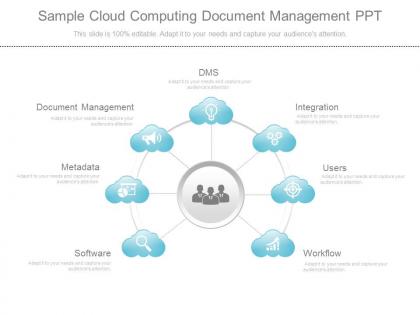
Take some time to check our Sample Cloud Computing Document Management PPT slide. Our designers has created this masterpiece after complete research. The PPT slide covers the different stages in the cloud computing document process such as integration, users, workflow, software, metadata, document management and DMS. Not many people are aware of these terms as people working in technology sector are aware of them. With the advancement of technology every day, it is difficult to manage business documents. Every organization uses one or the other interface to store the data and access whenever required. Many platforms are available to manage business documents such as doclanding, docusign, netdocuments etc. Business professionals ensures that their data is protected in the safest way. Our presentation slide enables you to share this cloud computing document management information with your team or clients in the best possible way. Just download the design and then present it as per your requirement.Evoke charity with our Sample Cloud Computing Document Management Ppt. Compassion will begin to build.
People who downloaded this PowerPoint presentation also viewed the following :
Sample cloud computing document management ppt with all 7 slides:
Get the audience head over heels with our Sample Cloud Computing Document Management Ppt. They will feel forcefully attracted.





FAQs for Sample cloud computing
Key benefits include enhanced accessibility, improved collaboration, automatic backups, reduced IT costs, and seamless scalability across organizations. These cloud-based systems streamline workflow efficiency by enabling remote access, real-time editing, and centralized storage, with many enterprises finding that they reduce operational overhead while delivering faster document retrieval and enhanced security protocols.
Cloud-based document management enhances collaboration by enabling real-time editing, centralized access, version control, automatic synchronization, and seamless sharing across devices and locations. Teams in industries like consulting, legal services, and project management find that these systems streamline workflows, reduce email dependency, and accelerate decision-making processes while ensuring everyone works with current information.
Organizations should consider end-to-end encryption, multi-factor authentication, role-based access controls, regular security audits, and compliance certifications when adopting cloud document management solutions. These measures work together to protect sensitive data while enabling seamless collaboration, with many financial services and healthcare institutions finding that comprehensive security frameworks ultimately deliver both regulatory compliance and enhanced operational efficiency.
Cloud document management enhances remote team accessibility by enabling real-time collaboration, synchronized file sharing, mobile device compatibility, and 24/7 availability from any location with internet connectivity. These capabilities streamline workflows by eliminating version control issues, reducing email dependency, and facilitating instant updates, with many distributed organizations finding that centralized cloud platforms ultimately deliver faster project completion and improved team productivity.
Cloud document management systems vary significantly in scalability, with enterprise platforms like Microsoft SharePoint and Google Workspace offering virtually unlimited storage and user capacity, while smaller solutions may have defined limits. These systems enhance organizational growth by providing flexible storage allocation, seamless user onboarding, and automated resource scaling, with many large institutions finding that cloud-based solutions deliver superior cost efficiency and performance consistency compared to traditional on-premise alternatives.
Artificial intelligence enhances cloud-based document management through automated document classification, intelligent search capabilities, content extraction, and workflow optimization. AI-powered systems streamline operations by recognizing document types, extracting key data, and routing files automatically, with organizations in legal, healthcare, and financial services finding significantly improved processing speeds and reduced manual tasks.
Businesses ensure compliance through encrypted storage, access controls, audit trails, data residency options, and regular security assessments within cloud document management systems. These safeguards enable organizations in healthcare, finance, and legal sectors to meet GDPR, HIPAA, and SOX requirements while streamlining document workflows, ultimately delivering regulatory confidence and operational efficiency.
Transitioning to cloud document management typically reduces upfront infrastructure costs, eliminates server maintenance expenses, and converts capital expenditures to predictable subscription fees. Organizations like healthcare systems and law firms often find significant savings through reduced IT staffing needs, automatic updates, and pay-as-you-scale pricing models, ultimately delivering lower total cost of ownership.
Cloud document management systems support version control through automated tracking, timestamping, real-time synchronization, audit trails, and rollback capabilities that maintain comprehensive document histories. These systems enable organizations to monitor changes seamlessly, prevent conflicting edits, and ensure regulatory compliance, with many enterprises finding that centralized version control significantly reduces errors while enhancing collaboration efficiency and document security.
Common implementation challenges include data migration complexities, security and compliance concerns, user adoption resistance, integration with existing systems, and cost management issues. Organizations often encounter workflow disruptions during transition periods, with many financial services and healthcare institutions finding that phased rollouts and comprehensive staff training significantly minimize resistance while ensuring regulatory compliance and operational continuity.
Businesses can measure cloud document management ROI through cost reduction metrics, productivity gains, compliance improvements, and storage savings compared to traditional systems. By tracking reduced IT maintenance costs, faster document retrieval times, enhanced collaboration efficiency, and decreased physical storage expenses, organizations typically find measurable returns within months, ultimately delivering competitive advantage through streamlined operations.
Organizations should prioritize robust security protocols, seamless integration capabilities, scalable storage solutions, comprehensive version control, and intuitive user interfaces when selecting cloud document management providers. These features streamline operations by enhancing collaboration, ensuring compliance, and minimizing administrative overhead, with many enterprises finding that strategic provider selection ultimately delivers improved productivity and competitive advantage.
Integration with existing software systems significantly enhances cloud document management effectiveness by eliminating data silos, streamlining workflows, and reducing manual document transfers between platforms. Through seamless API connections and automated synchronization, organizations can access documents directly within their CRM, ERP, or project management tools, ultimately delivering faster decision-making and improved operational efficiency across departments.
Best practices for training employees on new cloud document management technologies include hands-on workshops, role-based training modules, comprehensive security protocols education, collaborative learning sessions, and ongoing support resources. These approaches streamline adoption by addressing specific workflow needs, building confidence through practical experience, and ensuring compliance standards, with many organizations finding that phased implementation alongside peer mentoring ultimately delivers faster proficiency and enhanced productivity.
Cloud document management strengthens disaster recovery by providing automatic data replication, real-time backups, and geographically distributed storage across multiple data centers. These systems enable organizations to maintain business operations during emergencies, with financial services and healthcare institutions finding that cloud-based documents remain accessible even when physical offices are compromised, ultimately delivering operational resilience and minimized downtime.
-
Commendable slides with attractive designs. Extremely pleased with the fact that they are easy to modify. Great work!
-
Excellent work done on template design and graphics.