


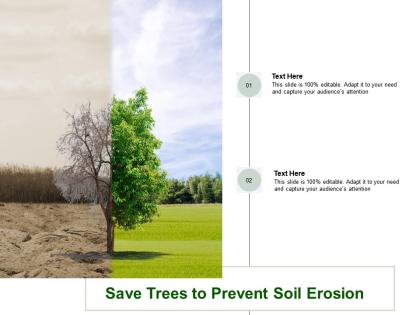
Save trees to prevent soil erosion




Try Before you Buy Download Free Sample Product
 Impress Your
 Audience
 100%
100% Editable
 Save Hours
 of Time


Groom them for the future with our Save Trees To Prevent Soil Erosion. They will develop into a capable bunch.
People who downloaded this PowerPoint presentation also viewed the following :
Save trees to prevent soil erosion with all 6 slides:
Groom them correctly with our Save Trees To Prevent Soil Erosion. They are good for building character.





FAQs for Save trees to
Individuals can contribute to tree conservation through planting native species, supporting local reforestation programs, participating in community tree care initiatives, advocating for green space protection, and choosing sustainable products. These conservation efforts enhance urban air quality, reduce energy costs through natural cooling, and create healthier neighborhoods, with many communities finding that collective action delivers significant environmental and economic benefits.
Deforestation significantly disrupts local ecosystems by eliminating wildlife habitats, reducing species diversity, fragmenting food chains, and altering water cycles. Forest-dependent communities, from tropical rainforests to temperate woodlands, experience cascading effects including soil erosion, decreased carbon storage, and loss of medicinal plants, ultimately threatening ecological balance and long-term environmental sustainability.
Trees combat climate change by absorbing carbon dioxide, releasing oxygen, providing natural cooling through shade, reducing urban heat islands, and filtering air pollutants like particulates and nitrogen oxides. Through strategic urban forestry initiatives, cities like Singapore and Copenhagen enhance air quality, lower energy costs, and create healthier environments, ultimately delivering improved public health outcomes and sustainable community development.
Businesses can implement sustainable practices through digital transformation, sustainable sourcing policies, paper reduction initiatives, carbon offset programs, and supply chain transparency measures. These approaches streamline operations by minimizing waste, enhancing resource efficiency, and reducing environmental impact, with many organizations finding that forest protection efforts ultimately deliver cost savings and competitive advantage.
**INPUT**: What are some innovative technologies being used to monitor and preserve tree populations? **OUTPUT**: Innovative tree monitoring technologies include satellite imagery systems, IoT sensors, drone surveillance, LiDAR mapping, and AI-powered forest analytics platforms. These technologies streamline conservation efforts by delivering real-time health assessments, tracking deforestation patterns, and enabling predictive maintenance, with many environmental organizations finding that automated monitoring ultimately reduces operational costs while enhancing preservation outcomes. [Word count: 55 words]
Urbanization typically reduces tree cover by 20-40% through development expansion, infrastructure needs, and land conversion for housing and commercial spaces. Strategic mitigation includes implementing green building codes, creating urban forest ordinances, establishing tree preservation zones, and requiring developer compensation programs, with cities like Singapore and Portland finding that mandatory canopy coverage requirements and public-private partnerships ultimately deliver enhanced air quality, reduced energy costs, and improved community resilience.
Educational programs about trees influence public awareness by demonstrating environmental benefits, teaching sustainable practices, highlighting climate impact, and connecting forest health to community well-being. These initiatives enhance understanding through hands-on activities, school curricula, and community workshops, with many municipalities finding that informed citizens increasingly support tree preservation policies, participate in planting initiatives, and adopt eco-friendly behaviors.
Individuals and organizations can participate through community reforestation programs, corporate sustainability partnerships, volunteer initiatives with environmental groups, adopting forest areas, and supporting tree-planting nonprofits through donations or employee engagement programs. These strategic approaches enable businesses to enhance their environmental credentials while delivering measurable sustainability outcomes, with many organizations finding that tree-planting initiatives strengthen stakeholder relationships and brand reputation.
Healthy urban trees deliver significant mental health benefits through stress reduction, improved air quality, enhanced mood regulation, and increased opportunities for outdoor recreation and social interaction. These natural environments enable city dwellers to experience lower anxiety levels, better cognitive function, and stronger community connections, while providing accessible green spaces that promote physical activity and psychological restoration.
Indigenous cultures view forests as sacred ecosystems integral to their spiritual beliefs, cultural identity, and survival, protecting them through traditional ecological knowledge, sustainable harvesting practices, and community-based governance systems. These communities often serve as the most effective forest guardians, with indigenous-managed territories showing significantly lower deforestation rates than government-protected areas, ultimately delivering both biodiversity conservation and climate benefits.
Trees in agricultural systems provide soil conservation, windbreaks, nutrient cycling, biodiversity enhancement, and climate regulation through strategic integration with crops and livestock. Through agroforestry practices, farming operations achieve improved soil fertility, reduced erosion, enhanced water retention, and diversified income streams, while coffee plantations, fruit orchards, and silvopasture systems demonstrate how trees ultimately deliver sustainable productivity and environmental resilience.
Governments can create effective forest conservation policies through strategic land-use regulations, sustainable logging permits, reforestation incentives, carbon credit programs, and protected area designations. These comprehensive approaches work by balancing economic interests with environmental protection, enabling countries like Costa Rica and Finland to achieve significant forest recovery while maintaining timber industries, ultimately delivering both ecological preservation and economic sustainability.
Conservationists face habitat destruction, climate change, invasive species, limited funding, and regulatory obstacles when protecting endangered trees. These challenges are particularly acute in biodiverse regions like rainforests and temperate forests, where organizations increasingly find that strategic partnerships with governments, corporations, and local communities deliver enhanced conservation outcomes and sustainable resource management.
Trees contribute to water conservation and soil preservation by stabilizing soil with extensive root systems, reducing erosion through canopy coverage, and enhancing groundwater recharge through improved infiltration. These natural mechanisms enable agricultural operations, urban developments, and conservation initiatives to maintain sustainable water resources while preventing costly soil degradation, ultimately delivering enhanced environmental resilience and long-term operational sustainability.
Creative fundraising ideas for tree-planting efforts include virtual tree adoption programs, corporate sponsorship packages, community tree-naming ceremonies, green product sales partnerships, and crowdfunded reforestation challenges. These approaches streamline donor engagement by offering tangible impact visibility, scalable participation options, and measurable environmental outcomes, with many environmental organizations finding that personalized giving experiences significantly enhance long-term supporter retention and community involvement.
No Reviews