


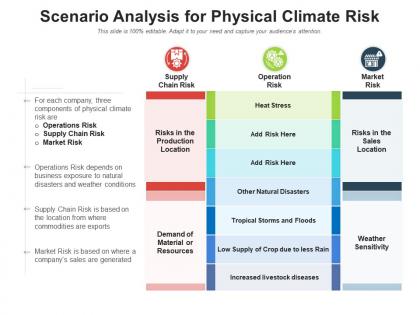
Scenario analysis for physical climate risk




Try Before you Buy Download Free Sample Product
 Impress Your
 Audience
 100%
100% Editable
 Save Hours
 of Time


Our Scenario Analysis For Physical Climate Risk are topically designed to provide an attractive backdrop to any subject. Use them to look like a presentation pro.
People who downloaded this PowerPoint presentation also viewed the following :
Scenario analysis for physical climate risk with all 2 slides:
Use our Scenario Analysis For Physical Climate Risk to effectively help you save your valuable time. They are readymade to fit into any presentation structure.
FAQs for Scenario analysis for
So you're gonna need four main things: hazard identification, exposure assessment, vulnerability analysis, and risk evaluation. Start by figuring out what climate threats could actually hit your operations - extreme weather, sea level changes, temperature shifts, whatever. Then see which of your assets are really exposed to those specific hazards. The vulnerability part's honestly the trickiest because you're basically trying to figure out how badly each threat could mess up your systems. After that, combine it all to get your overall risk picture. Oh and don't waste time on irrelevant stuff - like why model tornado risk if you're nowhere near tornado alley, you know?
So first thing - map your climate risks against the stuff you're already tracking. Operations, finances, strategy, reputation, whatever buckets you use. Most companies keep climate separate which is kinda dumb tbh. Build climate scenarios right into your normal risk processes. Your risk committees need to actually get how climate hits the business. Physical stuff like floods is obvious, but policy changes can wreck you too - honestly that's what I'd worry about more. Don't try to boil the ocean though. Pick one business unit, nail it there, then expand.
Most companies use three main approaches: scenario analysis, stress testing, and probabilistic modeling. Scenario analysis is super popular - you map out different climate futures (1.5°C vs 3°C warming) and see how they'd affect your business. Stress testing? That's where you push systems to their limits under extreme weather. The math gets pretty messy with these models, not gonna lie. Probabilistic methods try to put actual numbers on risk and impact. Oh, and most places end up mixing methods since one approach won't capture everything. I'd definitely start with scenario analysis if you're new to this.
So basically, physical risks are when climate change directly smacks your business - floods destroying warehouses, hurricanes messing up your supply chain, that kind of stuff. Transition risks? Those hit differently. They're from everyone moving toward cleaner energy and carbon regulations. Like suddenly your product becomes illegal or you're paying crazy carbon taxes. I always think of it as physical risks attacking you directly, while transition risks are more like the whole world shifting underneath you. Both suck for business obviously, but you'd handle them totally differently.
Start with NOAA and NASA - they've got the best long-term records and solid quality control. Your national weather service is great too. IPCC reports have good projections but honestly they're a slog to get through. For stuff specific to your area, try regional climate centers and university stations since they dig deeper into local patterns. Insurance databases are actually really useful for extreme weather data - who knew? Oh, and all the government sources are free which is nice. Build from those first, then you can add more specialized datasets once you've got the basics down.
So basically, instead of betting everything on one climate prediction, scenario analysis lets you test how your company would handle different futures. Run your risks through 2-3 established scenarios - maybe high warming, low warming, different policy responses. Think of it like stress-testing your assumptions, honestly. Single forecasts miss stuff that could bite you later. The IPCC pathways are solid starting points if you don't know where to begin. You'll spot vulnerabilities you'd never catch otherwise, plus you won't be scrambling if things don't go as expected. Multiple backup plans beat crossing your fingers any day.
Dude, stakeholders are everything for climate risk assessments. Get input from employees, customers, suppliers, community folks - they spot stuff you'd totally miss sitting in your office. They'll validate your scenarios and straight up tell you when you're being ridiculous about assumptions (which honestly happens more than you'd think). Early engagement is key, not some last-minute survey nonsense. These people actually live with whatever responses you come up with, so their buy-in matters for developing realistic strategies. Don't treat it like checking boxes - you need their perspective throughout the whole process.
Honestly, just pick the climate stuff that'll actually mess with your business - don't go crazy trying to do everything. NOAA's got this free climate explorer tool that's pretty solid for checking what risks you're facing locally. Your industry association probably has templates made for smaller companies (way easier than starting from zero, trust me). Maybe team up with other small businesses to split consultant costs if you need that level of detail. Really though, even just writing down your top 5 climate risks beats having nothing at all. You can always build on it later once you've got the basics sorted.
Look, climate risk totally flips investment analysis on its head. You've got to price in stuff like whether that beachfront property gets flooded every other year, or if oil companies are gonna get crushed by new regulations. Pretty crazy we ignored this for so long, honestly. These assessments show you which sectors and regions are screwed - then you either stay away or charge way more for the risk. My cousin works in real estate and she's finally starting to get this. Start working climate scenarios into your research process because everyone from regulators to pension funds expects it now.
Start with scenario analysis - map out different warming paths (1.5°C vs 3°C) and see how they'd actually hit your operations and supply chains. TCFD framework is pretty much the standard now since investors get it. You'll need to calculate losses from physical stuff like flooding, plus transition risks - carbon pricing, stranded assets, all that. Climate VaR tools can put dollar figures on it, which honestly makes everything easier to discuss with executives. Just be specific about timeframes and probabilities. Nobody wants to hear vague "climate might be bad" anymore.
So there's TCFD - that's your starting point since everyone basically copies it. Then you've got the EU doing their SFDR thing and taxonomy rules, plus the SEC has proposed climate disclosure stuff here in the US. Oh and the UK has their own version that's TCFD-based too. Honestly? It's kind of a mess right now with all these different regional requirements. But they're all pushing companies and financial institutions toward the same goal - standardized climate risk reporting. I'd say learn TCFD first since that's what most other frameworks build off, then figure out whatever specific rules apply to your region. Way less overwhelming that way.
So basically you want to skip the vague "we care about the environment" fluff and get into actual numbers. Climate risk assessments help you quantify real threats - like how flooding might mess with your supply chain or what new carbon taxes could cost you. Pick your biggest 3-5 risks and put dollar amounts on them. That's what investors and stakeholders actually want to see, not more generic sustainability speak. It sounds like more work upfront, but honestly? The concrete data makes your whole report way more convincing than the usual corporate green-washing.
Look at three things: coverage completeness, prediction accuracy, and actual impact on decisions. First, did you catch all the physical and transition risks that matter to your business? Don't just check template boxes. Track how your scenario predictions hold up over time - yeah, this part's slow. But here's what really matters: did it change anything? Capital allocation, strategy, operations? I've seen too many companies spend big on assessments that just collect dust. If it's not shifting real business decisions, you've wasted your money no matter how solid the analysis looks. Start measuring decision outcomes right now.
Where you grow up totally changes how you see climate risks. Flood zones make people way more worried about rising seas than desert folks, obviously. Cultural stuff matters too - some societies focus on community impacts while others just think about personal risks. I've been in meetings where everyone stares at identical data but walks away with completely different takeaways. It's honestly wild sometimes. Your background is basically a filter. When you're planning anything climate-related, you've got to think about local context first. Same message won't work everywhere.
Okay so first thing - ditch the dense reports because literally no one reads those. Heat maps and timeline visuals are your best friend here. Different groups care about different stuff though. Investors? Show them the money impact. Employees want to know how daily operations change. Communities just care what happens in their backyard, which honestly makes total sense. Keep the language simple and use real examples instead of wonky technical terms. Here's the thing - you gotta be honest about what you don't know while still giving people something they can actually act on. And don't do this once then disappear. Regular check-ins keep everyone in the loop.
-
Helpful product design for delivering presentation.
-
Awesome use of colors and designs in product templates.
-
Commendable slides with attractive designs. Extremely pleased with the fact that they are easy to modify. Great work!
-
Much better than the original! Thanks for the quick turnaround.