


Scorecard for auto sales powerpoint presentation slides





Try Before you Buy Download Free Sample Product
 Impress Your
 Audience
 100%
100% Editable
 Save Hours
 of Time


A scorecard is a customized tracking report showcasing organizational development and goals. A scorecard for auto sales enables an organization to set goals by providing measurable sales data and performance indicators to track performance. Check out our competently designed Scorecard for Auto Sales that covers quarterly sales performance for multiple vehicles, a percentage sales comparison, and competitor assessment for identifying gaps. This PowerPoint presentation discusses annual sales revenue, units sold, and regional performance comparison to assess various KPIs and sales statistics. Lastly, this template also caters to sales comparison based on vehicle category, organizations, and countries that enable companies to decide the most profitable markets to penetrate. Book a free demo with our research team and customize this 100 percent editable scorecard template based on your business requirements. Download it now.
People who downloaded this PowerPoint presentation also viewed the following :
Content of this Powerpoint Presentation
Slide 1: This slide shows title i.e. 'Scorecard for Auto Sales'.
Slide 2: This slide displays Scorecard for Commercial and Passenger Auto Sales.
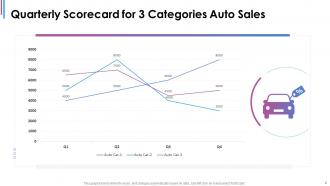
Slide 3: This slide presents Quarterly Scorecard for 3 Categories Auto Sales.
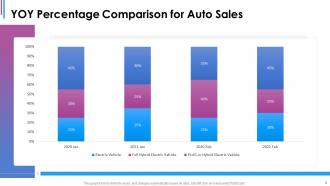
Slide 4: This slide exhibits YOY Percentage Comparison for Auto Sales.
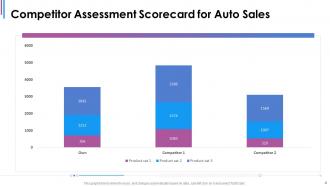
Slide 5: This slide depicts Competitor Assessment Scorecard for Auto Sales.
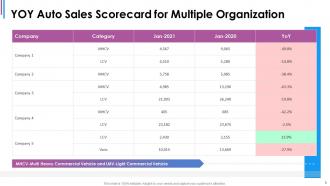
Slide 6: This slide showcases YOY Auto Sales Scorecard for Multiple Organization.
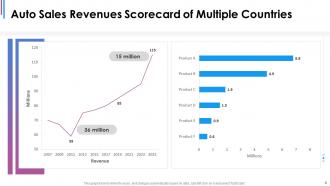
Slide 7: This slide highlights Auto Sales Revenues Scorecard of Multiple Countries.
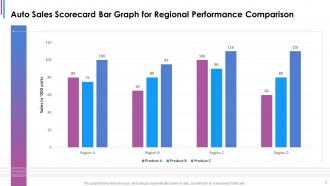
Slide 8: This slide illustrates Auto Sales Scorecard Bar Graph for Regional Performance Comparison.
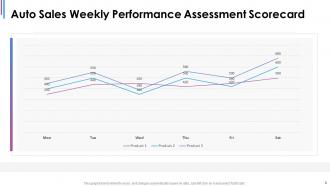
Slide 9: This slide displays Auto Sales Weekly Performance Assessment Scorecard.
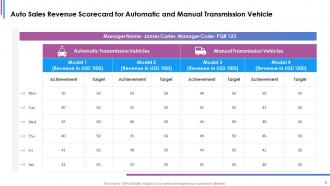
Slide 10: This slide presents Auto Sales Revenue Scorecard for Automatic and Manual Transmission Vehicle.
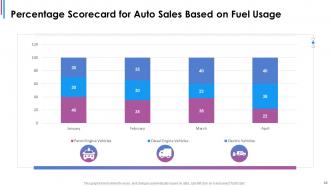
Slide 11: This slide exhibits Percentage Scorecard for Auto Sales Based on Fuel Usage.
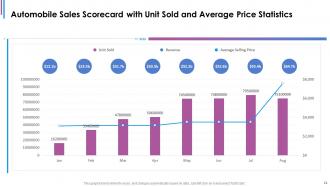
Slide 12: This slide depicts Automobile Sales Scorecard with Unit Sold and Average Price Statistics.
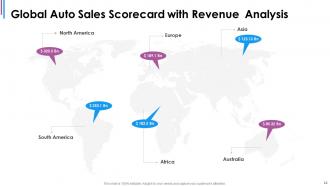
Slide 13: This slide showcases Global Auto Sales Scorecard with Revenue Analysis.
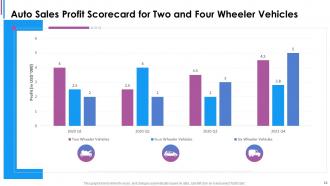
Slide 14: This slide highlights Auto Sales Profit Scorecard for Two and Four Wheeler Vehicles.
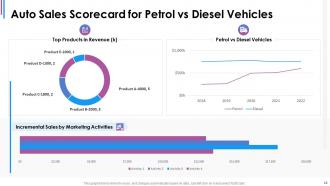
Slide 15: This slide illustrates Auto Sales Scorecard for Petrol vs Diesel Vehicles.
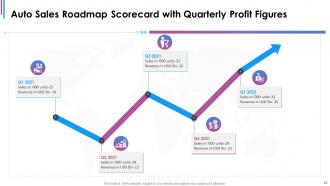
Slide 16: This slide displays Auto Sales Roadmap Scorecard with Quarterly Profit Figures.
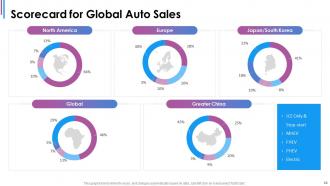
Slide 17: This slide presents Scorecard for Global Auto Sales.
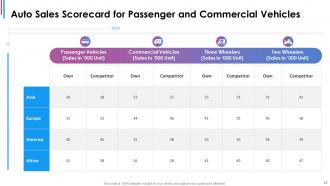
Slide 18: This slide exhibits Auto Sales Scorecard for Passenger and Commercial Vehicles.
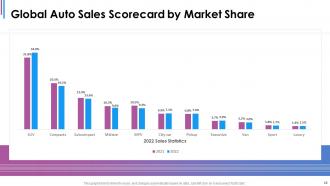
Slide 19: This slide depicts Global Auto Sales Scorecard by Market Share.
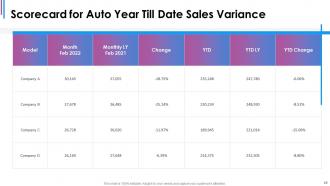
Slide 20: This slide showcases Scorecard for Auto Year Till Date Sales Variance.
Slide 21: This is the icons slide.
Slide 22: This slide presents title for additional slides.
Slide 23: This slide depicts 30-60-90 days plan for projects.
Slide 24: This slide shows roadmap.
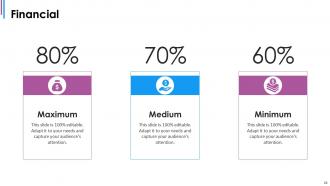
Slide 25: This slide showcases financials.
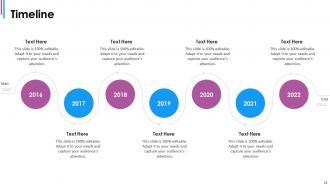
Slide 26: This slide exhibits yearly timeline.
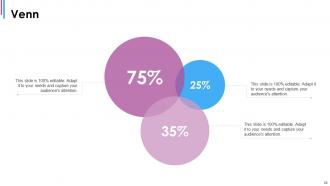
Slide 27: This slide displays Venn.
Slide 28: This slide depicts posts for past experiences of clients.
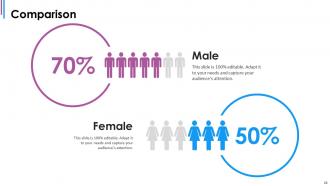
Slide 29: This slide highlights comparison of products based on selects.
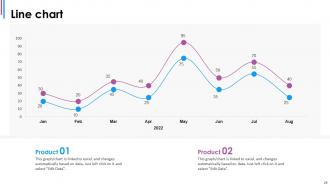
Slide 30: This slide exhibits monthly line charts for different products. The charts are linked to Excel.
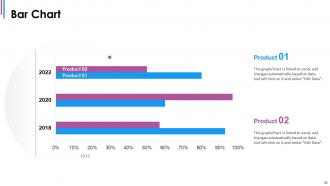
Slide 31: This slide exhibits yearly bar charts for different products. The charts are linked to Excel.
Slide 32: This is thank you slide & contains contact details of company like office address, phone no., etc.
Scorecard for auto sales powerpoint presentation slides with all 37 slides:
Use our Scorecard For Auto Sales Powerpoint Presentation Slides to effectively help you save your valuable time. They are readymade to fit into any presentation structure.








FAQs for Scorecard for auto sales
Auto sales scorecards should include sales volume, conversion rates, average deal size, customer satisfaction scores, lead response time, and gross profit margins. These metrics enable dealerships to track performance across sales processes, identify top performers, optimize pricing strategies, and enhance customer experiences, with many automotive retailers finding that comprehensive scorecards drive accountability and ultimately deliver increased revenue growth.
Sales teams can effectively track monthly vehicle sales performance through comprehensive scorecards featuring key metrics like units sold, revenue generated, conversion rates, lead response times, and customer satisfaction scores. These tracking systems enable dealerships to identify top performers, optimize sales processes, and adjust strategies in real-time, with many automotive organizations finding that consistent performance monitoring ultimately delivers improved team accountability and increased monthly sales targets.
Customer feedback serves as a critical metric for evaluating auto sales success, measuring satisfaction levels, service quality, purchase experience, and long-term loyalty indicators. This feedback enables dealerships to identify performance gaps, refine sales processes, and enhance customer relationships, with many automotive businesses finding that positive feedback correlates directly with repeat sales and referral generation.
Integrating digital marketing metrics enhances Auto Sales Scorecards by tracking lead generation efficiency, conversion rates across channels, customer acquisition costs, and campaign ROI alongside traditional sales data. This strategic combination enables dealerships to optimize marketing spend, identify high-performing channels like social media or search ads, and ultimately deliver faster lead-to-sale conversions while reducing overall acquisition expenses.
Effective auto sales visualization methods include interactive dashboards, heat maps, trend line charts, geographic sales mapping, and comparative bar charts. These approaches streamline data interpretation by highlighting regional performance patterns, seasonal fluctuations, and model-specific trends, enabling dealerships and manufacturers to quickly identify opportunities, optimize inventory allocation, and enhance sales strategies for competitive advantage.
Sales training programs can be aligned with scorecard findings by identifying performance gaps, targeting specific skill deficiencies, and customizing curricula based on individual representative weaknesses revealed through metrics analysis. Through data-driven insights, automotive dealerships can focus training on conversion rates, customer relationship management, and closing techniques, while tracking progress against scorecard benchmarks, ultimately delivering improved sales performance and enhanced revenue generation across their sales teams.
Dealerships should benchmark sales conversion rates, average deal time, customer satisfaction scores, lead response times, and inventory turnover against industry standards. These metrics enable automotive retailers to identify performance gaps, optimize sales processes, and enhance customer experiences, with many dealerships finding that strategic benchmarking delivers improved conversion rates and competitive positioning.
Auto sales scorecards should be updated monthly to capture sales cycle dynamics, with quarterly comprehensive reviews for strategic adjustments and annual overhauls for market evolution. This tiered approach enables dealerships to track short-term performance trends, seasonal fluctuations, and changing customer preferences, while ensuring metrics remain aligned with industry shifts, ultimately delivering sustained competitive advantage and operational efficiency.
Economic trends significantly influence auto sales scorecard metrics by affecting consumer purchasing power, financing rates, inventory levels, and market demand patterns. During economic downturns, scorecards typically show decreased conversion rates and longer sales cycles, while growth periods enhance metrics like average transaction values and customer acquisition rates, ultimately requiring dealerships to adjust their performance benchmarks and strategic focus accordingly.
CRM systems improve scorecard accuracy by automating data collection, eliminating manual entry errors, and providing real-time performance tracking across all customer touchpoints. These technologies streamline lead management, sales pipeline analysis, and customer interaction monitoring, with many automotive dealerships finding that integrated CRM platforms deliver more precise metrics, enhanced forecasting capabilities, and ultimately stronger competitive advantage in sales performance management.
Sales strategies that improve scorecard metrics include targeted lead nurturing, consultative selling approaches, strategic follow-up campaigns, competitive pricing analysis, and personalized customer engagement tactics. These methods enhance conversion rates, reduce sales cycle times, and increase average deal values by addressing specific customer pain points, while many dealerships find that combining digital marketing with relationship-building ultimately delivers higher close rates and customer retention.
Inventory management integrates into auto sales performance evaluation by tracking inventory turnover rates, monitoring stock-to-sales ratios, measuring days-on-lot metrics, and analyzing vehicle mix optimization. Through automated dashboards and real-time analytics, dealerships can evaluate salespeople's ability to move slow-turning inventory while maintaining optimal stock levels, ultimately improving cash flow and lot efficiency.
Long-term trends to monitor include market share evolution, customer acquisition costs, digital channel performance, inventory turnover rates, and profit margin sustainability across product lines. These metrics enable dealerships to identify shifting consumer preferences, optimize resource allocation, and adapt sales strategies proactively, with many automotive businesses finding that annual trend analysis delivers competitive positioning advantages and sustainable revenue growth.
Dealerships can effectively use scorecards to motivate sales teams by establishing clear performance metrics, creating friendly competition through leaderboards, setting achievable targets with rewards, and providing real-time feedback on individual progress. These tools enhance motivation by offering transparency in performance tracking, recognizing top performers publicly, and enabling managers to identify coaching opportunities, ultimately driving higher sales conversion rates and team engagement.
Common pitfalls when developing an Auto Sales Scorecard include tracking too many metrics, focusing solely on volume over quality, neglecting customer satisfaction indicators, using outdated benchmarks, and failing to align metrics with strategic objectives. These oversights can mislead sales teams by creating confusion, encouraging short-term thinking, and missing crucial performance drivers, ultimately undermining dealership profitability and customer retention efforts.
-
Great designs, really helpful.