


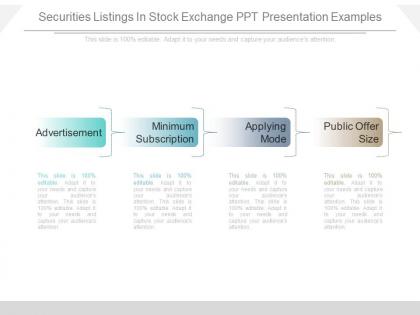
Securities listings in stock exchange ppt presentation examples




Try Before you Buy Download Free Sample Product
 Impress Your
 Audience
 100%
100% Editable
 Save Hours
 of Time


Give them a glimpse with our Securities Listings In Stock Exchange Ppt Presentation Examples. Build expectations of a glittering event.
People who downloaded this PowerPoint presentation also viewed the following :
Securities listings in stock exchange ppt presentation examples with all 7 slides:
Every message is important. Our Securities Listings In Stock Exchange Ppt Presentation Examples aim to help you present your message through the highest end design.




FAQs for Securities listings in stock exchange
Listing securities on public exchanges delivers enhanced access to capital, increased liquidity, improved company visibility, regulatory credibility, and strategic acquisition currency. These advantages enable companies to fund expansion more effectively, attract institutional investors, and establish market valuation benchmarks, with many organizations finding that public listing ultimately accelerates growth while providing shareholders greater exit flexibility.
IPOs involve issuing new shares through investment banks who underwrite and price the offering, while direct listings allow existing shareholders to sell shares directly on exchanges without intermediaries or new capital raising. Through direct listings, companies like Spotify and Slack have bypassed traditional underwriting fees and lock-up periods, enabling immediate trading flexibility while maintaining greater control over timing and pricing decisions.
Regulatory requirements for going public include financial audits, disclosure documentation, governance standards, minimum capitalization thresholds, and compliance certifications across jurisdictions. These requirements vary significantly, with the SEC requiring extensive Form S-1 filings in the US, while markets like London and Hong Kong have different disclosure standards, ultimately enabling companies to access capital markets while ensuring investor protection and market transparency.
Market conditions significantly impact securities listing timing and success by influencing investor appetite, valuation multiples, and market volatility levels. During favorable conditions, companies achieve higher valuations and stronger investor demand, while challenging periods may require postponing listings or accepting lower prices, with many organizations finding that strategic timing aligned with positive market sentiment ultimately delivers better capital raising outcomes and long-term shareholder value.
Underwriter selection significantly impacts IPO success through pricing expertise, regulatory guidance, market positioning, and investor network access. Investment banks like Goldman Sachs or Morgan Stanley leverage their institutional relationships, distribution capabilities, and market knowledge to optimize share pricing, ensure regulatory compliance, and secure strong initial trading performance, ultimately determining the company's public market debut and long-term investor confidence.
A strong brand reputation enhances securities listing prospects by increasing investor confidence, demonstrating market credibility, and showcasing customer loyalty that translates to revenue stability. Companies with established brand recognition often command higher valuations and generate greater institutional investor interest, with many finding that brand strength accelerates the listing process while ultimately delivering enhanced market reception and sustained post-listing performance.
**INPUT**: What factors do investors consider when evaluating newly listed securities? **OUTPUT**: Investors evaluate newly listed securities by analyzing financial performance, management quality, market positioning, growth potential, and competitive advantages within their sector. Through comprehensive due diligence, institutional and retail investors examine revenue trends, debt levels, and business scalability, while assessing regulatory compliance and industry outlook, ultimately determining long-term investment viability and strategic value. [Word count: 54 words]
Dual listings enhance company valuation through increased liquidity, broader investor access, expanded capital pools, reduced cost of equity, and enhanced market visibility across multiple jurisdictions. While presenting regulatory complexity and increased compliance costs, many multinational corporations find that dual listings ultimately deliver significant valuation premiums and strategic market positioning advantages.
International stock exchanges differ through varying minimum market capitalization thresholds, financial performance standards, corporate governance requirements, disclosure obligations, and shareholder distribution criteria. While NYSE emphasizes stringent financial benchmarks and NASDAQ focuses on growth metrics, exchanges like LSE and Tokyo Stock Exchange prioritize different governance structures, with many multinational corporations finding that understanding these distinctions enables strategic market entry and optimized capital access.
A company's strong financial health significantly enhances its ability to attract investors by demonstrating consistent revenue growth, healthy profit margins, manageable debt levels, and robust cash flow. These financial indicators enable companies to command higher valuations, reduce investor risk concerns, and generate greater market confidence, with many institutional investors finding that financially stable companies deliver more predictable returns and long-term growth potential.
Technology advancements streamline securities listings through automated compliance monitoring, digital documentation systems, real-time data analytics, and blockchain-based verification processes. These innovations enhance investor engagement by delivering faster market access, transparent pricing mechanisms, and improved due diligence capabilities, with many financial institutions finding that digital platforms ultimately reduce listing timeframes while increasing market participation and operational efficiency.
Maintaining post-listing compliance presents challenges including regular financial reporting deadlines, evolving regulatory standards, disclosure obligations, audit requirements, and investor communication demands. These ongoing responsibilities require dedicated resources, robust internal controls, and continuous monitoring systems, with many public companies finding that establishing comprehensive compliance frameworks early helps streamline operations and minimize regulatory risks.
ETFs interact with securities listings by holding portfolios of listed securities while trading as individual listed instruments themselves, creating dual market exposure through underlying assets and fund shares. This structure enhances market liquidity by enabling continuous trading, price discovery, and arbitrage opportunities, with many institutional investors finding that ETFs streamline portfolio diversification while maintaining real-time market access and transparency.
Geopolitical factors influence securities listings through regulatory changes, trade tensions, sanctions, and cross-border investment restrictions that affect market access and investor confidence. These dynamics reshape capital flows between major financial centers like New York, London, and Hong Kong, with many multinational corporations increasingly diversifying their listing strategies to mitigate political risks and maintain global investor access.
Companies can enhance listing visibility through comprehensive investor relations campaigns, strategic timing aligned with market conditions, strong financial transparency, compelling growth narratives, and robust ESG credentials. These strategies work synergistically, with many successful listings combining proactive media engagement, institutional investor outreach, and clear value propositions that demonstrate scalability, ultimately delivering enhanced market reception and stronger initial valuations.
-
Understandable and informative presentation.
-
Understandable and informative presentation.