


Security management framework good powerpoint themes




Try Before you Buy Download Free Sample Product
 Impress Your
 Audience
 100%
100% Editable
 Save Hours
 of Time


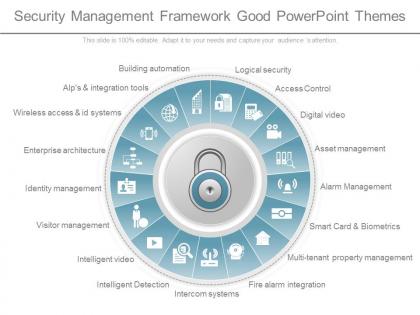
Security management framework good PowerPoint Template. Our security management PPT visual consists of a professional graphic of multiple staged circular diagram which is beneficial for representing your important business concepts and workflows. The security framework presentation slide has been crafted by using professional colors which can be changed as per your business presentation theme as the slide is fully amendable. By highlighting your management framework, using our visual, you can attract the attention of your audience as they find the presentation interesting and eye-catching. The viewer’s find the information in the slide easy to understand with the use of creative icons for all the points in the graphic. The most helpful feature of this security management PowerPoint template is that there is enough space to enter text matching your business objectives or goals. So, in order to make your slide attractive, you should incorporate this management framework PPT slide into your professional presentations. Our Security Management Framework Good Powerpoint Themes have a fetish for being accurate. They eliminate errors of assessment.
People who downloaded this PowerPoint presentation also viewed the following :
Security management framework good powerpoint themes with all 7 slides:
Our Security Management Framework Good Powerpoint Themes bring you to the cusp of the boom. Your aspirations will begin to fly.





FAQs for Security management framework
So you need five main things: governance structure, risk assessment, security policies, incident response plans, and continuous monitoring. Most teams totally bomb the governance part - like, seriously, get your leadership roles straight first. Do regular risk assessments that actually feed into policies people won't hate following. Your incident response better be tested (learned that one the hard way). Oh, and monitoring should cover both tech stuff and the human side - people are usually the weak link anyway. I'd start by checking what you've got now against these five areas.
So risk assessment is pretty much the backbone of your whole security setup. You've gotta identify what assets you have, figure out what could go wrong, then calculate how screwed you'd actually be. Honestly, the process can be a total slog sometimes, but it's the only way to know where your money should go. Without it? You're basically playing security whack-a-mole and hoping for the best. Once you have those risk numbers, they'll show you exactly which controls to tackle first instead of just guessing.
So basically, policies and procedures are like your security playbook. Policies tell you what needs protecting (customer data, etc.) while procedures give you the actual steps to follow when shit hits the fan. Without them, you're crossing your fingers that everyone just knows what to do - spoiler alert: they don't. I learned this the hard way at my last job. They're also super helpful for training new people and keeping auditors happy. Honestly, just start with your most critical stuff first and build from there. You'll thank yourself later.
Honestly, just map your security stuff straight to whatever framework you're going after - ISO 27001, NIST, SOC 2, whatever. Do a gap analysis first to see what you've already got covered. Then bake those requirements into your actual policies so it becomes automatic instead of this dreaded separate thing. I've seen too many teams scramble at audit time because they treated compliance like an afterthought. Run internal audits regularly so you catch problems before the real auditors show up. The whole point is staying audit-ready instead of panicking when assessment season hits.
Ugh, brace yourself - people HATE change, especially when it means more paperwork and hoops to jump through. Budget's always tight too. Getting leadership on board is tricky since they want to see results yesterday, but security ROI takes time to prove. You'll constantly be fighting that security vs. convenience battle - make things too locked down and everyone complains they can't do their jobs. Oh, and threats keep evolving while you're still figuring out your new framework. Honestly though, start with small pilot programs first. Get some easy wins under your belt to show it's actually working, then expand from there. Executive buy-in is absolutely crucial before you kick anything off.
Security frameworks don't replace what you've got - they just layer on top. Map the framework controls to your current governance stuff, like audit processes and executive reports. No point creating duplicate work or separate silos, right? Find where security decisions already happen in your company first. Then figure out how the framework requirements fit into those spots. It's honestly like adding guardrails to existing roads instead of building new ones. Your risk management and compliance reporting can stay pretty much the same. Just plug the framework into your current committee structure and workflows.
Honestly, I'd focus on the stuff that actually matters - incident response times, how fast you catch threats, and breach costs since those hit your bottom line hard. Employee training scores are huge too because people mess up constantly. Track your patch timelines and how quickly you fix vulnerabilities. The compliance audit results will keep your executives happy, which... trust me, you want that. Business impact metrics tell the real story though - way better than just counting security events. Don't go crazy measuring everything right away. Pick maybe 3-4 key ones that make sense for your company and build from there.
Honestly, you've gotta bake flexibility into your security setup from day one. Do quarterly threat reviews - yeah I know, more meetings, but they're actually useful ones. Set up quick response protocols for when new attack methods pop up. Connect your security team with threat intelligence feeds so they're not flying blind. The real trick is having pre-approved processes ready to go. When something nasty hits (and it will), you can update policies fast without getting stuck in red tape hell. Build in emergency update procedures and always pilot test new security stuff before rolling it out everywhere. Sounds obvious but you'd be surprised how many places skip that step.
Honestly, your employees are gonna make or break your security - doesn't matter how fancy your tech is. One person clicks the wrong link or walks away from their computer unlocked? Game over. Training helps people spot sketchy stuff and actually get why these rules exist instead of just rolling their eyes. But skip those terrible annual PowerPoints that put everyone to sleep. Do short monthly sessions with real examples they'll actually see. Like, show them what a phishing email looks like in your industry. Makes it way more relevant and they'll actually pay attention.
Think of incident response planning as your "oh shit" playbook for when hackers break in. Without it, you're basically running around like headless chickens while your data gets stolen. A good plan means everyone knows their role beforehand - who calls the lawyers, who pulls the plug, whatever. Plus going through the planning process usually shows you holes in your security you didn't even know existed. Honestly, it's one of those things that makes executives sleep better at night too. My advice? Just start documenting what you do now, even if it's a hot mess.
Honestly, start with whatever's giving you the biggest headaches right now. AI-powered threat detection is pretty solid these days, and SIEM platforms help centralize all your logging mess. Automated incident response saves tons of time too. CSPM tools are clutch for catching those config mistakes before hackers do - seen too many breaches from that. Zero-trust IAM solutions add decent protection layers. Oh, and don't sleep on threat intel feeds and vuln scanners. There's actually a ton of integration options now. Just don't try to implement everything at once or you'll go crazy.
Look, a good security framework basically maps out what could actually mess up your business and how to stop it before it happens. You'll identify your critical stuff, figure out dependencies, and build response plans that actually work when things go sideways. The smart move is baking security into your planning from day one - trust me, way better than panicking after everything's already broken. Oh, and test your recovery scenarios regularly because there's nothing worse than a continuity plan that doesn't actually continue anything when you need it most.
So definitely use something like GitLab or SharePoint for all your security docs - just make sure access controls are tight. Document policies, procedures, who does what, how controls connect to each other. Honestly, I've watched frameworks completely crash when key people leave and nobody knows how anything works anymore. Do quarterly reviews and update docs whenever you change controls. Treat it like code basically - collaborative and current. Map what exists first, then just get into the habit of updating docs every time you mess with a control. It's boring work but saves your ass later.
Look, you gotta build vendor assessments right into your procurement process from day one. Make it automatic - questionnaires, pen test results, compliance certs, all that fun stuff. Yeah, it's annoying but you can't skip it. Create different risk tiers so you're not auditing the guy who delivers your office snacks the same way you'd audit your cloud provider (learned that one the hard way). Don't forget to schedule regular re-assessments too. Your contracts should spell out security requirements upfront. Trust me, doing this stuff proactively saves you from major headaches later.
Dude, automation is a game changer for security stuff. Start with the boring repetitive tasks - vulnerability scans, threat detection, compliance reports. Your team will thank you later. Policy enforcement works great too, like auto-quarantining sketchy files or blocking weird user activity. User provisioning is another big one - nobody wants to manually add/remove access all day. Real-time monitoring alerts are clutch. Honestly, if you're still doing everything manually, you're probably burning out your people for no reason. Just pick your most annoying daily tasks and see what you can script.
-
Professional and unique presentations.
-
Awesome use of colors and designs in product templates.