


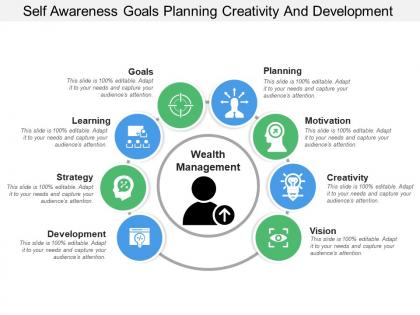
Self awareness goals planning creativity and development




Try Before you Buy Download Free Sample Product
 Impress Your
 Audience
 100%
100% Editable
 Save Hours
 of Time


Our Self Awareness Goals Planning Creativity And Development team are an inspired lot. Their efforts will drive your vision forward.
People who downloaded this PowerPoint presentation also viewed the following :
Self awareness goals planning creativity and development with all 5 slides:
Examine the intelligence with our Self Awareness Goals Planning Creativity And Development. Analyze inputs of your competitors actions.




FAQs for Self awareness goals planning
Self-awareness encompasses emotional intelligence, personal values clarification, strengths and weaknesses assessment, behavioral pattern recognition, and feedback receptivity. These components work together by enhancing decision-making capabilities, improving interpersonal relationships, and enabling strategic personal development, with many professionals finding that this comprehensive approach ultimately delivers better leadership effectiveness and career advancement opportunities.
Self-awareness significantly enhances personal and professional relationships by improving communication, reducing conflicts, and fostering deeper empathy and understanding. Through better emotional regulation and authentic interactions, individuals can build stronger team dynamics, more effective leadership capabilities, and meaningful personal connections, while many organizations find that self-aware employees contribute to healthier workplace cultures and improved collaboration outcomes.
Self-reflection serves as the primary mechanism for enhancing self-awareness by enabling individuals to examine their thoughts, emotions, behaviors, and motivations systematically. Through regular reflective practices, professionals can identify patterns in their decision-making, recognize emotional triggers, and understand their impact on others, ultimately delivering improved leadership effectiveness and stronger interpersonal relationships.
**INPUT**: In what ways can feedback from others contribute to a deeper understanding of oneself? **OUTPUT**: Feedback from others reveals blind spots, behavioral patterns, communication styles, emotional reactions, and professional strengths that individuals cannot easily observe themselves. Through constructive input from colleagues, mentors, and team members, professionals gain valuable perspectives on their leadership effectiveness, interpersonal skills, and workplace impact, ultimately enabling more strategic personal development and enhanced organizational performance. [Word count: 58 words]
Mindfulness practices enhance self-awareness by encouraging present-moment attention, non-judgmental observation of thoughts and emotions, and regular self-reflection through meditation and breathing exercises. These techniques enable individuals to recognize behavioral patterns, emotional triggers, and decision-making processes more clearly, ultimately delivering greater emotional intelligence and improved interpersonal relationships in both professional and personal settings.
Common obstacles to self-awareness include cognitive biases, fear of uncomfortable truths, lack of feedback mechanisms, emotional defensiveness, and limited self-reflection time. These barriers can be overcome by seeking diverse feedback sources, practicing mindfulness techniques, engaging professional coaches, maintaining regular journaling habits, and creating structured reflection processes, with many organizations finding that systematic self-assessment programs ultimately enhance leadership effectiveness and team performance.
Self-awareness enhances decision-making by enabling individuals to recognize their biases, emotional triggers, and cognitive patterns that influence choices. Through honest self-reflection, professionals can evaluate options more objectively, anticipate their reactions to outcomes, and make strategic decisions aligned with their values and long-term goals, ultimately delivering more consistent and effective leadership results.
Self-awareness measurement techniques include personality assessments like Myers-Briggs and DISC, 360-degree feedback surveys, mindfulness practices, journaling, and emotional intelligence evaluations. These methods enhance professional development by identifying blind spots, improving leadership capabilities, and strengthening interpersonal relationships, with many organizations finding that self-aware employees deliver better team collaboration and strategic decision-making.
Self-awareness aids emotional regulation and resilience by enabling individuals to recognize emotional triggers, understand response patterns, and implement strategic coping mechanisms before reactions escalate. Through mindful self-monitoring, professionals can navigate workplace stress, interpersonal conflicts, and high-pressure situations more effectively, ultimately delivering enhanced decision-making capabilities and sustained performance under challenging circumstances.
Self-awareness forms the foundation of effective leadership by enabling leaders to understand their strengths, weaknesses, emotional triggers, and impact on others. This clarity enhances decision-making, communication, and team dynamics, with many successful executives finding that self-aware leaders build stronger relationships, adapt more readily to challenges, and ultimately deliver better organizational outcomes.
Journaling cultivates self-awareness by creating structured reflection, tracking emotional patterns, identifying behavioral triggers, and documenting personal growth over time. Through consistent writing practice, individuals gain clarity on their values, motivations, and decision-making processes, while many professionals find that regular journaling ultimately enhances their leadership effectiveness and strategic thinking capabilities.
Understanding triggers and biases is crucial for self-awareness because it reveals unconscious patterns that influence decision-making, emotional responses, and interpersonal relationships in professional settings. This awareness enables leaders and teams to navigate workplace conflicts more effectively, make more objective strategic decisions, and build stronger collaborative relationships, with many organizations finding that bias-aware leadership ultimately delivers improved team performance and more inclusive workplace cultures.
Self-awareness enhances workplace creativity by enabling individuals to recognize their cognitive patterns, emotional triggers, and creative preferences, while identifying knowledge gaps that spark innovative thinking. Through mindful self-reflection, employees leverage their unique perspectives, collaborate more effectively with diverse teams, and approach problem-solving with greater openness, ultimately delivering breakthrough solutions and competitive advantage.
Self-awareness strongly correlates with mental health by enabling individuals to recognize emotional patterns, identify triggers, and develop effective coping strategies. Through enhanced emotional regulation and stress management, self-aware individuals experience reduced anxiety, improved relationships, and greater resilience, with many mental health professionals finding that increased self-awareness ultimately delivers better therapeutic outcomes and sustained well-being.
Organizations foster self-awareness culture through regular feedback mechanisms, 360-degree assessments, mindfulness training programs, reflective journaling initiatives, and leadership modeling of self-reflective behaviors. These approaches enhance emotional intelligence, improve communication, and strengthen decision-making capabilities, with many companies finding that self-aware teams deliver better collaboration, reduced workplace conflicts, and ultimately higher performance outcomes.
-
Professional and unique presentations.
-
Great quality product.