


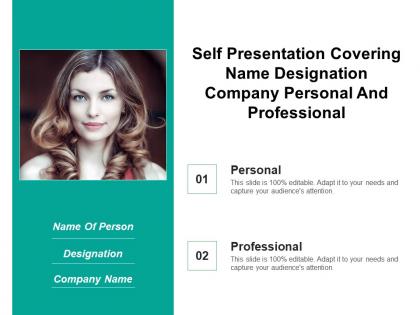
Self presentation covering name designation company personal and professional




Try Before you Buy Download Free Sample Product
 Impress Your
 Audience
 100%
100% Editable
 Save Hours
 of Time


Come to clear cut decisions with our Self Presentation Covering Name Designation Company Personal And Professional. You won't have to split hairs.
People who downloaded this PowerPoint presentation also viewed the following :
Self presentation covering name designation company personal and professional with all 6 slides:
Even under tight deadlines you're giving your best effort. Save time while getting the best quality design for your presentations with our Self Presentation Covering Name Designation Company Personal And Professional.
FAQs for Self presentation covering name designation company
Effective digital self-presentation includes clear visual branding, consistent messaging across platforms, professional photography, compelling storytelling, and strategic content curation. These elements work together by building authentic credibility, enhancing personal visibility, and establishing thought leadership, with many professionals finding that cohesive digital presence ultimately delivers stronger networking opportunities and career advancement.
Visual aids enhance self-presentation impact by improving message clarity, increasing audience engagement, supporting memory retention, and demonstrating professionalism through organized content delivery. These tools streamline complex information presentation, with many professionals in consulting, sales, and training finding that strategic visual elements ultimately deliver stronger audience connections, enhanced credibility, and more persuasive communication outcomes.
Body language significantly influences self-presentation during live events through posture, gestures, facial expressions, eye contact, and spatial positioning. These nonverbal cues communicate confidence, credibility, and engagement to audiences, with many speakers finding that deliberate body language awareness enhances message delivery, builds stronger audience connections, and ultimately projects greater professional authority and authenticity.
Tailoring self-presentation involves adjusting communication style, emphasizing relevant experiences, and aligning messaging with audience priorities and expectations. Professionals increasingly adapt their approach by highlighting technical expertise for industry peers, emphasizing leadership qualities for executive audiences, and showcasing collaborative skills for team environments, ultimately delivering more impactful connections and strategic positioning across diverse professional contexts.
Effective strategies include deep breathing exercises, thorough preparation and practice, positive visualization techniques, structured content organization, and gradual exposure to speaking opportunities. These approaches work by reducing physical symptoms, building confidence through familiarity, and creating mental frameworks for success, with many professionals finding that consistent practice ultimately transforms anxiety into enhanced engagement and stronger audience connections.
Storytelling transforms self-presentation by creating emotional connections, demonstrating competencies through concrete examples, and making personal narratives memorable and relatable. Through strategic storytelling, professionals showcase their problem-solving abilities, leadership experiences, and career progression while engaging audiences more effectively than traditional resume recitations, ultimately delivering stronger personal branding and competitive advantage.
Common self-presentation mistakes include inconsistent messaging across platforms, over-sharing personal information, neglecting professional appearance standards, failing to tailor communication to specific audiences, and lacking authentic engagement with stakeholders. These missteps often undermine credibility in sectors like consulting, sales, and leadership roles, with many professionals finding that strategic consistency and audience awareness ultimately deliver stronger relationships and enhanced career opportunities.
Feedback can be effectively incorporated through systematic collection from trusted colleagues, structured self-reflection sessions, and targeted practice of specific improvement areas. By documenting patterns in feedback, creating measurable goals, and regularly rehearsing presentations with mentors, professionals enhance their communication skills, build greater confidence, and deliver more impactful messages that resonate with diverse audiences.
Confidence-building techniques include thorough preparation, positive visualization, strategic body language practice, voice modulation exercises, and structured feedback sessions. These approaches enhance self-presentation by reducing anxiety, improving message clarity, and strengthening audience connection, with many professionals finding that consistent practice and preparation ultimately deliver greater executive presence and more persuasive communication outcomes.
Cultural differences significantly influence self-presentation through varying norms around eye contact, personal space, communication styles, hierarchical respect, and emotional expression. These cultural frameworks shape how individuals present themselves in professional settings, with many organizations finding that understanding these differences enhances cross-cultural collaboration, improves team dynamics, and ultimately delivers more effective global business relationships.
Templates for self-presentation offer consistent branding, professional design quality, time efficiency, structured content organization, and reduced design stress. These tools streamline personal marketing by ensuring visual coherence across platforms, enabling faster portfolio creation, and delivering polished presentations, with many professionals finding that template-based approaches enhance their credibility while minimizing preparation time.
Personal branding integrates into self-presentation through consistent visual identity, authentic storytelling, strategic networking approaches, and value-driven messaging across all interactions. These elements work together by establishing credibility, building recognition, and communicating unique expertise, with many professionals finding that cohesive personal branding ultimately enhances career opportunities and business relationships.
PowerPoint, Canva, Prezi, Google Slides, and Keynote offer comprehensive design capabilities for creating polished self-presentation slides. These platforms enhance visual appeal through professional templates, animation features, and collaborative editing tools, while many professionals find that combining multiple software solutions streamlines their workflow and delivers more engaging, memorable presentations that effectively communicate their personal brand.
Balancing professionalism and authenticity requires aligning your genuine values and communication style with workplace expectations, industry standards, and organizational culture. This involves showcasing your real personality through appropriate channels, maintaining consistent personal branding across interactions, and adapting your authentic self to different professional contexts, ultimately delivering credible leadership presence while building meaningful workplace relationships.
Verbal communication serves as the primary vehicle for conveying expertise, confidence, and authenticity during self-presentation, encompassing tone, clarity, storytelling ability, and strategic message delivery. Through articulate expression and compelling narratives, professionals enhance their credibility, build stronger connections with audiences, and ultimately differentiate themselves in competitive environments, with many finding that polished verbal skills directly correlate with career advancement opportunities.
-
Topic best represented with attractive design.
-
The Designed Graphic are very professional and classic.