


Servers with laptops for firewall networking ppt slides




Try Before you Buy Download Free Sample Product
 Impress Your
 Audience
 100%
100% Editable
 Save Hours
 of Time


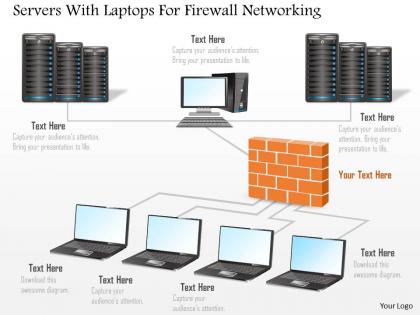
In a business system in order to control the access to the resources of a network by using a Control method and to deny the excess traffic then simply merge our Extremely Informative Servers with laptops for firewall networking PowerPoint presentation templates which are experts in creating awareness among the members of the audience about the importance and the process of firewall networking. Also, this diagram clearly indicates how a wall is created in-between the hub or the trusted zone like a corporate network and untrusted zones such as internet which allows only reliable information to enter the business system and the rest is rejected by the firewall. Apart from this, this design has been formed by carefully understanding the concept of firewall security. Moreover, these illustrations are professional and attractive which creates curiosity amongst the audience to stick to the presentation till the end. Therefore, without any further delay Simply click Download and start creating remarkable presentations.Use our Servers With Laptops For Firewall Networking Ppt Slides to engage with the community. Generate action for the good of everybody.
People who downloaded this PowerPoint presentation also viewed the following :
Servers with laptops for firewall networking ppt slides with all 5 slides:
Enfold your thoughts in our Servers With Laptops For Firewall Networking Ppt Slides. They will stay safe and secure.

FAQs for Servers with laptops for firewall
Firewalls serve multiple critical functions including traffic filtering, access control, threat detection, network segmentation, and connection monitoring based on predetermined security rules. These technologies enhance organizational security by blocking unauthorized access, preventing malicious attacks, and controlling data flow between networks, with many enterprises finding that strategic firewall deployment significantly reduces security breaches while maintaining operational efficiency.
Stateful firewalls track active connections and maintain session information, while stateless firewalls examine each packet independently without connection context. Stateful firewalls provide enhanced security by monitoring connection states and allowing return traffic automatically, whereas stateless firewalls offer faster processing but require more configuration rules, with many organizations finding that stateful firewalls deliver superior protection for complex network environments.
Firewalls provide essential DDoS protection by filtering malicious traffic, rate limiting connections, and blocking suspicious IP addresses before they overwhelm network resources. Through deep packet inspection and traffic analysis, financial institutions and e-commerce platforms can detect attack patterns, maintain service availability, and preserve legitimate user access, ultimately delivering operational continuity and enhanced security.
Next-generation firewalls enhance traditional security by incorporating deep packet inspection, application awareness, intrusion prevention systems, and threat intelligence capabilities beyond basic port blocking. These advanced technologies streamline security operations by identifying sophisticated threats, controlling application usage, and automating response protocols, with many financial institutions and healthcare organizations finding significantly faster threat detection and reduced security management overhead.
Hardware firewalls offer dedicated processing power, network-wide protection, and reduced impact on individual device performance, while software firewalls provide granular application control, cost-effectiveness, and easier deployment across distributed workforces. Many organizations implement a strategic combination, with hardware firewalls securing network perimeters and software firewalls protecting endpoints, ultimately delivering comprehensive security layers that enhance both operational efficiency and threat detection capabilities.
Firewalls integrate with intrusion detection and prevention systems through shared threat intelligence, coordinated policy enforcement, and real-time communication protocols that enable automated responses to security incidents. This strategic combination enhances network protection by allowing IDS/IPS systems to trigger firewall rule updates, while firewalls provide filtered traffic for deeper inspection, ultimately delivering comprehensive security coverage and faster threat mitigation across enterprise networks.
Common firewall configuration mistakes include using default passwords, overly permissive rules, inadequate logging, poor rule organization, and neglecting regular updates. These oversights compromise network security across industries, with many financial institutions and healthcare organizations finding that systematic configuration reviews, proper documentation, and automated monitoring ultimately deliver stronger protection and regulatory compliance.
Cloud firewalls can be optimized through micro-segmentation, auto-scaling policies, centralized management dashboards, API-driven configurations, and distributed threat intelligence integration. These approaches enable dynamic resource allocation, seamless traffic filtering across multi-cloud environments, and automated security responses, with many enterprises finding that cloud-native firewall solutions deliver enhanced visibility, reduced latency, and improved operational efficiency.
When choosing a firewall solution, businesses should consider network size, traffic volume, security requirements, scalability needs, and budget constraints. Organizations must evaluate whether they need next-generation features like application control and intrusion prevention, with many companies finding that hybrid solutions combining hardware and cloud-based protection deliver optimal security while maintaining operational efficiency.
Firewall logging and monitoring capabilities enhance cybersecurity by tracking network traffic patterns, identifying unauthorized access attempts, and documenting security incidents in real-time. These comprehensive logs enable IT teams to detect anomalies, analyze attack vectors, and strengthen defenses proactively, with many organizations finding that detailed monitoring ultimately delivers faster threat response and improved compliance reporting.
Firewalls can impact network performance through packet inspection processes, rule evaluation overhead, and bandwidth limitations, though modern firewalls minimize these effects significantly. While basic packet filtering creates minimal latency, deep packet inspection and complex security rules may reduce throughput, with many organizations finding that strategic firewall placement and proper configuration ultimately deliver enhanced security without substantially compromising network speed.
DMZ creates a secure buffer zone between internal networks and external threats, isolating public-facing servers like web applications, email systems, and DNS services from critical internal infrastructure. This strategic network segmentation enables organizations to provide necessary external access while maintaining robust security, with many enterprises finding that DMZ implementation significantly reduces attack surface and enhances overall network protection.
Firewalls handle encrypted traffic through deep packet inspection, SSL/TLS decryption, certificate analysis, and behavioral monitoring techniques. While encryption presents challenges in content visibility and threat detection, modern firewalls increasingly deploy advanced analytics and machine learning to identify suspicious patterns, enabling organizations to maintain security without compromising data protection, ultimately delivering enhanced network defense capabilities.
Firewall rules and policies significantly impact user access control by determining network permissions, defining application access levels, restricting data flows, and establishing authentication requirements. These policies enable organizations to balance security with productivity, particularly in banking and healthcare sectors, where controlled access prevents unauthorized data breaches while maintaining operational efficiency, ultimately delivering enhanced security posture and regulatory compliance.
Emerging technologies influencing firewall networking include artificial intelligence and machine learning for threat detection, cloud-native security architectures, zero-trust network models, software-defined perimeters, and advanced behavioral analytics. These technologies enhance firewall capabilities by automating threat response, adapting to distributed infrastructures, and providing granular access controls, with many organizations finding that AI-powered firewalls significantly reduce response times while improving security accuracy.
-
Very unique and reliable designs.
-
Helpful product design for delivering presentation.