


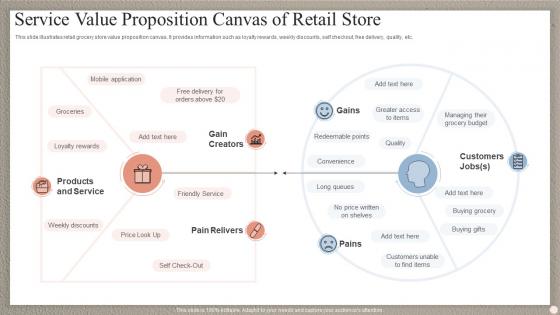
Service Value Proposition Canvas Of Retail Store




Try Before you Buy Download Free Sample Product
 Impress Your
 Audience
 100%
100% Editable
 Save Hours
 of Time


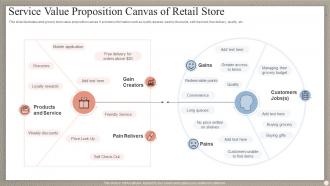
This slide illustrates retail grocery store value proposition canvas. It provides information such as loyalty rewards, weekly discounts, self checkout, free delivery, quality, etc.
People who downloaded this PowerPoint presentation also viewed the following :
Service Value Proposition Canvas Of Retail Store with all 6 slides:
Use our Service Value Proposition Canvas Of Retail Store to effectively help you save your valuable time. They are readymade to fit into any presentation structure.





FAQs for Service Value Proposition Canvas
The Service Value Proposition Canvas includes customer segments, value propositions, customer jobs, pain points, gain creators, pain relievers, and service channels. These components work together by mapping customer needs to service solutions, identifying service delivery touchpoints, and aligning operational capabilities with customer expectations, ultimately enabling organizations to design more targeted services and enhance customer satisfaction while streamlining service operations.
Businesses identify customer needs using the Service Value Proposition Canvas by mapping customer jobs, pains, and gains through systematic research, surveys, interviews, and behavioral analysis. This structured approach enables organizations to uncover specific pain points like inefficient processes or unmet expectations, while revealing desired outcomes across different customer segments, ultimately delivering more targeted services and enhanced customer experiences.
The Service Value Proposition Canvas enhances service design by clarifying customer pain points, mapping service features to specific needs, identifying value gaps, and aligning team understanding around customer outcomes. Through systematic visualization of customer jobs-to-be-done and corresponding service solutions, organizations streamline design processes, reduce development costs, and create more targeted offerings, ultimately delivering services that resonate strongly with market demands.
The Service Value Proposition Canvas facilitates alignment by systematically mapping customer jobs, pains, and gains against service features, pain relievers, and gain creators, ensuring comprehensive understanding of customer needs. Through this structured approach, service organizations enhance customer satisfaction, reduce service gaps, and improve operational efficiency, with many companies finding that this visual framework streamlines communication between teams while ultimately delivering more targeted services and stronger competitive advantage.
Customer empathy serves as the foundation for developing effective Service Value Propositions by enabling deep understanding of customer pain points, desired outcomes, and emotional triggers throughout their service journey. Through empathetic research and direct customer engagement, organizations can identify unmet needs, anticipate service expectations, and design value propositions that resonate authentically, ultimately delivering more personalized experiences and stronger competitive differentiation.
Companies can use the Service Value Proposition Canvas to differentiate themselves by identifying unique customer pain points, mapping specific value drivers their competitors overlook, and aligning service features with precise customer needs. Through systematic analysis of customer jobs-to-be-done and gain creators, organizations in sectors like banking, healthcare, and retail can discover untapped opportunities, ultimately delivering distinctive experiences that create sustainable competitive advantages in increasingly saturated markets.
Validation techniques include customer interviews, surveys, A/B testing, prototype feedback, and market analysis to test key assumptions within the Service Value Proposition Canvas. Through direct customer engagement and data collection, organizations can verify pain points, validate proposed solutions, and refine value propositions, with many service companies finding that iterative testing ultimately delivers stronger market fit and competitive positioning.
The Service Value Proposition Canvas adapts across industries by customizing value propositions, customer segments, and pain points to sector-specific contexts, such as patient outcomes in healthcare or scalability in technology services. Healthcare organizations focus on clinical efficacy and patient experience, while technology companies emphasize innovation speed and integration capabilities, with many finding that industry-specific customization delivers stronger competitive positioning.
Common pitfalls include making assumptions without customer validation, focusing solely on features rather than benefits, neglecting to prioritize pain points by severity, and creating value propositions too broad to resonate meaningfully. Many service organizations find that avoiding generic language, regularly updating their canvas based on market feedback, and ensuring alignment between promised value and actual service delivery capabilities ultimately delivers stronger customer relationships and competitive differentiation.
Feedback loops enhance Service Value Proposition accuracy by collecting continuous customer insights, validating assumptions through real usage data, and identifying gaps between perceived and actual value delivery. Through systematic feedback collection from touchpoints like surveys, support interactions, and usage analytics, organizations refine their propositions based on genuine customer experiences, ultimately delivering more targeted services and stronger market alignment.
The Service Value Proposition Canvas supports agile methodologies by enabling rapid customer insight validation, iterative service refinement, and cross-functional team alignment around user needs. Through visual collaboration and continuous feedback loops, agile teams can quickly pivot service offerings, validate assumptions with real customer data, and deliver incremental value improvements, ultimately accelerating time-to-market while maintaining customer-centricity throughout development cycles.
Teams can collaborate effectively by assigning clear roles for customer research, value mapping, and service design, while conducting structured workshops to align perspectives and validate assumptions. Regular cross-functional sessions enable marketing, operations, and customer service teams to contribute unique insights, ensuring the canvas reflects comprehensive market understanding and delivers actionable service strategies that enhance customer experiences.
Companies like Spotify revolutionized music streaming by mapping customer jobs-to-be-done against personalized playlists, pain relievers, and gain creators through systematic canvas application. Netflix, Airbnb, and Uber similarly leveraged this framework to identify unmet needs, streamline service delivery, and create compelling value propositions, ultimately achieving market dominance by aligning services with customer priorities.
The Service Value Proposition Canvas helps visualize complex service offerings by mapping customer jobs, pains, and gains against corresponding service features, pain relievers, and gain creators in a structured format. This visual approach enables service teams to identify gaps, redundancies, and optimization opportunities across multiple touchpoints, while demonstrating clear value alignment, ultimately delivering enhanced customer experiences and strategic competitive advantage.
Key metrics for measuring Service Value Proposition effectiveness include customer satisfaction scores, Net Promoter Score (NPS), customer retention rates, service delivery time, and cost per service transaction. These measurements enable organizations to track performance across multiple dimensions, with many service-oriented businesses finding that combining operational efficiency metrics with customer experience indicators ultimately delivers comprehensive insights into value creation and competitive positioning.
-
Enough space for editing and adding your own content.
-
I'm happy to discover your PowerPoint presentations and templates. They met my expectations precisely. Very innovative!