


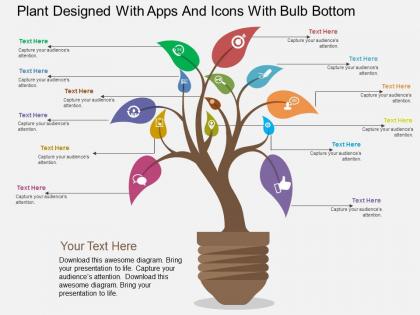
Sh plant designed with apps and icons with bulb bottem flat powerpoint design




Try Before you Buy Download Free Sample Product
 Impress Your
 Audience
 100%
100% Editable
 Save Hours
 of Time


Our sh Plant Designed With Apps And Icons With Bulb Bottem Flat Powerpoint Design aid experiments. They encourage greater exploration.
People who downloaded this PowerPoint presentation also viewed the following :
Sh plant designed with apps and icons with bulb bottem flat powerpoint design with all 4 slides:
Get by with a little help from our sh Plant Designed With Apps And Icons With Bulb Bottem Flat Powerpoint Design. They will put your act together.


FAQs for Sh plant designed with apps and icons with bulb bottem
Smart plant design principles include integrated digital technologies, predictive maintenance systems, automated process control, real-time data analytics, and flexible modular construction. Unlike traditional approaches that rely on reactive maintenance and isolated systems, smart plants enable proactive decision-making, seamless operational integration, and adaptive manufacturing capabilities, with industries like pharmaceuticals and chemicals finding significantly reduced downtime and enhanced production efficiency.
IoT technology enhances operational efficiency in smart plant design by enabling real-time monitoring, predictive maintenance, and automated process optimization through interconnected sensors and data analytics. Manufacturing facilities and chemical plants leverage these systems to minimize downtime, reduce energy consumption, and streamline production workflows, ultimately delivering cost savings and improved operational performance.
Sustainability drives smart plant development through energy-efficient systems, waste reduction technologies, circular economy principles, and renewable energy integration. These eco-friendly approaches enable manufacturers to minimize environmental impact while reducing operational costs, with many industrial facilities finding that sustainable smart technologies deliver both regulatory compliance and competitive advantage in an increasingly environmentally-conscious market.
Digital twin technology enhances plant design and operations by creating real-time virtual replicas that enable predictive maintenance, optimize resource allocation, and streamline workflow processes. Through continuous data integration, manufacturing facilities, chemical plants, and refineries can simulate operational scenarios, reduce downtime costs, and accelerate design iterations, ultimately delivering improved safety protocols and competitive operational efficiency.
Key considerations include scalability requirements, system interoperability, cybersecurity protocols, workforce training needs, and maintenance accessibility. These factors work together to ensure seamless operations, with many manufacturing facilities finding that strategic automation integration reduces operational costs by 20-30% while enhancing production flexibility and ultimately delivering sustained competitive advantage in increasingly demanding markets.
Smart plants utilize data analytics for predictive maintenance by analyzing sensor data, monitoring equipment performance patterns, and identifying potential failures before they occur. Through machine learning algorithms and real-time monitoring systems, manufacturing facilities can reduce unplanned downtime by up to 50%, optimize maintenance schedules, and significantly lower operational costs, ultimately delivering enhanced productivity and competitive advantage.
Smart plant design significantly enhances employee safety and ergonomics by integrating advanced monitoring systems, automated hazard detection, ergonomic workstation layouts, and intelligent environmental controls. Through IoT sensors and predictive analytics, manufacturing facilities can identify potential safety risks before incidents occur, optimize workspace configurations to reduce physical strain, and maintain ideal working conditions, ultimately delivering reduced workplace injuries and improved productivity across industrial operations.
**INPUT**: What are the challenges faced during the transition from conventional to smart plant design? **OUTPUT**: Transitioning to smart plant design presents challenges including legacy system integration, workforce retraining, cybersecurity vulnerabilities, high initial investment costs, and data management complexity. While manufacturing and chemical processing facilities face steep learning curves and potential operational disruptions, these challenges ultimately deliver enhanced efficiency, predictive maintenance capabilities, and competitive advantage in an increasingly automated industrial landscape. **Word count: 58 words**
Smart plant design reduces energy consumption through IoT sensors for real-time monitoring, AI-driven predictive maintenance, automated control systems, and optimized equipment placement. These technologies streamline operations by minimizing equipment downtime, optimizing heating and cooling systems, and reducing waste heat, with manufacturing facilities increasingly finding that integrated smart systems deliver 15-30% energy savings while enhancing operational efficiency.
**INPUT**: What are the best practices for selecting equipment and machinery for a smart plant? **OUTPUT**: Best practices include evaluating IoT connectivity capabilities, assessing real-time monitoring features, ensuring seamless integration with existing systems, prioritizing energy efficiency ratings, and selecting scalable automation technologies. These strategic considerations streamline operations by reducing maintenance costs, enhancing predictive analytics, and optimizing resource allocation, with manufacturing facilities increasingly finding that connected equipment delivers significant competitive advantage. [Word count: 58 words]
Cloud computing enhances smart plant monitoring by enabling centralized data processing, scalable storage infrastructure, remote accessibility, and seamless integration with IoT sensors and control systems. Through cloud platforms, manufacturing facilities can achieve real-time operational visibility, predictive maintenance capabilities, and automated responses to equipment anomalies, while significantly reducing IT infrastructure costs and enabling global plant management from centralized dashboards.
Manufacturing, pharmaceuticals, oil and gas, chemicals, food processing, and utilities benefit most from smart plant design principles. These industries leverage IoT sensors, predictive analytics, and automated systems to enhance operational efficiency, reduce downtime, and minimize safety risks, with many facilities finding that integrated smart technologies deliver significant cost reductions and competitive advantages.
Regulatory standards significantly influence smart plant design by mandating compliance frameworks, safety protocols, data security requirements, and environmental controls that shape technology selection and system architecture. These standards drive implementation of automated monitoring systems, real-time reporting capabilities, and robust cybersecurity measures, with industries like pharmaceuticals and chemicals finding that regulatory-compliant smart designs ultimately deliver enhanced operational transparency and competitive advantage.
Smart plant technology investments typically yield significant long-term cost reductions through decreased maintenance expenses, enhanced energy efficiency, reduced downtime, and optimized resource allocation. While initial capital requirements are substantial, manufacturing facilities, chemical plants, and processing operations find that predictive maintenance capabilities, automated quality control, and real-time optimization ultimately deliver 15-30% operational cost savings and competitive advantage.
Collaborative platforms enhance communication in smart plant initiatives by centralizing project data, enabling real-time updates, and facilitating cross-functional coordination between engineers, operators, and management teams. These digital environments streamline decision-making processes, reduce information silos, and accelerate project timelines, with many manufacturing organizations finding that integrated collaboration ultimately delivers faster implementations and more cohesive smart plant strategies.
-
Colors used are bright and distinctive.
-
Top Quality presentations that are easily editable.