


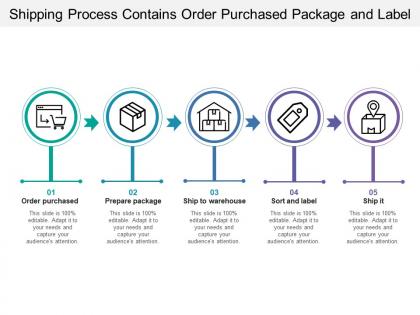
Shipping process contains order purchased package and label




Try Before you Buy Download Free Sample Product
 Impress Your
 Audience
 100%
100% Editable
 Save Hours
 of Time


Bring alienation to an end with our Shipping Process Contains Order Purchased Package And Label. Ensure every individual actually gets included.
People who downloaded this PowerPoint presentation also viewed the following :
Shipping process contains order purchased package and label with all 5 slides:
Heighten the flavor of your thoughts. Add a dash of our Shipping Process Contains Order Purchased Package And Label.




FAQs for Shipping process contains order purchased
The key shipping process steps include order processing, inventory allocation, picking and packing, carrier selection, shipment dispatch, and delivery tracking. These stages streamline operations by automating warehouse workflows, optimizing route planning, and providing real-time visibility, with many logistics companies finding that integrated systems reduce fulfillment times and enhance customer satisfaction.
Shipping carrier choice significantly impacts delivery speed and cost through network reach, transportation methods, and service tiers offered. Premium carriers like FedEx and UPS deliver faster express services at higher costs, while standard carriers offer economical options with longer transit times, with many businesses finding that strategic carrier partnerships ultimately balance customer expectations and operational budgets.
International shipping requires commercial invoices, customs declarations, bills of lading, certificates of origin, and export/import licenses, while domestic shipping typically needs only basic shipping labels and delivery confirmations. These additional documents enable customs clearance, tariff assessment, and regulatory compliance across borders, with many logistics companies finding that automated documentation systems streamline processing and reduce delays.
Common shipping challenges include delayed deliveries, damaged goods, inventory mismanagement, regulatory compliance issues, and rising transportation costs. These obstacles can be mitigated through advanced tracking systems, protective packaging protocols, and automated inventory management, with many logistics companies finding that strategic partnerships with reliable carriers and real-time visibility platforms ultimately streamline operations while reducing costs.
Technology enhances shipping through real-time tracking, automated notifications, route optimization, inventory management integration, and predictive analytics. These systems streamline operations by reducing manual processes, minimizing delivery errors, and providing transparent communication, with many logistics companies finding that customers experience improved satisfaction while businesses achieve lower operational costs and competitive advantage.
Packaging materials serve as protective barriers, cost controllers, and brand ambassadors by preventing damage, optimizing dimensional weight, and enhancing customer experience. Strategic packaging choices enable businesses to reduce shipping costs, minimize returns from damaged goods, and improve operational efficiency, with many retailers finding that right-sized packaging delivers significant savings while maintaining product integrity throughout transit.
Businesses can optimize shipping strategy through multi-carrier partnerships, automated route planning, real-time tracking systems, strategic warehouse placement, and flexible delivery options. These approaches streamline operations by reducing transit times, minimizing shipping expenses, and enhancing transparency, with many retailers finding that offering same-day or next-day delivery options ultimately delivers competitive advantage and improved customer loyalty.
Environmental considerations in shipping include carbon emissions, fuel consumption, packaging waste, transportation modes, and supply chain optimization. Companies can adopt sustainable practices by implementing electric vehicle fleets, optimizing delivery routes, using biodegradable packaging materials, and consolidating shipments, with many logistics organizations finding that these approaches significantly reduce operational costs while enhancing their competitive advantage in an increasingly environmentally-conscious marketplace.
Customs clearance significantly impacts international shipping timing through documentation review, duty assessment, physical inspections, and regulatory compliance verification. While standard clearance takes 1-3 days, complex shipments involving pharmaceuticals, electronics, or high-value goods may experience delays of several weeks, with many logistics companies finding that pre-clearance programs and automated systems help streamline processes and minimize disruptions.
**INPUT**: What are the best practices for handling returns in the shipping process? **OUTPUT**: Best practices for handling returns include clear return policies, prepaid shipping labels, automated tracking systems, quality inspection protocols, and streamlined refund processes. These approaches enhance customer satisfaction by minimizing friction, reducing processing time, and improving inventory management, with many retailers finding that efficient return handling ultimately drives repeat purchases and competitive advantage.
Shipping insurance options vary significantly among carriers, with FedEx, UPS, and DHL offering different coverage limits, claim processes, premium structures, and liability protections for lost or damaged goods. Businesses should evaluate coverage costs against shipment values, claim settlement timeframes, and exclusions for specific product categories, with many logistics managers finding that comprehensive third-party insurance often delivers better protection and faster claim resolution than standard carrier coverage.
The shipping process significantly impacts inventory management through demand forecasting, stock level optimization, warehouse allocation, and supply chain coordination. Efficient shipping operations enable businesses to reduce carrying costs, minimize stockouts, accelerate order fulfillment, and enhance customer satisfaction, with many retailers and manufacturers finding that streamlined shipping ultimately delivers competitive advantage and improved operational efficiency.
Businesses can effectively communicate shipping options by providing clear delivery timeframes, transparent tracking information, multiple shipping tiers, real-time updates, and upfront cost breakdowns at checkout. E-commerce platforms and retail companies enhance customer satisfaction by integrating automated notifications, detailed shipping calculators, and proactive delay alerts, ultimately reducing inquiries while building trust through consistent, accurate delivery expectations.
Current e-commerce shipping trends include same-day delivery, sustainable packaging solutions, real-time tracking integration, automated warehouse fulfillment, and flexible delivery options like pickup points. These developments streamline operations by reducing delivery times, minimizing environmental impact, and enhancing customer experiences, with many retailers finding that strategic shipping investments ultimately deliver competitive advantage and increased customer loyalty.
Companies leverage data analytics to improve shipping efficiency by analyzing route optimization, demand forecasting, carrier performance, inventory placement, and delivery patterns. Through predictive analytics and real-time tracking systems, logistics teams streamline warehouse operations, reduce transportation costs, and enhance customer satisfaction, with many organizations finding that data-driven insights ultimately deliver faster deliveries and significant competitive advantages.
-
Enough space for editing and adding your own content.
-
Nice and innovative design.