


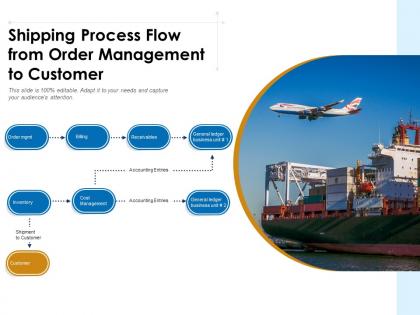
Shipping process flow from order management to customer




Try Before you Buy Download Free Sample Product
 Impress Your
 Audience
 100%
100% Editable
 Save Hours
 of Time


Explain the benefits of different ingredients with our Shipping Process Flow From Order Management To Customer. Convince folks to adopt a balanced diet.
People who downloaded this PowerPoint presentation also viewed the following :
Shipping process flow from order management to customer with all 2 slides:
Advise folks on balanced consumption with our Shipping Process Flow From Order Management To Customer. Explain what constitutes a healthy diet.

FAQs for Shipping process flow from order
The key stages of shipping process flow include order processing, inventory verification, picking and packing, carrier selection, shipment dispatch, tracking and monitoring, and delivery confirmation. These stages streamline operations by reducing fulfillment times, minimizing errors, and enhancing customer visibility, with many e-commerce and retail organizations finding that automated workflows ultimately deliver faster services and improved customer experiences.
Shipping method selection significantly impacts both delivery speed and expenses, with express services delivering within 1-2 days at premium costs while standard ground shipping takes 3-7 days at lower rates. Companies must balance customer expectations with operational budgets, with many retail and e-commerce businesses finding that offering multiple shipping tiers enhances customer satisfaction while optimizing cost structures.
Technology streamlines shipping operations through automated tracking systems, route optimization software, warehouse management platforms, real-time inventory monitoring, and predictive analytics tools. These solutions enhance efficiency by reducing manual errors, accelerating order processing, and improving delivery accuracy, with logistics companies finding that integrated technology ultimately delivers faster customer service and significant cost reductions.
Businesses ensure accurate inventory management during shipping through real-time tracking systems, automated scanning technologies, integrated warehouse management software, and regular cycle counting protocols. These systems streamline operations by minimizing human error, providing instant visibility into stock levels, and enabling proactive replenishment decisions, with many logistics companies finding that automated processes reduce discrepancies by up to 95% while enhancing customer satisfaction.
Common shipping process challenges include inventory discrepancies, documentation errors, carrier delays, damaged goods, customs complications, and tracking visibility gaps. These issues often stem from manual processes, poor communication between stakeholders, and inadequate technology integration, with many logistics companies finding that streamlined automation and real-time monitoring significantly reduce operational costs while enhancing customer satisfaction.
Customs clearance significantly impacts international shipping timelines by adding processing delays, documentation requirements, and potential inspection periods that can extend delivery by several days or weeks. Complex shipments involving restricted goods, incomplete paperwork, or high-value items often face longer clearance times, with many logistics companies building buffer periods into their delivery schedules to account for these regulatory checkpoints and maintain customer expectations.
Packaging ensures product protection during transit, reduces damage-related costs, enhances brand presentation, and optimizes shipping efficiency through proper sizing and weight distribution. Strategic packaging enables businesses to minimize transportation expenses, improve customer satisfaction upon delivery, and streamline warehouse operations, with many e-commerce and manufacturing companies finding that thoughtful packaging design ultimately delivers competitive advantage and operational cost savings.
Shipping costs increase proportionally with package weight and distance, with international destinations typically costing significantly more than domestic shipments due to customs processing, longer transit routes, and carrier handling fees. Major shipping companies use zone-based pricing structures, where remote locations like rural areas or international markets can cost three to five times more than urban domestic deliveries, ultimately impacting businesses' pricing strategies and customer acquisition across different geographic markets.
Businesses should track delivery time accuracy, shipping cost per unit, order fulfillment speed, damage rates, and customer satisfaction scores to evaluate shipping efficiency. These metrics enable companies to identify bottlenecks, optimize carrier relationships, and reduce operational costs, with many retailers finding that comprehensive tracking ultimately delivers faster customer experiences and significant competitive advantages.
Best practices for managing returns include clear return policies, prepaid shipping labels, automated return processing systems, quality inspection protocols, and efficient restocking procedures. These practices streamline operations by reducing processing time, minimizing costs, and enhancing customer satisfaction, with many retailers finding that seamless return experiences ultimately drive customer loyalty and competitive advantage.
Companies improve customer satisfaction through shipping practices by offering transparent tracking systems, flexible delivery options, proactive communication about delays, expedited shipping choices, and reliable packaging standards. These enhancements streamline the customer experience while building trust, with many retail and e-commerce organizations finding that investing in advanced logistics technology and customer-centric shipping policies ultimately delivers higher retention rates and competitive advantage.
Environmental considerations in shipping include carbon footprint reduction, sustainable packaging materials, fuel-efficient transportation modes, waste minimization, and emission compliance standards. These initiatives streamline operations by reducing costs, enhancing brand reputation, and meeting regulatory requirements, with many logistics companies finding that sustainable practices ultimately deliver competitive advantage while satisfying increasingly environmentally conscious consumers.
International shipping regulations involve customs declarations, import/export licenses, duty calculations, country-specific restrictions, and compliance with international trade agreements, while domestic shipping primarily focuses on carrier requirements and local transportation laws. These international complexities require additional documentation, longer processing times, and specialized knowledge of destination country regulations, with many logistics companies finding that automated compliance systems streamline cross-border operations and reduce costly delays.
E-commerce significantly transforms shipping process flows by demanding faster delivery times, real-time tracking capabilities, automated warehouse operations, and flexible return processes. Through digital integration and streamlined logistics, retailers enhance customer experiences while reducing operational costs, with many finding that optimized shipping flows deliver competitive advantage in an increasingly demanding marketplace.
Collaboration with third-party logistics providers enhances shipping efficiency by leveraging specialized expertise, advanced tracking systems, and established distribution networks that many businesses lack internally. These partnerships enable companies to reduce operational costs, accelerate delivery times, and improve customer satisfaction, while accessing scalable infrastructure and technology solutions that would be expensive to develop in-house.
No Reviews