


Shopify investor funding elevator pitch deck ppt template




Try Before you Buy Download Free Sample Product
 Impress Your
 Audience
 100%
100% Editable
 Save Hours
 of Time


Shopify is considered one of the emerging eCommerce platforms that aid people in selling online and offers various services such as payments, marketing, shipping, and customer engagement tools. The pitch deck showcases Shopifys summary to potential investors with details about its mission statement, profitable business model, growth vectors of Shopify, and key statistics associated with it. It addresses the characteristics of the Shopify platform as an integrated platform for every channel and any device. The target market of Shopify is showcased with merchant acquisitions and merchant profiles catered by the platform. The extensive partner network of Shopify is presented in terms of larger brands association, extensive partner ecosystem, growth minded culture, key partners associated, etc. The pitch deck caters unique value proposition of Shopify and financial highlights in terms of robust market position, consistent revenue growth, stable MRR growth, increasing Shopify subscription revenues, Shopify merchant wheel, and investment highlights. Get your hands on this amazing customizable pitch deck now.
People who downloaded this PowerPoint presentation also viewed the following :
Content of this Powerpoint Presentation
Slide 1: This is the cover slide for Shopify Investor Funding Elevator Pitch Deck.
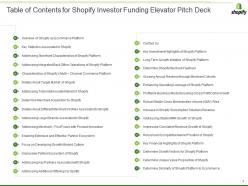
Slide 2: This is the Table of Contents slide that lists out all the elements covered in the deck.
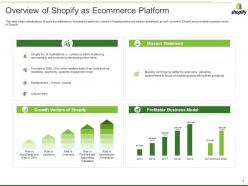
Slide 3: This slide caters details about Shopify as multinational ecommerce platform, in terms of headquarters and mission statement, growth vectors of Shopify and profitable business model of Shopify.
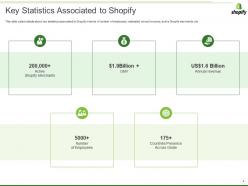
Slide 4: This slide caters details about key statistics associated to Shopify in terms of number of employees, estimated annual revenue, active Shopify merchants, etc.
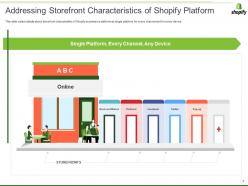
Slide 5: This slide caters details about storefront characteristic of Shopify ecommerce platform as single platform for every channel and for every device.
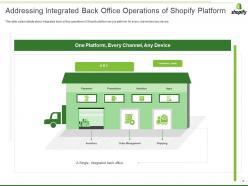
Slide 6: This slide caters details about integrated back-office operations of Shopify platform as one platform for every channel and any device.
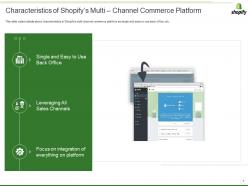
Slide 7: This slide caters details about characteristics of Shopify’s multi channel commerce platform as single and easy to use back office, etc.
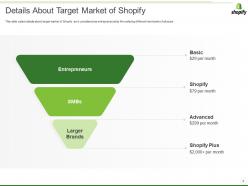
Slide 8: This slide caters details about target market of Shopify as it considered as entrepreneurship firm catering different merchants of all sizes.
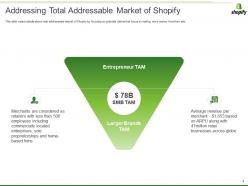
Slide 9: This slide caters details about total addressable market of Shopify by focusing on potential clients that focus on making more money from their site.
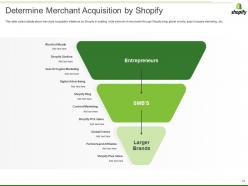
Slide 10: This slide caters details about merchant acquisition initiatives by Shopify in building wide network of merchants through Shopify blog, global events, search engine marketing, etc.
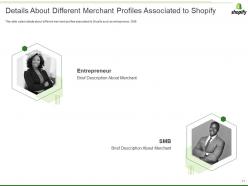
Slide 11: This slide caters details about different merchant profiles associated to Shopify such as entrepreneur, SMB.
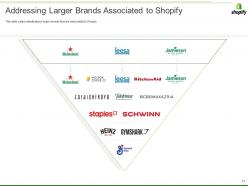
Slide 12: This slide caters details about larger brands that are associated to Shopify.
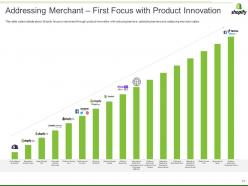
Slide 13: This slide caters details about Shopify focus on merchant through product innovation with reducing barriers, optimizing barriers and catalyzing merchant sales.
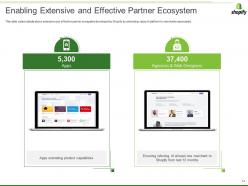
Slide 14: This slide caters details about extensive and effective partner ecosystem developed by Shopify by extending value of platform to merchants associated.
Slide 15: This slide caters details about Shopify’s initiative on developing growth – minded culture by recruiting talented individuals, global outreach , etc.
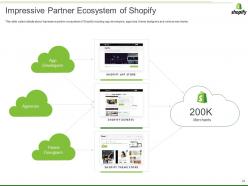
Slide 16: This slide caters details about impressive partner ecosystem of Shopify including app developers, agencies, theme designers and various merchants.
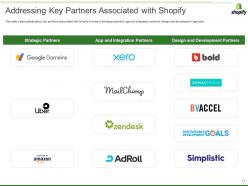
Slide 17: This slide caters details about key partners associated with Shopify in terms of strategic partners, app and integration partners, design and development agencies.
Slide 18: This slide caters details about solutions rendered YouTube in order to solve issues mentioned by providing platform to upload videos and video conversion for accessibility.
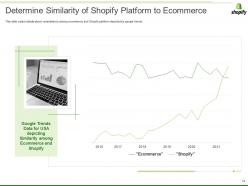
Slide 19: This slide caters details about resemblance among ecommerce and Shopify platform depicted by google trends.
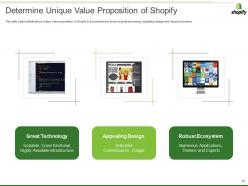
Slide 20: This slide caters details about unique value proposition of Shopify to its customers in terms of great technology, appealing design and robust ecosystem.
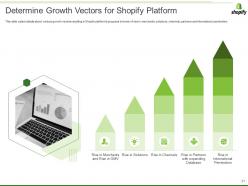
Slide 21: This slide caters details about various growth vectors resulting in Shopify platform’s progress in terms of rise in merchants, solutions, channels, partners and international penetration.
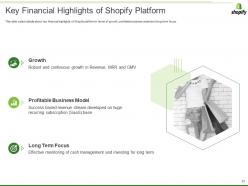
Slide 22: This slide caters details about key financial highlights of Shopify platform in terms of growth, profitable business model and long-term focus.
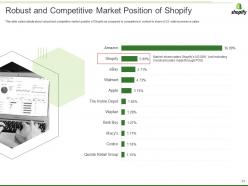
Slide 23: This slide caters details about robust and competitive market position of Shopify as compared to competitors in context to share of US retail ecommerce sales.
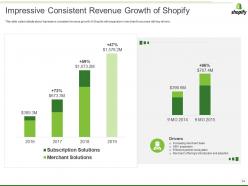
Slide 24: This slide caters details about impressive consistent revenue growth of Shopify with expansion in merchant’s success with key drivers.
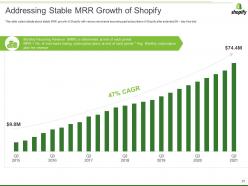
Slide 25: This slide caters details about stable MRR growth of Shopify with various merchants becoming paid subscribers of Shopify after extended 90 – day free trial.
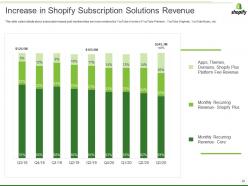
Slide 26: This slide caters details about subscription based paid memberships services rendered by YouTube in terms of YouTube Premium, YouTube Originals, YouTube Music, etc.
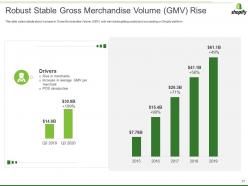
Slide 27: This slide caters details about increase in Gross Merchandise Volume (GMV) with merchants getting scaled and succeeding on Shopify platform.
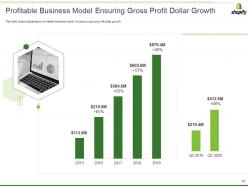
Slide 28: This slide caters details about profitable business model focusing on gross profit dollar growth.
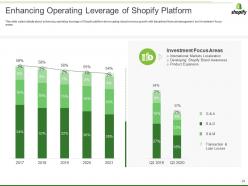
Slide 29: This slide caters details about enhancing operating leverage of Shopify platform showcasing robust revenue growth with disciplined financial management and investment focus areas.
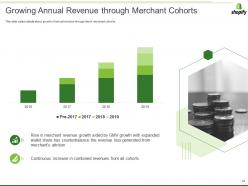
Slide 30: This slide caters details about growth of annual revenue through rise in merchant cohorts.
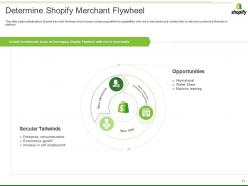
Slide 31: This slide caters details about Shopify merchant flywheel which focus on enhancing platform’s capabilities with rise in merchants as it enable them to sell more products efficiently on platform.
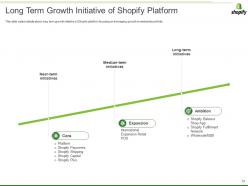
Slide 32: This slide caters details about long term growth initiative of Shopify platform focusing on leveraging growth investments portfolio.
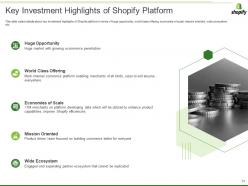
Slide 33: This slide caters details about key investment highlights of Shopify platform in terms of huge opportunity, world class offering, economies of scale, mission oriented, wide ecosystem, etc.
Slide 34: This slide can be used to share your contact details.
Slide 35: This is an icon slide. Use it as per your needs.
Slide 36: This is an Additional Slide
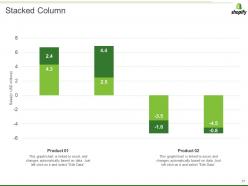
Slide 37: This is a Stacked Column chart slide that can be used to compare different products.
Slide 38: This is an About Us slide that can be used to give a brief overview of your business.
Slide 39: This is Our Mission Our vision slide to state your mission, vision, etc.
Slide 40: This is Our Team slide with name and designation to fill.
Slide 41: This is a Timeline slide to showcase chronological sequence of events.
Slide 42: This is an Idea Generation image slide to present innovative/ creative aspects.
Slide 43: This is a Comparison slide that can be used to conduct a comparative analysis between two different elements.
Slide 44: This is a Thank you slide for acknowledgment. You can share your contact details here.
Shopify investor funding elevator pitch deck ppt template with all 44 slides:
Use our Shopify Investor Funding Elevator Pitch Deck Ppt Template to effectively help you save your valuable time. They are readymade to fit into any presentation structure.

FAQs for Shopify investor funding elevator pitch
You'll want the standard stuff - problem/solution, market size, business model, traction. But here's the thing: investors are drowning in e-commerce pitches right now. What's gonna set you apart? Really drill down on merchant acquisition and how you're driving GMV growth. Unit economics are huge too. Competition section should cover Amazon, WooCommerce, the usual crowd. Oh, and make sure your financials aren't totally unrealistic - I've seen so many founders blow it there. Your go-to-market strategy needs to be solid. Honestly, I'd peek at some successful SaaS decks first just to get the format right.
Break down exactly how you make money - product sales, subscriptions, whatever it is. Show real unit economics, not fantasy numbers that make investors roll their eyes. Simple visuals work best for your customer funnel and lifetime value stuff. The big question they'll ask: can you 10x revenue without costs exploding too? Honestly, that scalability piece is make-or-break. Include a comparison slide showing your margins vs other Shopify businesses - investors love benchmarking against competition. Oh, and don't oversell the projections. They've seen every pitch deck trick in the book.
Revenue growth rate is huge - start there. Customer acquisition cost and lifetime value are the other two biggies investors actually look at. Your monthly recurring revenue trends matter too, plus gross margins and repeat purchase rates. Conversion rates and average order value will prove your store isn't trash. The LTV to CAC ratio is honestly the most telling metric though - you want at least 3:1 or investors get weird about it. Throw in inventory turnover if you're holding stock. Clean charts with month-over-month comparisons make trends super obvious. Don't overthink the presentation part.
Track your customer acquisition costs, lifetime value ratios, and how operational expenses scale with revenue growth. That last one's huge - you need to prove that doubling revenue doesn't mean doubling costs. Charts showing improving gross margins over time really help here. Also automation wins, show what processes you've streamlined. Honestly though, skip the unrealistic hockey stick projections. Give them a few realistic growth scenarios instead. Investors appreciate the honesty way more than you'd think. End with concrete milestones tied to funding amounts - like "with 500K we'll hit X, with 1M we'll achieve Y." Makes it crystal clear what their money actually buys.
Dude, you NEED to include CAC in your pitch. Investors want to see you're not burning cash randomly. Show your current CAC next to lifetime value - aim for at least 3:1 LTV to CAC ratio. Break it down by channel too (Facebook ads, organic, referrals, whatever). Don't just lump everything together. Include your payback period and how CAC changes as you grow. This stuff literally makes or breaks funding conversations since it proves you can scale profitably. Oh, and practice defending those numbers - they'll definitely grill you on the math during Q&A.
Dude, make your slides visual first. Charts showing GMV growth and merchant numbers hit way harder than paragraphs - investors want to see that hockey stick curve immediately. Screenshots of your platform are great but annotate them so people actually get what they're looking at. Product mockups can show off how you beat competitors on UX too. Each slide should grab attention in like 10 seconds max, think billboard style. Oh and keep colors consistent - I've seen too many decks that look like rainbow explosions. Skip the fancy animations, they're just distracting.
Dude, VCs are totally obsessed with unit economics - they want to see your CAC, LTV, monthly recurring revenue, and gross margins broken down by each metric. Show them realistic acquisition funnels, not some crazy hockey stick curve you pulled out of nowhere. Your retention rates matter way more than you think. Focus on that predictable recurring revenue since that's what gets them excited about SaaS models. Oh, and make sure you can demonstrate a clear path to profitability within 18-24 months. They'll also want to know your take rate strategy as you scale your merchant base.
Don't just talk about having "better features" - that's what every business says. What makes you actually different? Maybe it's exclusive supplier deals, proprietary data, or some distribution channel others can't touch. Honestly, skip the "we have amazing customer service" line because everyone claims that. Show me real numbers instead - repeat purchase rates, customer acquisition costs, stuff that actually proves your point. The big question is why someone would pick you over Amazon consistently. And whatever your edge is, make sure it'll still matter in two years, not just right now.
Honestly, just focus on the numbers that show you're actually growing. Like if you went from 50 orders to 500 in three months, lead with that. Revenue milestones hit different too - your first $10K month or doubling sales quarter-over-quarter. The whole "started in my garage, now doing $50K monthly" thing works if it's real (investors love that story for some reason). Throw in some social proof - maybe you got featured somewhere or have crazy repeat customer rates. Pick 2-3 solid examples with actual numbers and timelines. Makes you look legit instead of just talking in circles about "potential."
Definitely add a "Risks & Mitigation" slide - shows you're not totally clueless about what could go sideways. Hit the obvious stuff like market saturation, platform dependency, customer acquisition costs. But here's the thing - don't just dump a list of problems on them. That's depressing as hell. For each risk, explain exactly how you'll handle it or pivot if things go wrong. Honestly, investors love founders who think through the worst-case scenarios because it proves you're actually strategic. Be real about the challenges but confident about your plans to tackle them.
Honestly? Start with Pitch or Canva - their investor templates are solid and you won't look like you threw something together in 20 minutes. PowerPoint's fine too if you're decent at design, but why reinvent the wheel? Hit up SlideShare to check out how other e-commerce companies structured theirs. Guy Kawasaki's 10/20/30 rule is pure gold for staying focused. Oh, and definitely grab Shopify's case studies and growth numbers for your market slides. Investors eat that stuff up - real platform data beats generic market research every time. Makes your whole pitch way more credible.
Dude, your team slide is make-or-break for Shopify investors. They want to see actual e-commerce chops, not just generic startup experience. Show off previous online stores you've built, Shopify dev work, or retail operations. Skip the boring "10 years CEO experience" bullet points. What they really care about is domain stuff - conversion optimization, helping merchants scale, marketplace expertise. I've seen way too many founders pitch without understanding the merchant journey at all. Include some quick wins or metrics that prove you actually get what store owners deal with daily. Your credibility in e-commerce space will set you apart from all the other SaaS pitches.
Yeah, Shopify's been super tight-lipped about their early pitch materials - you won't find much out there. Instead, check out decks from Buffer, Airbnb, or Mixpanel since they're all SaaS companies with similar recurring revenue models. Focus your deck on merchant growth numbers and GMV. Those metrics matter way more than fancy slides anyway. Show how you're actually fixing problems for online sellers - that's what investors care about. Honestly? I'd skip the deck hunting and spend that time talking to your target customers. Their pain points will write your pitch for you. Problem-solution fit first, then worry about making it look pretty.
Oh absolutely use customer testimonials in your pitch deck! They're like instant credibility. Drop them in your problem/solution slides to show the real pain points, then hit investors again with them on your traction slides. Pick 2-3 solid ones max - different customer types work best. And honestly? Numbers are everything here. "Boosted revenue 40%" hits way harder than some vague "love your product" quote. Investors want proof people actually pay for this stuff, not just think it's neat. Oh and scatter them throughout, don't dump them all in one boring slide.
Don't just trail off at the end - that's the worst. Be super specific about next steps. Want a follow-up meeting? Say when. Need due diligence docs? Give them a timeline. Ask for the exact investment amount you're looking for. Practice this part because people always rush through it or sound weirdly desperate. Remind them why you're awesome one more time, paint that picture of success with their money behind you, and actually show you're excited to work together. Oh, and leave a simple one-pager with your contact info - don't make them hunt you down later.
-
Thanks for all your great templates they have saved me lots of time and accelerate my presentations. Great product, keep them up!
-
Understandable and informative presentation.