


Upwork investor funding elevator pitch deck ppt template




Try Before you Buy Download Free Sample Product
 Impress Your
 Audience
 100%
100% Editable
 Save Hours
 of Time


This PowerPoint presentation covers Upwork Investor Funding Elevator Pitch Deck. Upwork is the worlds work marketplace that connects millions of companies worldwide with independent talent. This PPT is of great significance for companies and freelancers to collaborate in innovative ways that maximize their potential. This deck depicts Upwork mission and vision statements, financial summary, and investment highlights. Further, it includes details about the Upwork market such as the Global Labor Market Revolution bought by Upwork, how Upwork enables a new work paradigm, and how it brings value for freelancers and clients. Additionally, this PPT familiarizes readers with details on how Upwork brings efficiencies to the labor marketplace and provides the global remote work opportunity. This presentation also includes sections namely competitive landscape, freelancers service offerings, work methodology of Upwork, end to end software functionality, product offerings, etc. Further, this pitch deck illustrates Upwork business model, revenue recognition and margin profile, expansion plans, etc. Lastly, this deck highlights details on growth opportunities, growth journey of Upwork, awareness and acquire users plan, geographic localization, and Upwork team.
People who downloaded this PowerPoint presentation also viewed the following :
Content of this Powerpoint Presentation
Slide 1: This slide introduces Upwork Investor Funding Elevator Pitch Deck. State Your Company Name and begin.
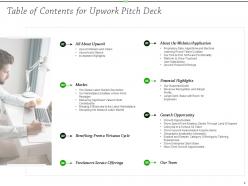
Slide 2: This slide shows Table of Content for the presentation.
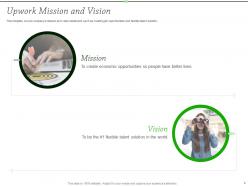
Slide 3: This template covers company’s mission and vision statement such as creating job opportunities and flexible talent solution.
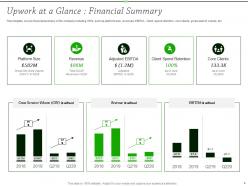
Slide 4: This template presents financial summary of the company including KPI’s such as platform size, revenues, EBITDA, Client spend retention, core clients, gross search volume, etc.
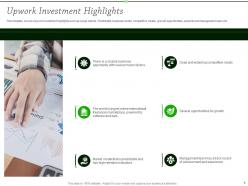
Slide 5: This template displays Upwork investment highlights such as Large market, Predictable business model, competitive moats, growth opportunities, experienced management team etc.
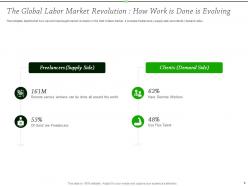
Slide 6: This template depicts that how Upwork has bought market revolution in the field of labor market.
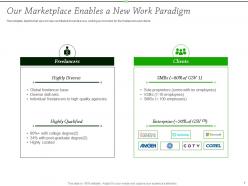
Slide 7: This template presents that Upwork has contributed towards a new working environment for the freelancers and clients.
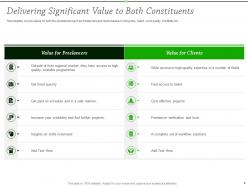
Slide 8: This template covers values for both the constituents such as freelancers and clients based on hiring time, talent, work quality, credibility etc.
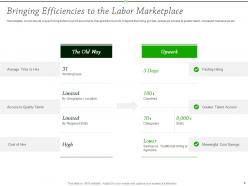
Slide 9: This template displays the old ways of hiring before Upwork and what is changed after Upwork.
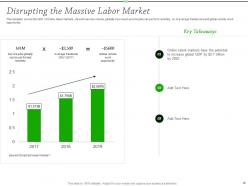
Slide 10: This template covers the GDP of Online talent markets ,Upwork service volume, etc.
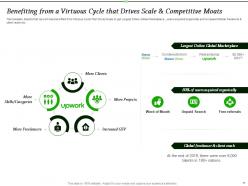
Slide 11: This template depicts that Upwork has benefited from Virtuous Cycle That Drives Scale to get Largest Online Global Marketplace.
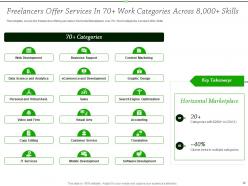
Slide 12: This slide presents Freelancers Offer Services In 70+ Work Categories Across 8,000+ Skills.
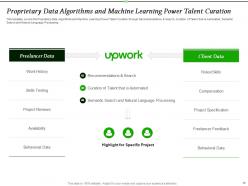
Slide 13: This slide shows Proprietary Data Algorithms and Machine Learning Power Talent Curation.
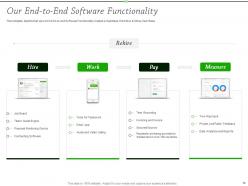
Slide 14: This template depicts that Upwork's End-to-end Software Functionality Creates a Seamless Workflow & Sticky User Base
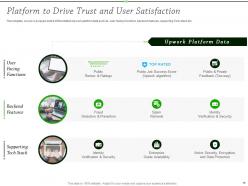
Slide 15: This template covers A purpose-built & differentiated Upwork platform data.
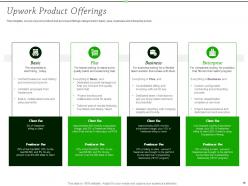
Slide 16: This template displays Upwork product and services offerings categorized in basic, plus, business and enterprise prices.
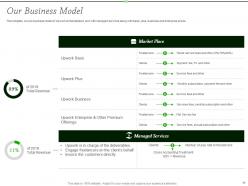
Slide 17: This template covers business model of Upwork at marketplace and with managed services along with basic, plus, business and enterprise prices
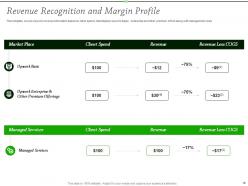
Slide 18: This slide presents Revenue Recognition and Margin Profile.
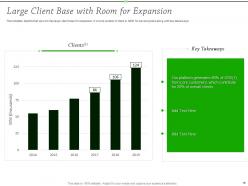
Slide 19: This slide shows Large Client Base with Room for Expansion.
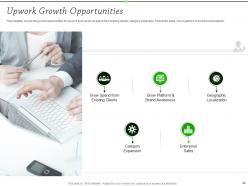
Slide 20: This template covers the growth opportunities for Upwork such as Grow spend from existing clients, Category expansion, etc.
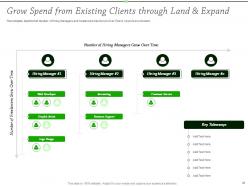
Slide 21: This template depicts that Number of Hiring Managers and freelancers has Grown Over Time in Upwork environment.
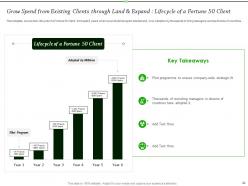
Slide 22: This slide shows Grow Spend from Existing Clients through Land & Expand : Lifecycle of a Fortune 50 Client.
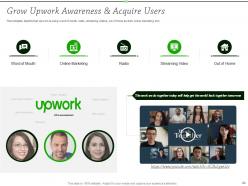
Slide 23: This template depicts that Upwork is using word of mouth as their online marketing tool.
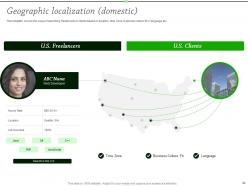
Slide 24: This template covers the ways of searching freelancers or clients based on location, time zone, business culture fit or language etc.
Slide 25: This template depicts that user can do personalized search by category or can do category customizations.
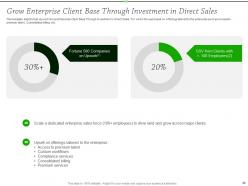
Slide 26: This slide presents Grow Enterprise Client Base Through Investment in Direct Sales.
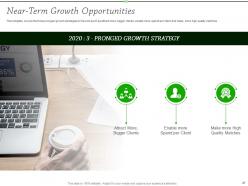
Slide 27: This slide shows Near-Term Growth Opportunities.
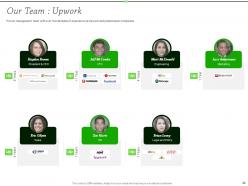
Slide 28: This slide displays Proven management team with over five decades of experience at Upwork and predecessor companies.
Slide 29: This slide shows Icons for Upwork Investor Funding Elevator Pitch Deck.
Slide 30: This slide is titled as Additional Slides for moving forward.
Slide 31: This is About Us slide to show company specifications etc.
Slide 32: This is Our Mission slide with related imagery and text.
Slide 33: This slide shows 30 60 90 Days Plan with text boxes.
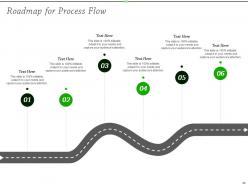
Slide 34: This slide displays Roadmap with text boxes.
Slide 35: This slide shows Weekly Timeline with Task Name.
Slide 36: This is Our Team slide with names and designation.
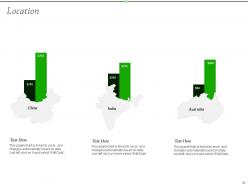
Slide 37: This is a Location slide with maps to show data related with different locations.
Slide 38: This slide displays Puzzle with related icons and text.
Slide 39: This is a Thank You slide with address, contact numbers and email address.
Upwork investor funding elevator pitch deck ppt template with all 39 slides:
Use our Upwork Investor Funding Elevator Pitch Deck Ppt Template to effectively help you save your valuable time. They are readymade to fit into any presentation structure.






FAQs for Upwork investor funding elevator pitch
So your pitch deck needs the standard stuff - problem/solution, market size, business model, team bios. But honestly, the marketplace dynamics are what'll make or break your presentation. Show your take rates, user acquisition costs, and retention for both freelancers and clients. Those network effects are everything in this space. Traction slide should focus on real growth momentum, not just pretty numbers that don't mean much. Include unit economics clearly in your financials - investors love seeing those work. Oh, and definitely throw in competitive landscape (it's crowded) plus how you'll defend your position. I'd add regulatory risks too since gig economy rules keep changing.
Skip the generic skills lists - nobody cares. Show them actual results instead. Like "boosted their conversion rate by 40%" rather than just claiming you're great at marketing. I've seen way too many pitch decks that are pure fluff and it's painful. Include screenshots of your real work, before/after comparisons, or client testimonials. Case studies work great too. Here's the thing though - don't dump everything you've ever done on them. Pick 3-4 strengths that actually solve their specific problem. Tailor it to what they need, not what you want to brag about.
Start with your strongest numbers - MRR, GMV, and user acquisition costs are what they'll want to see first. Your take rate and active user counts matter too, especially the freelancer/client split. Cohort retention data is gold for marketplace pitches, honestly investors go crazy for that stuff. Don't skip the boring operational metrics either - CAC vs LTV ratios show you actually understand unit economics. Oh, and repeat usage rates are clutch since they prove stickiness. Just make sure you can explain how each number ties back to long-term growth potential.
Look, investors hear pitches all day - numbers just blur together. But a good story? That sticks. Start with the real problem your users face, make it personal so people actually feel it. Then boom - your solution swoops in to fix everything. Classic hero's journey stuff, and honestly, it works because we're all suckers for that narrative. Just don't make it all fluffy though. You still need to back everything up with actual data and show real traction. The trick is mixing the emotional hook with solid business proof. Get them invested in your users' struggle first, then they'll want to invest their money.
Your deck needs to look clean and professional - consistent fonts, good white space, colors that actually work together. High-quality visuals are a must. Data charts should tell your story, not confuse people. Way too many decks I've seen look ancient! Don't cram text everywhere. Each slide should be readable on phones and laptops since investors will view it everywhere. Oh, and visual hierarchy matters - guide their eyes to what's important first. Honestly, good design separates serious founders from amateurs pretty quickly.
Honestly, just swap out the key slides based on what they actually care about. Tech clients? Start with your code samples and stack. Marketing folks want to see campaign results and ROI numbers right up front. Keep your intro slide the same (duh), but definitely tailor your case studies to their world. Startups love seeing scrappy, quick wins - enterprise clients are more about process docs and compliance stuff. It's kind of annoying but makes a huge difference. Oh, and always check their job posting for specific problems they mention. Use their exact wording in your deck. Makes it feel like you built it just for them.
Honestly, most people make their pitch decks way too long. Clients check out after like 5-6 slides max. Skip the generic templates too - they can smell copy-paste from a mile away. Don't dump your entire portfolio in there either. Pick ONE really solid case study that actually matches what they need. Way more powerful than showing everything you've ever done. Also, never lead with your rates - talk about the value first. Keep it conversational and specific to their project. I learned this the hard way after sending boring pitches for months. Less really is more here.
Don't just throw all your testimonials on one slide - that's boring and nobody reads walls of text anyway. Start strong with your best quote right after the intro. Then scatter different ones that show off various skills throughout the deck. One about deadlines, another about quality, maybe communication skills. Screenshots beat typed quotes every time because they look real. Oh, and if you can find testimonials with actual numbers or results, those are gold. Always include names and companies when clients give you permission - makes it way more credible.
Dude, you absolutely need market research in that pitch deck. Without it, you're basically telling investors "trust me bro" about the freelance world. Show them actual numbers - market size, growth trends, how people behave on platforms like Upwork. Back up your claims with real data about the gig economy and competitor stuff. Pain points too. I mean, investors see through BS pretty quickly, and wishful thinking won't cut it. The research proves there's genuine demand for what you're building. Skip this and your whole pitch falls flat.
Start with the exact problem you fix and throw some real numbers at them - "boosted client revenue 40%" or "finished 15 projects early." Most freelancers just dump a skill list, which honestly does nothing. Pick 2-3 things that actually make you different from everyone else bidding. Tell them about that nightmare project you somehow pulled off, then connect it to what you'll do for them. Don't waste space on being "passionate" about whatever - they want proof you can get results. Numbers grab attention way better than generic enthusiasm anyway.
Make your financial projections realistic - seriously, investors are so tired of seeing those ridiculous hockey stick graphs that never happen. Show 3-5 years of revenue and expenses, plus key stuff like customer acquisition costs. Conservative numbers actually build way more trust. I'd throw in multiple scenarios if you can - base case, optimistic, pessimistic. Your numbers need to match whatever market size you mentioned earlier. Oh, and definitely be ready to defend every single assumption because they're gonna grill you on the financials during Q&A. That's where most pitches fall apart honestly.
Yeah, don't try to hide the risky stuff - investors aren't dumb and they'll call you out on it anyway. Make a whole section just for risks. Cover the obvious things like being too dependent on one client, competition, uneven cashflow, maybe skills you're missing. I see freelancers try to downplay this all the time and it's such a mistake. What matters is showing you've thought about solutions for each one. Like "60% of my revenue comes from one client, but I'm talking to 3 new prospects right now." That's way better than pretending everything's perfect when it's not.
Look, most Upwork decks are trash so you're already ahead. Start with their actual problem instead of dumping your resume on them. Tell a story with clean visuals and real numbers that prove you've done this before. What makes you different? Your industry knowledge, solid ROI results, whatever it is. Case studies are huge - show measurable results, not vague "increased engagement" nonsense. Keep slides clean but don't make them boring as hell. Oh and definitely end with clear next steps and timeline so they actually know what they're signing up for. You've got this.
Skip the "I'm super experienced" fluff - nobody cares. Numbers are what actually matter. Did you boost sales by 34%? Beat a deadline by two weeks? Screenshots of client reviews work amazingly well too, honestly people eat that stuff up. I'd make quick one-page case studies for your biggest wins. Problem, what you did, results with real numbers. "Increased conversions by 23%" hits way harder than "improved performance." Even small metrics count - response rates, time saved, whatever you can measure. The data tells your story better than fancy words ever will.
Definitely lead with remote work going permanent - that's the goldmine here. The gig economy is exploding way faster than regular jobs, and companies aren't just hiring freelancers for overflow anymore. They're going straight to specialists for key projects. There's this massive talent shortage happening right now too. Here's what's interesting - AI isn't killing jobs, it's actually boosting demand for creative and strategic roles that humans excel at. Gen Z really prefers project work over the traditional 9-to-5 grind. Just make sure you tie each of these trends back to how they expand Upwork's market potential.
-
Perfect template with attractive color combination.