


Fiverr investor funding elevator pitch deck ppt template





Try Before you Buy Download Free Sample Product
 Impress Your
 Audience
 100%
100% Editable
 Save Hours
 of Time


Fiverr is a freelance services marketplace based in Israel. Fiverr allows you to list and apply for small one-time jobs or gigs online. The platform of Fiverr connects businesses with on-demand freelancing talent. Check out our efficiently designed Fiverr Investor Funding Pitch Deck that will present a summary of Fiverr showing investment highlights of Fiverr, workplace transformation by Fiverr, the market opportunity of Fiverr, the current freelancing trend in the market, Fiverrs unique e-commerce approach, and Fiverr versus other staffing companies. Also, this PowerPoint presentation provides details about the value proposition of Fiverr, Fiverrs two side marketplace framework, Fiverrs buyer and seller case study, How Fiverr generates revenue, the growth strategy of Fiverr, and Fiverrs strong unit economics on performance marketing. Additionally, this pitch deck provides information on Fiverrs strong revenue growth, Fiverrs annual spend per buyer, Fiverrs long-term growth drivers, Fiverrs cash flow statement, and Fiverrs balance sheet statement. Book a free demo with our research or design team and customize this 100 percent editable pitch deck based on your specific business needs. Get access now.
People who downloaded this PowerPoint presentation also viewed the following :
Content of this Powerpoint Presentation
Slide 1: This slide displays title i.e. 'Fiverr Pitch Deck'.
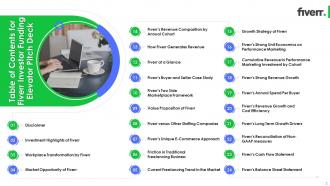
Slide 2: This slide presents table of contents.
Slide 3: This slide exhibits disclaimer.
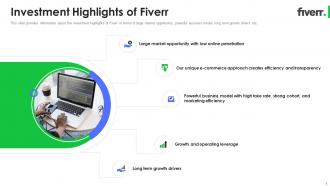
Slide 4: This slide provides information about the investment highlights of Fiverr in terms of large market opportunity, powerful business model, etc.
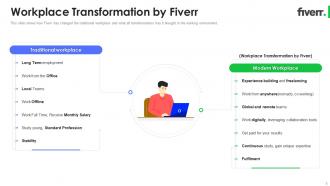
Slide 5: This slide shows how Fiverr has changed the traditional workplace and what all transformations has it brought in the working environment.
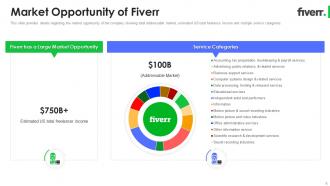
Slide 6: This slide provides details regarding the market opportunity of the company showing total addressable market, etc.
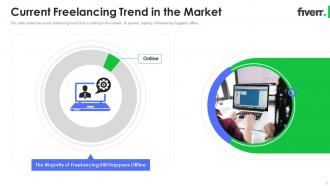
Slide 7: This slide shows the resent freelancing trend that is existing in the market. At present, majority of freelancing happens offline.
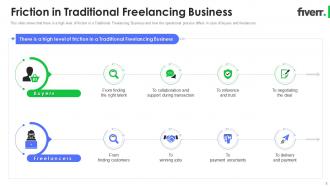
Slide 8: This slide shows that there is a high level of friction in a Traditional Freelancing Business.
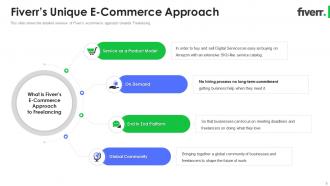
Slide 9: This slide shows the detailed overview of Fiverr’s ecommerce approach towards Freelancing.
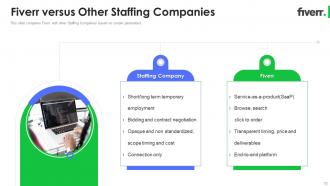
Slide 10: This slide compares Fiverr with other Staffing Companies based on certain parameters.
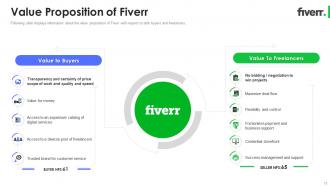
Slide 11: This slide displays information about the value proposition of Fiverr with respect to both buyers and freelancers.
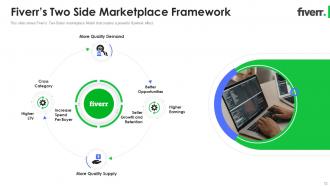
Slide 12: This slide shows Fiverr’s Two-Sided marketplace Model that creates a powerful flywheel effect.
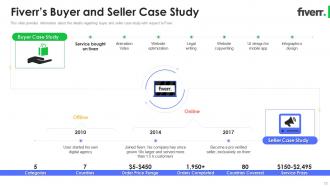
Slide 13: This slide provides information about the details regarding buyer and seller case study with respect to Fiverr.
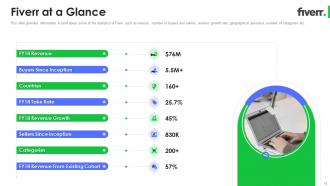
Slide 14: This slide provides information in brief about some of the statistics of Fiverr such as revenue, number of buyers and sellers, etc.
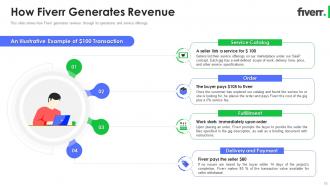
Slide 15: This slide shows how Fiverr generates revenue through its operations and service offerings.
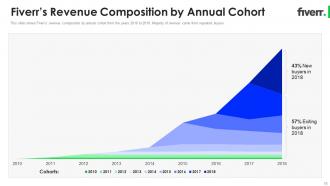
Slide 16: This slide shows Fiverr’s revenue composition by annual cohort from the years 2010 to 2018. Majority of revenue came from repeated buyers.
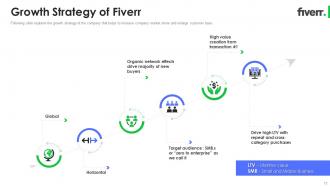
Slide 17: This slide explains the growth strategy of the company that helps to increase company market share and enlarge customer base.
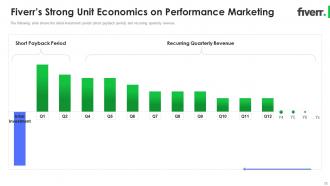
Slide 18: This slide shows the initial investment period (short payback period) and recurring quarterly revenue.
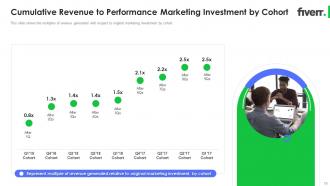
Slide 19: This slide shows the multiples of revenue generated with respect to original marketing investment by cohort.
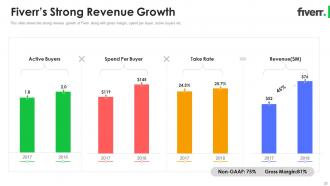
Slide 20: This slide shows the strong revenue growth of Fiverr along with gross margin, spend per buyer, active buyers etc.
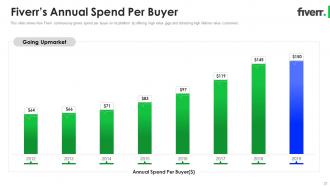
Slide 21: This slide shows how Fiverr continuously grows spend per buyer on its platform by offering high value gigs and attracting high lifetime value customers.
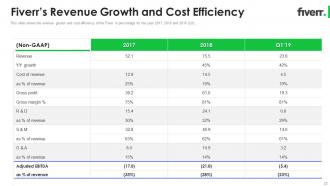
Slide 22: This slide shows the revenue growth and cost efficiency of the Fiverr in percentage for the year 2017, 2018 and 2019 (Q1).
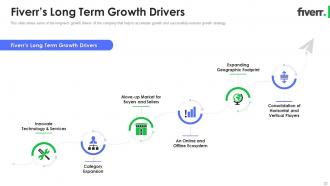
Slide 23: This slide shows some of the long-term growth drivers of the company that help to accelerate growth and successfully execute growth strategy.
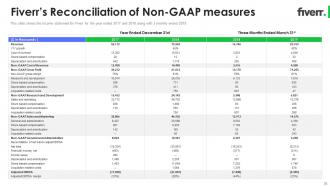
Slide 24: This slide shows the income statement for Fiverr for the year ended 2017 and 2018 along with 3 months ended 2019.
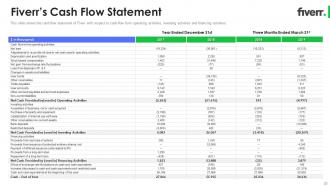
Slide 25: This slide shows the cash flow statement of Fiverr with respect to cash flow form operating activities, investing activities and financing activities.
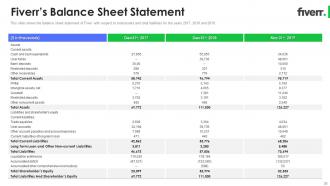
Slide 26: This slide shows the balance sheet statement of Fiverr with respect to total assets and total liabilities for the years 2017, 2018 and 2019.
Slide 27: This is the icons slide.
Slide 28: This slide presents title for additional slides.
Slide 29: This slide shows about your company, target audience and its client's values.
Slide 30: This slide presents your company's vision, mission and goals.
Slide 31: This slide shows details of team members like name, designation, etc.
Slide 32: This slide depicts 30-60-90 days plan for projects.
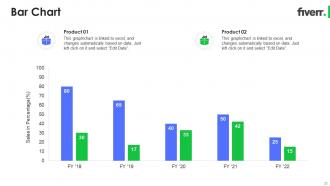
Slide 33: This slide exhibits yearly sales bar charts for different products. The charts are linked to Excel.
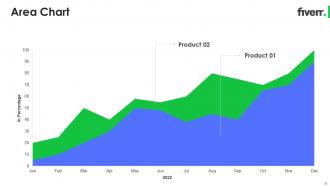
Slide 34: This slide exhibits yearly profits stacked line charts for different products. The charts are linked to Excel.
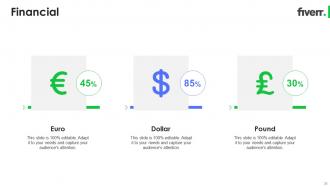
Slide 35: This slide showcases financials.
Slide 36: This slide shows roadmap.
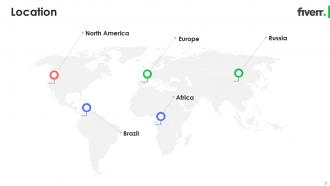
Slide 37: This slide exhibits location of the company in world map.
Slide 38: This is thank you slide & contains contact details of company like office address, phone no., etc.
Fiverr investor funding elevator pitch deck ppt template with all 43 slides:
Use our Fiverr Investor Funding Elevator Pitch Deck Ppt Template to effectively help you save your valuable time. They are readymade to fit into any presentation structure.







FAQs for Fiverr investor funding elevator pitch
So for your Fiverr pitch deck, you'll want the usual suspects - problem statement, your solution, business model, team bios, and funding ask with breakdown. But honestly? The traction slide is where you'll live or die with marketplace ideas. Investors need to see both sides growing - active sellers AND buyers, transaction volumes, the whole thing. Unit economics matter too since they want that path to profitability mapped out. Oh and don't forget competitive analysis - they always ask about that. Keep it tight, maybe 10-12 slides tops. Practice the 10-minute version until you can do it in your sleep.
Here's what worked for me on Fiverr - you gotta show what makes you different from everyone else doing the same thing. Start with the problem you're solving, then get super specific about why you're better. Like don't just say "fast delivery," say "logos in 24 hours instead of the usual week." Numbers are your friend here - "boosted client retention 40%" hits way harder than vague stuff. Honestly, skip the "premium quality" nonsense because literally everyone says that. Talk about your actual process or tools instead. Oh and test your pitch on someone who doesn't know your industry first - they'll catch the confusing parts you missed.
Show them your revenue growth, customer acquisition costs, and how often clients come back - that's what they really care about. Monthly recurring revenue is huge if you've got it. Profit margins matter too since Fiverr takes their slice. The key thing? Prove you're not just trading hours for dollars anymore. Building a team or turning your services into products - that's the freelancer-to-agency story investors love. Your niche and market position are important, but honestly, it all comes down to showing this isn't just a side hustle that caps out when you burn out.
For your market analysis, hit these three slides: total addressable market size, your specific gig economy niche, and where you stand against competitors. Pull real data from IBISWorld or Statista - investors literally love seeing those growth charts for freelance services. Demographics and spending patterns of your target audience should come next. Then identify your main competitors, but here's the thing - don't just say you're better. Actually show what gaps you're filling that they aren't. Oh, and definitely end with realistic market share projections for the next 2-3 years with actual numbers backing it up.
Okay so first - tons of white space and big headlines because investors flip through these super fast. Your story flow should go: problem, solution, market size, business model, traction, team, financials, ask. Less text is always your friend here. Stick with the same fonts and colors throughout, and please make your charts readable - I can't tell you how many decks I've seen with microscopic pie charts that are useless. One clear point per slide. Oh, and practice talking through it a bunch because honestly? The deck is just backup. You're the main event, not your slides.
So you'll want that problem-solution-traction flow, but make it feel real. Pick a specific freelancer who's actually struggling - like someone super talented but stuck on page 50 of search results, you know? Then walk through exactly how your platform changed their life with real numbers and stories. I've sat through way too many generic pitch decks that all sound identical! Each part of your story should tie back to why the market opportunity is huge or how you're beating competitors. Wrap up with solid metrics proving this transformation is actually happening at scale.
Don't bullshit your growth numbers - investors see right through that crap. Keep slides focused, not crammed with every single feature you've built. I've watched founders waste 10 minutes on tech details when all anyone cares about is traction and market size. Never claim you have zero competitors (seriously, that's a red flag). Your financial ask needs to make sense, and you better know exactly where the money's going. Oh, and practice your timing - stick to 15 minutes max or you'll lose them.
Map out where your Fiverr thing could go - like if you're handling 10 projects now, show how you'd hit 50+ by bringing on other freelancers or using some automation. Break it down into 6-month, 1-year, and 3-year goals with actual numbers. Investors eat up those crazy growth charts even when they're pretty ambitious (which honestly, they usually are). Include stuff like revenue per client and repeat customers. Don't forget to mention the roadblocks you'll probably hit and how you'd fix them. Oh, and definitely expand into related services - that's where the real money is.
So for your Fiverr pitch, investors want to see revenue projections broken down by your different services, plus customer acquisition costs and lifetime value stuff. Cash flow forecasts are huge - they need to know when you'll actually make money. If you're doing any recurring revenue model, definitely highlight that. Those crazy hockey stick growth charts? Skip them, they just look fake. Your unit economics have to actually work with how Fiverr's platform operates. I'd do at least a 3-year forecast, but honestly the key is backing it up with whatever real performance data you already have. That's what makes it believable.
Definitely focus on the hard numbers - screenshots of your dashboard with completed orders and revenue growth will sell your story way better than just talking about it. Those 5-star reviews are pure gold on slides, honestly. Also grab some solid customer testimonials if you can. Monthly progression over the last 6 months makes a clean chart that investors actually pay attention to. If you're still building up, lean into your completion rate and response times instead. Oh, and if you've snagged any premium gigs, definitely highlight those. Just don't go crazy with random metrics - stick to stuff that actually shows you're growing consistently.
Just be straight up about the risks - honestly, investors can smell BS from a mile away. Make a slide covering your biggest challenges like market competition or keeping freelancers happy. Here's the key part though: don't just dump problems on them. Show how you'll handle each one. Competition scaring you? Explain what makes you different. I've seen too many founders either ignore risks completely or panic-spiral through them. Find that middle ground where you're like "yeah, this could be tough, but here's our game plan." Way better than acting like you've got zero problems.
Start with whatever experience directly connects to your Fiverr project idea. Got someone with marketplace or freelancing experience? Perfect - that's exactly what investors want to see. Don't just throw out boring qualifications though. Tell a short story about why your team's background makes sense for this specific problem. Like, if you've built similar platforms before or understand the freelancer pain points firsthand, say that. The whole point is showing investors this isn't just random people with a random idea - you actually know what you're doing and why this combo works.
Honestly, I'd skip PowerPoint if you can. Canva and Pitch.com have way better templates made specifically for investor decks. Beautiful.ai is actually pretty cool - it fixes your design automatically as you add stuff, which saves time. Google Slides works fine too if you're collaborating with others. Figma gives you total control but yeah, there's definitely a learning curve there. I spent way too long messing with fonts last time I used it lol. Whatever you choose, just grab a template first. Don't try building from scratch - you'll waste hours on spacing and colors instead of focusing on your actual pitch content.
Okay so basically you gotta switch up your pitch depending on who you're talking to. VCs want to hear about massive market size and how you'll scale - they're hunting for unicorns. Angels care more about your team's experience and whatever early numbers you've got. Strategic investors? They're thinking about how you fit into what they're already doing. It's kinda like tweaking your resume for different companies, honestly. Same info, different angle. Oh and definitely stalk their portfolio first - sounds creepy but you'll thank me when you can name-drop their other investments. Start with whatever gets them excited right off the bat.
Look, investors hate when you pretend competition doesn't exist - major turnoff. You've gotta show them you actually get the market you're jumping into. How's your platform gonna beat Upwork, Freelancer, or regular Fiverr? Don't just wave away the threats either. Be real about what you're up against. Find the gaps in what's already out there and explain why people will switch to you instead. A comparison chart works great for this - shows exactly where you'll crush it vs the competition. I've seen too many founders tank their pitch by ignoring this part completely.
-
Out of the box and creative design.
-
Presentation Design is very nice, good work with the content as well.