


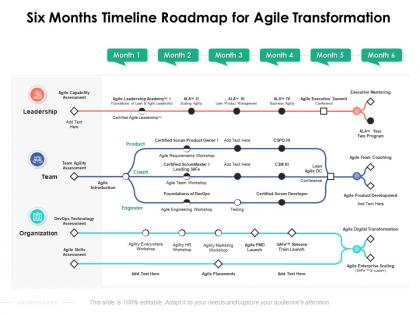
Six months timeline roadmap for agile transformation




Try Before you Buy Download Free Sample Product
 Impress Your
 Audience
 100%
100% Editable
 Save Hours
 of Time


The success rate of business plans is hugely dependent on the plan of action, and this editable Six Months Timeline Roadmap For Agile Transformation rightly serves the purpose. Encapsulate all the information related to the project in a well structured manner to obtain maximum efficiency by incorporating our stunning PowerPoint theme. State the critical deliverable, steps involved, time frame, workforce allocation, and lots more in an easy to understand manner by utilizing this pre designed roadmap PowerPoint layout. You can also prioritize your tasks and discuss the problem areas with your colleagues by incorporating this tailor made PPT layout. Empower your work plan by employing this professionally designed PPT theme. Entrepreneurs can download Six Months Timeline Roadmap For Agile Transformation as a beneficial communication tool that facilitates in collaborating with different tasks and achieve targets.
People who downloaded this PowerPoint presentation also viewed the following :
Six months timeline roadmap for agile transformation with all 2 slides:
Give your audience a fulfilling experience. They will find our Six Months Timeline Roadmap For Agile Transformation elevating.
FAQs for Six months timeline roadmap
Key stages include assessment and readiness evaluation, pilot team formation, scaled implementation across departments, cultural change management, and continuous improvement cycles. These phases enable organizations to systematically transition from traditional methodologies to Agile practices, with many companies finding that structured rollouts deliver improved project delivery times, enhanced team collaboration, and ultimately greater market responsiveness.
Organizations can assess their current Agile maturity by evaluating team collaboration practices, delivery frequency, customer feedback integration, leadership support, and existing process flexibility. Through comprehensive maturity assessments and stakeholder interviews, companies across sectors like financial services and manufacturing identify gaps in their current practices, ultimately enabling targeted transformation strategies that deliver measurable improvements in delivery speed and organizational responsiveness.
Leadership and culture serve as the foundational pillars of successful Agile transformation, with executive commitment, cultural shift toward collaboration, and adaptive mindset changes determining overall outcomes. Strong leadership champions streamline the transition by fostering psychological safety, empowering cross-functional teams, and modeling Agile behaviors, while organizations with supportive cultures achieve faster adoption rates and sustained transformation success.
Teams can effectively measure Agile transformation progress through velocity tracking, sprint burndown charts, cycle time analysis, team satisfaction surveys, and customer feedback metrics. These measurements enable organizations to assess delivery speed, quality improvements, and team engagement while identifying bottlenecks, with many companies finding that regular retrospectives and stakeholder reviews ultimately deliver enhanced transparency and accelerated business value.
Agile transformations commonly employ Scrum, Kanban, SAFe (Scaled Agile Framework), Lean principles, and DevOps practices for comprehensive organizational change. These frameworks streamline project delivery, enhance cross-functional collaboration, and accelerate time-to-market, with many enterprises finding that combining multiple approaches delivers greater operational efficiency and competitive advantage in increasingly dynamic business environments.
Aligning Agile practices with existing organizational structures requires gradual integration through cross-functional team formation, process mapping, and cultural change management initiatives. Organizations typically start by identifying compatible existing processes, implementing pilot programs in select departments, and establishing feedback loops, while maintaining essential compliance frameworks and gradually scaling successful practices across divisions to minimize disruption.
Common challenges during Agile transformation include resistance to change, inadequate training, poor communication between teams, lack of leadership support, and rigid organizational structures. These obstacles can be mitigated through comprehensive change management programs, structured coaching initiatives, and cross-functional collaboration frameworks, with many organizations finding that phased implementation and continuous feedback loops ultimately deliver smoother transitions and sustainable adoption.
Cross-functional teams supporting Agile methodologies can be created by combining diverse skill sets like development, testing, design, business analysis, and product management within autonomous units. These teams streamline collaboration by eliminating handoffs, accelerating decision-making, and enhancing product quality, with many organizations finding that strategic resource allocation across departments ultimately delivers faster time-to-market and improved customer experiences.
Essential Agile transformation training includes certified Scrum Master and Product Owner courses, Agile coaching certifications, leadership workshops, and team-based simulation exercises. These resources enhance collaboration, streamline project delivery, and accelerate decision-making processes, with many organizations finding that strategic combination of formal training and hands-on coaching ultimately delivers sustainable cultural change and competitive advantage.
Stakeholders can be engaged through regular communication updates, interactive workshops, feedback sessions, steering committee participation, and transparent progress reporting throughout the transformation journey. Organizations like financial services and healthcare institutions find that involving stakeholders in sprint reviews, change impact assessments, and milestone celebrations builds buy-in while ensuring alignment, ultimately delivering smoother transitions and sustained adoption.
**INPUT**: What metrics should be used to evaluate the effectiveness of Agile implementation? **OUTPUT**: Effective Agile implementation metrics include sprint velocity, lead time, customer satisfaction scores, team productivity measures, and defect reduction rates. These indicators enable organizations to track delivery efficiency, quality improvements, and stakeholder engagement, with many companies finding that combining quantitative sprint data with qualitative team feedback ultimately delivers comprehensive insights into transformation success and competitive advantage. [Word count: 59 words]
Post-transformation continuous improvement requires establishing regular retrospectives, maintaining cross-functional collaboration, implementing feedback loops from stakeholders, and creating metrics-driven assessment cycles. Organizations sustain agile maturity by embedding learning cultures, conducting quarterly capability reviews, and adapting practices based on market changes, with many finding that dedicated improvement teams drive ongoing optimization and competitive advantage.
Scaling Agile across organizations involves implementing communities of practice, establishing shared frameworks like SAFe or LeSS, creating cross-functional guilds, and developing consistent training programs. These approaches streamline coordination by standardizing processes, enhancing communication through regular cross-team ceremonies, and building shared expertise, with many enterprises finding that centralized coaching and unified toolsets ultimately deliver improved collaboration and faster delivery cycles.
Agile transformation enhances customer satisfaction by delivering frequent product iterations, incorporating continuous feedback, and reducing time-to-market through iterative development cycles. This customer-centric approach enables organizations to respond quickly to changing requirements, streamline delivery processes, and ultimately deliver higher-quality solutions that align with market demands, driving measurable business value.
Initial steps include assessing current organizational maturity, securing executive sponsorship, forming cross-functional transformation teams, identifying pilot projects, and establishing clear success metrics. These foundational elements enable organizations to systematically transition from traditional methodologies to Agile frameworks, with many companies finding that starting small through pilot programs in departments like software development or marketing ultimately delivers faster delivery cycles and enhanced team collaboration across the enterprise.
No Reviews