

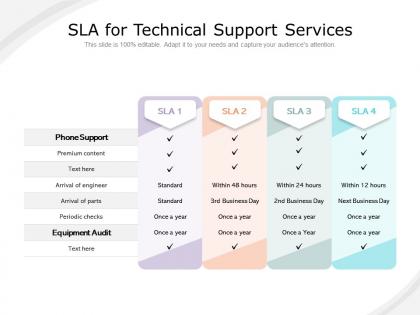
Sla for technical support services




Try Before you Buy Download Free Sample Product
 Impress Your
 Audience
 100%
100% Editable
 Save Hours
 of Time


The frequency of deposits into your account will increase due to our SLA For Technical Support Services. It ensures your capital builds.
People who downloaded this PowerPoint presentation also viewed the following :
Sla for technical support services with all 2 slides:
Acquaint folks with your favorite destinations with our SLA For Technical Support Services. Elaborate on the facilities that enthralled you.
FAQs for Sla for
You'll want service descriptions and performance metrics - like 99.9% uptime targets that are actually measurable. Define who's responsible for what when stuff breaks. Penalties matter too, otherwise vendors just shrug off missed targets. Escalation procedures are clutch for those lovely 2am disasters. Honestly, the reporting requirements piece gets overlooked but you need that to prove they're hitting their marks. Don't skip having legal review the penalty clauses - I've seen some pretty toothless agreements that basically let vendors off the hook.
Get some automated monitoring running first - uptime, response times, all that stuff. Dashboards are pretty clutch for seeing how you're doing against your SLA targets in real time. Oh, and set up alerts BEFORE you hit the thresholds, not after you're already screwed. I learned that one the hard way lol. Keep your stakeholders in the loop with regular reports. Most critical metrics should be automated first, then build from there. Also don't forget to actually look at your SLAs every few months and tweak them based on what's really happening.
Honestly, the biggest mistake is being way too vague with your metrics. Skip stuff like "reasonable response time" and actually spell it out - like "4-hour response for critical issues." Don't promise 99.99% uptime if your servers can't handle it (learned that one the hard way). Get your tech team involved early - they'll spot the impossible promises before you're stuck with them. Oh, and always plan for when things break because they definitely will. Include escalation paths and review periods so you can tweak things later.
So basically, IT SLAs are all about the technical stuff - uptime percentages, how fast they fix outages, system performance metrics. Pretty cut and dried. Customer service ones focus more on the people side: how quickly calls get answered, resolution rates, customer satisfaction scores. IT SLAs get super detailed with exact numbers, which honestly makes sense since you can measure that stuff precisely. Customer service agreements often include fuzzier goals around communication quality and that sort of thing. Just make sure whatever metrics you pick actually mean something to the people who'll be affected by them - don't just throw random numbers around.
Pick metrics that actually show when your users are having a bad time. Uptime percentage is obvious - if it's down, everyone's mad. Response times matter too, especially for different priority stuff. I'd also track how long it takes to fix things when they break. Page load speeds are huge (seriously, people bounce after like 3 seconds). Error rates tell you if you're shipping garbage. Customer satisfaction scores are solid if you can get reliable data. Don't go crazy though - 3 to 5 good metrics you can actually control beats trying to measure everything. Start with whatever causes the most pain.
So you'll definitely need different SLA targets depending on your industry - the stakes are totally different. Healthcare is brutal because downtime literally puts lives at risk, plus there's all that HIPAA stuff to worry about. Finance is just as intense with SOX compliance and zero room for data breaches. Manufacturing cares more about IoT sensors staying online. Honestly, the penalty structures should match too - a healthcare data leak is way more serious than some e-commerce site going down for an hour. I'd start by looking up what regulations hit your specific industry hardest, then build everything around those requirements.
Dude, treat that SLA like a real contract because it basically is one. Every metric could bite you in court later. Don't promise crazy uptime percentages - I've watched companies learn this the hard way when they guaranteed like 99.99% uptime. Cap your liability at something reasonable. Double-check it doesn't clash with your main service agreement too. Your legal team needs to eyeball the whole thing, especially the remedies part and any auto-renewal stuff. Honestly, the penalties section is where most people mess up. You'll thank yourself later for being conservative with what you commit to.
Honestly, kickoff meetings are everything - get everyone in a room and hash out expectations upfront. Don't just fire off some PDF nobody will read. You'll want regular check-ins and clear escalation paths for when stuff inevitably goes wrong. Track your metrics like crazy, then actually have those awkward conversations when people miss targets. Oh, and make the consequences real - nobody cares about SLAs that don't have teeth. The whole thing works better when it feels like a team commitment rather than just another contract sitting in someone's folder. Performance reviews help keep everyone honest too.
Look, customer feedback is basically your cheat sheet for writing SLAs that don't suck. Start by asking what they actually care about - fast responses? Quick fixes? Better updates? Most companies just guess and wonder why their SLAs are garbage. Use their complaints to figure out where you're missing the mark. I swear, half the SLAs I've seen were written by someone who's never talked to a customer. Set up regular check-ins so you can tweak things based on real problems they're having, not what sounds good on paper.
Think of SLAs as your insurance policy with vendors. You're setting up performance standards and penalties before problems hit - and trust me, they will. During negotiations, vendors take you way more seriously when they know there's actual consequences for screwing up. Plus it keeps relationships smooth since everyone knows exactly what's expected. The key is making sure your metrics are actually measurable and the penalties hurt enough to matter. Otherwise you're just writing fancy paperwork that nobody cares about. It's honestly one of the best tools you've got for keeping vendors honest.
Set up quarterly reviews - or yearly if your company moves slower. Pull performance data and get feedback from your team plus the client side. Check what's actually working and if you're even tracking the right stuff (honestly, half the time you'll realize your metrics are weird). Document any changes you want, get everyone to agree, then update the agreement with fresh signatures. Don't spring new metrics on people mid-quarter though - that's just asking for drama. Oh, and put these reviews on your calendar now or you'll totally forget.
SLAs are honestly pretty clutch for incident response - they give your team actual numbers to hit instead of just "fix it fast." So like, 15 minutes for critical stuff, maybe 4 hours for smaller bugs. Makes prioritizing way easier when everything's on fire (which, let's be real, it usually is). The deadlines also force you to actually plan out escalation and coverage properly. You can't just hope someone's around at 2am. Best part though? You can wave those SLA requirements around to get the budget and headcount your team actually needs. Works every time.
Role-based training works best - people need to know which SLAs actually matter for their job. I'd use real incidents from your company instead of boring theoretical stuff. Everyone should know how to read those dashboards too, otherwise they'll just freak out when things go sideways. Don't do one massive training session - smaller, regular refreshers stick better. Practice drills are clutch for walking through breach scenarios without the stress. Oh, and make a quick reference guide that's actually easy to find when everything's on fire. Trust me on that last one.
Get some monitoring tools running 24/7 - they'll catch performance issues way before you would manually. ServiceNow or Jira Service Management work great for this stuff. Set up alerts when you're getting close to SLA limits so you're not scrambling last minute. Real-time dashboards are a lifesaver too, honestly way better than trying to track everything in spreadsheets (been there, it sucks). Pick something that plays nice with your current systems though - you don't want data scattered everywhere. Figure out what metrics your stakeholders actually care about first, then find tools that make those numbers super visible.
Missing SLA benchmarks usually hits your wallet first - service credits or straight-up fines that pile up fast. Client relationships get messy too. You might end up renegotiating contracts or worse, losing them completely. A lot of agreements have escalating penalties, so each screw-up costs more than the last. Honestly, the reputation damage stings the most since bad news spreads like wildfire. Oh, and some industries are way less forgiving than others. Track those metrics obsessively and always pad your timelines. Trust me, it's worth the paranoia to avoid this nightmare.
No Reviews