

Smart Contracts Introduction In Blockchain 2 0 Training Ppt




Try Before you Buy Download Free Sample Product
 Impress Your
 Audience
 100%
100% Editable
 Save Hours
 of Time


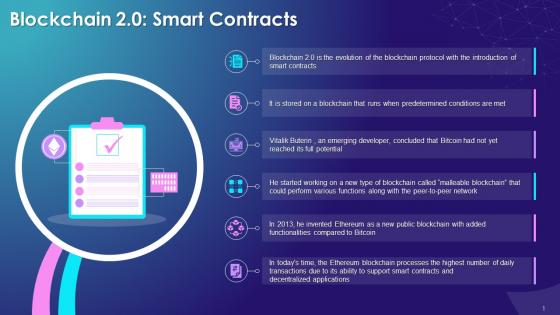
This slide illustrates the important events of Blockchain 2.0 such as the Vitalik Buterian developing Ethereum in 2013. It also includes details about the introduction of the smart contracts which consists of computer codes shared between participants in the business networks.
People who downloaded this PowerPoint presentation also viewed the following :
Smart Contracts Introduction In Blockchain 2 0 Training Ppt with all 16 slides:
Use our Smart Contracts Introduction In Blockchain 2 0 Training Ppt to effectively help you save your valuable time. They are readymade to fit into any presentation structure.









FAQs for Smart Contracts Introduction In Blockchain 2
Smart contracts are self-executing digital agreements with terms written directly into code, automatically enforcing and executing when predetermined conditions are met. These blockchain-based programs streamline transactions by eliminating intermediaries, reducing costs, and ensuring transparency, with financial services, supply chain management, and real estate industries finding they deliver faster processing, enhanced security, and operational efficiency.
Smart contracts enhance security by eliminating intermediaries, using cryptographic verification, and executing automatically when predetermined conditions are met, significantly reducing human error and manipulation risks. Through blockchain's immutable ledger, financial institutions and supply chain companies can track transactions transparently, prevent unauthorized changes, and minimize fraud, ultimately delivering faster, more secure business processes.
Smart contracts deliver automated execution, reduced operational costs, enhanced transparency, eliminated intermediaries, and faster transaction processing for businesses. These blockchain-based agreements streamline supply chain management, automate payment systems, and ensure compliance verification across industries like insurance, real estate, and financial services, ultimately enabling organizations to minimize manual oversight while accelerating business processes and reducing administrative overhead.
Smart contracts significantly outperform traditional contracts by automating execution, eliminating intermediaries, and reducing processing times from days to minutes. While traditional contracts require manual verification and legal oversight, smart contracts streamline operations through automated compliance and instant settlement, with financial institutions and supply chain companies finding dramatically lower administrative costs and faster transaction processing.
**INPUT**: What programming languages are commonly used to write smart contracts, and what are their pros and cons? **OUTPUT**: Common smart contract programming languages include Solidity, Vyper, Rust, JavaScript, and Go, each offering distinct advantages for blockchain development. While Solidity dominates Ethereum development with extensive documentation, and Rust delivers enhanced security features, developers increasingly find that language selection depends on blockchain platform requirements, security priorities, and team expertise, ultimately enabling faster deployment and reduced development costs. [Word count: 58 words]
Decentralized applications serve as user-friendly interfaces that enable businesses and individuals to interact with smart contracts without requiring technical blockchain expertise. These applications streamline contract deployment, execution, and monitoring across various sectors, with financial services, supply chain management, and healthcare organizations finding that dApps significantly reduce operational complexity while enhancing transparency and automated compliance.
Smart contracts handle dispute resolution through oracle-based arbitration systems, multi-signature approval processes, escrow mechanisms, and integration with traditional legal frameworks. Many financial institutions and supply chain organizations find that combining automated dispute detection with human arbitration delivers faster resolution times, reduced costs, and greater transparency, while maintaining legal compliance in complex commercial agreements.
Smart contract adoption faces challenges including scalability bottlenecks, regulatory uncertainty, technical complexity, energy consumption concerns, and limited interoperability between blockchain platforms. While these present hurdles, many organizations in financial services, supply chain, and insurance are finding that strategic implementation with proper legal frameworks and technical expertise enables them to streamline operations and reduce costs, ultimately delivering competitive advantages in an increasingly digital marketplace.
Smart contracts enhance supply chain management by automating verification processes, enabling real-time tracking, and creating immutable transaction records throughout the entire chain. Through blockchain integration, manufacturers, distributors, and retailers can streamline compliance monitoring, reduce manual paperwork, and ensure product authenticity, while consumers gain unprecedented transparency into sourcing and delivery processes, ultimately delivering faster dispute resolution and enhanced trust.
Smart contracts rely on oracles to access external data like market prices, weather conditions, payment confirmations, and API feeds, since blockchain networks cannot directly retrieve real-world information. Through oracle integration, financial institutions automate loan approvals, insurance companies streamline claims processing, and supply chain operators track shipments in real-time, ultimately delivering faster services and reduced operational costs.
Industries most likely to benefit from smart contracts include financial services, real estate, healthcare, supply chain management, and insurance sectors. These industries leverage smart contracts by automating loan approvals, streamlining property transactions, securing patient data transfers, and enabling transparent tracking, with many organizations finding that automation reduces processing times and operational costs significantly.
Regulatory frameworks for smart contracts vary significantly, with some jurisdictions like Switzerland and Singapore establishing comprehensive guidelines, while others including the US and EU maintain fragmented approaches across different agencies and member states. These varying regulatory landscapes present both challenges and opportunities for organizations, with many financial institutions and multinational corporations finding that strategic compliance planning enables competitive advantages in blockchain adoption while ensuring operational legitimacy.
Smart contract auditing best practices include comprehensive code reviews, automated vulnerability scanning, formal verification methods, extensive testing protocols, and multi-phase security assessments. These methodologies enhance blockchain applications by identifying critical vulnerabilities, ensuring compliance standards, and validating business logic, with many financial institutions and DeFi platforms finding that rigorous auditing ultimately delivers reduced security risks and increased user trust.
Smart contracts can automate compliance monitoring and enforcement for specific regulatory requirements through predefined rules, automated reporting, and real-time transaction validation. However, they present both opportunities and challenges, with many financial institutions and healthcare organizations finding that while smart contracts streamline compliance processes, they require careful legal review to ensure alignment with evolving regulatory frameworks.
Emerging smart contract innovations include cross-chain interoperability protocols, AI-powered automated execution, enhanced privacy features through zero-knowledge proofs, and oracle integration for real-time data feeds. These advancements enable organizations across finance, supply chain, and healthcare to streamline complex agreements, reduce operational costs, and enhance transaction security, ultimately delivering seamless automation and competitive advantage.
-
Based on my personal experience, I would recommend other people to subscribe to SlideTeam. No one can be disappointed here!
-
Qualitative and comprehensive slides.